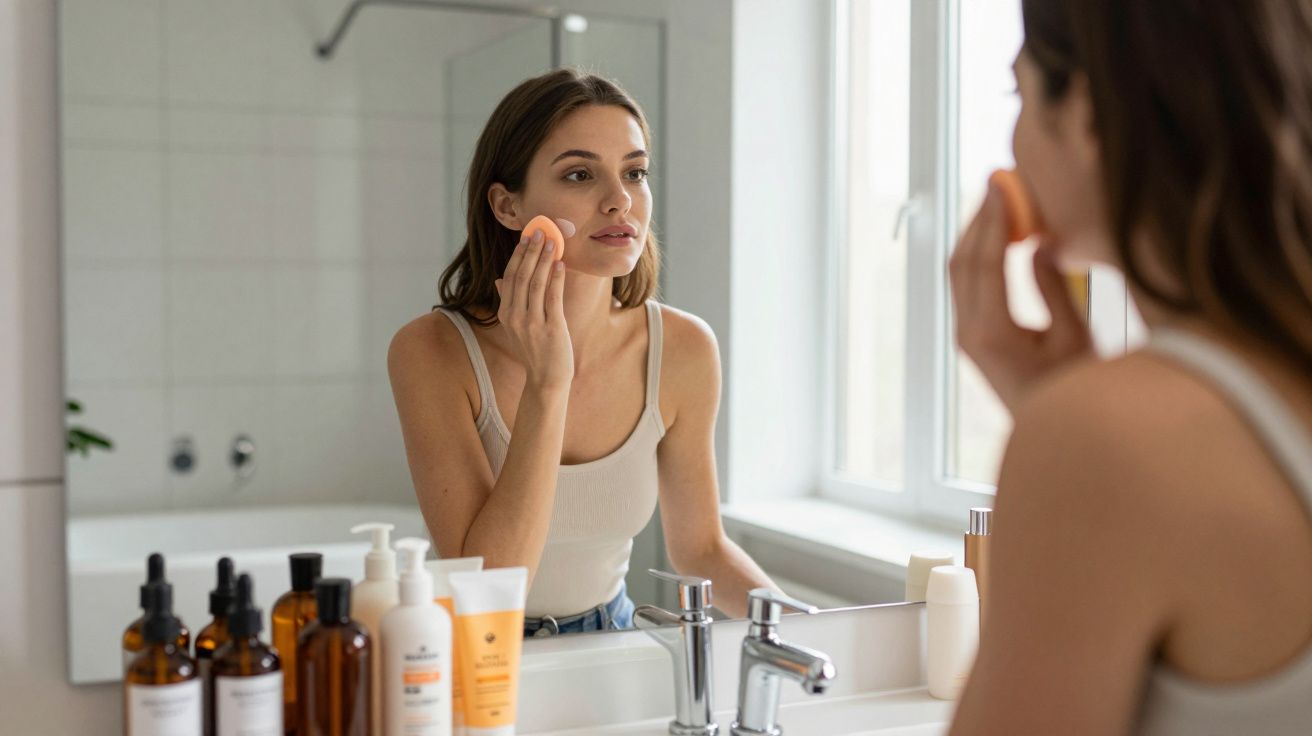
The moment your base turns into crumbs
You know the scene. You’ve done the whole routine – cleanser, serum, moisturiser, SPF – and you’re finally buffing in foundation when it happens. Tiny rolls of product start gathering at your jawline and around your nose, like pencil eraser shavings. You smooth them away, they come back. You add more make‑up, it gets worse. The clock is sprinting. Your mood is not.
It feels like betrayal. The same moisturiser worked last month. The same foundation behaved all winter. Yet today, they’re fighting on your face. You’re left wondering if your skin has changed overnight, if you’ve bought a dud product, or if some mysterious “purge” is to blame.
Dermatologists see this more often than you’d think. The good news: it’s not your skin suddenly failing. It’s a textural clash between formulas – especially between two families of ingredients that do brilliant things separately, but love to pill when stacked.
Why your moisturiser suddenly “eraser rubs”
Those little balls on your skin aren’t dry skin or dirt. They’re bits of product that have rolled up and detached because the layers beneath your make‑up never quite settled.
Most modern skincare and base products use film-formers – ingredients that dry down into a very thin layer on the skin. They smooth, hydrate, blur pores and grip make‑up. But stack too many different films and then rub or buff at them, and they behave like dried PVA glue under your fingers.
Think in textures, not in “good” or “bad”: slip + stick + friction. That combination turns your routine into crumbs.
Three main forces create pilling:
- Too much product sitting on the surface, not absorbed.
- Incompatible textures (slippy silicone over bouncy gel, for example).
- Rubbing or layering too fast, before each step has time to settle.
The result is mechanical. You’re literally rolling layers off your face. It’s annoying, not dangerous – but it’s usually avoidable once you know the main culprits.
The two ingredients dermatologists see clashing most
Dermatologists consistently point to a frequent trouble pairing:
Silicone-heavy bases
+ high-molecular-weight hyaluronic acid gels
On their own, both are workhorses.
1. The silicone side of the story
Silicones (like dimethicone, cyclopentasiloxane, trimethicone) are common in:
- Primers
- “Pore-blurring” moisturisers
- Long-wear foundations and concealers
- Some SPFs
They lay down a very smooth, flexible film. That’s what gives that “velvety” or “slip” feel and helps foundation glide. But that film doesn’t always sink into the skin; it sits lightly on top.
On ingredient lists, look for words ending in:
-cone(dimethicone, cyclohexasiloxane)-siloxane(cyclopentasiloxane)-conol(dimethiconol)
2. The hyaluronic gel that bites back
Hyaluronic acid (HA) is a humectant – it pulls water into the upper layers of skin. The high-molecular-weight forms, and the gels thickened with carbomer, acrylates or gums, create that cushiony, bouncy, almost “jelly” feel.
You’ll find them in:
- Lightweight gel moisturisers
- Hydrating serums labelled “plumping” or “water gel”
- Oil-free creams for combination or acne-prone skin
On the INCI (ingredients) list, you might see:
- Hyaluronic Acid, Sodium Hyaluronate
- Carbomer, Acrylates/C10-30 Alkyl Acrylate Crosspolymer
- Xanthan Gum, Sclerotium Gum
What happens when they meet under make‑up
Layer a thick HA gel moisturiser and then apply a silicone-heavy primer or foundation on top, and you have:
- A squishy, jelly-like film hugging water
- A slippy, silicone film trying to glide over it
- Your fingers, brush or sponge adding pressure and movement
Instead of blending together, those layers catch, drag and roll into crumbs. To your eye, it looks like your moisturiser is “peeling off”. In reality, it’s the combined films balling up under friction.
A consultant dermatologist might phrase it this way: the ingredients aren’t chemically “reacting”; they’re physically disagreeing.
How to stop pilling in three moves dermatologists actually use
You don’t need an entirely new bathroom shelf. Start with these practical tweaks.
1. Pair like with like
Match base textures:
- Use water-based moisturisers under water-based foundations.
- Use a silicone-free or low-silicone moisturiser under silicone-heavy primers/foundations.
- If your SPF feels very slippy and siliconey, treat it like a primer and skip a separate silicone primer on top.
Label shortcut:
- “Aqua/Water” high up + no obvious
-conenear the top = likely water-based. - Several
-cone/-siloxaneingredients in the first 5–10 lines = silicone-heavy.
2. Lighten the layers and slow the pace
- Use less of each product than you think. A pea-sized blob of moisturiser for the whole face is often enough.
- Allow 1–3 minutes between serum, moisturiser, SPF and make‑up. Let each layer lose its tackiness before the next.
- If something still feels wet or very sticky, wait or blot lightly with a tissue before applying make‑up.
Think of it as letting paint dry between coats. Rushing is what turns it to rubber crumbs.
3. Change how you apply, not just what you apply
- Pat, don’t scrub. Press moisturiser in with flat palms or fingertips, rather than vigorous rubbing.
- When applying foundation, use gentle taps or short downward strokes, not long circles that churn the under-layers.
- With brushes, avoid over-buffing. With sponges, bounce rather than drag.
Small shifts in technique can be enough to stop the “eraser” effect, even if you keep all the same products.
Small tweaks that help more than you’d expect
These quiet adjustments often make the biggest difference:
- Apply hyaluronic acid on damp skin, then seal with a light cream. This reduces the thick gel “film” that loves to pill.
- Avoid stacking three or four film-formers (HA gel + rich moisturiser + slippy SPF + silicone primer). Pick two.
- Exfoliate gently 1–2 times a week. Built-up dead skin can worsen pilling and make it harder for products to sit smoothly.
- If a product always pills no matter what, change the step above or below it rather than immediately binning it. It may simply need a different partner.
- At night, use your heavier, more layered routine. In the morning, go lean: hydrate, protect, and stop.
You don’t have to abandon skincare for the sake of good make‑up. You just have to stop making your face a wrestling ring of competing textures.
Myths that clog your judgement
Social feeds have their own story about pilling. Dermatologists tend to roll their eyes at a few of them.
“My skin must be rejecting the product.”
In most cases, pilling is not an allergy or irritation response. It’s a mechanical issue. True reactions come with redness, burning, itching or bumps – not just rolling crumbs.
“It means the product is fake or expired.”
Old or badly stored products can separate, but brand-new, premium formulas pill too when layered badly. Price doesn’t stop physics.
“Oilier skin types don’t get pilling.”
They do – sometimes more so. Extra sebum can join the mix, making a slippy base that fights with thick gels and silicones.
“If it pills, I should scrub harder to make it absorb.”
Scrubbing only creates more friction, more rolling and more redness. The solution is gentler application and smarter pairing, not more force.
Where the problem shows – and what it tells you
Understanding when and where the pilling happens helps you tweak the right step.
| What you notice | Likely cause | First move |
|---|---|---|
| Pilling as soon as you rub in moisturiser | Too much product / previous serum hasn’t sunk in | Halve the amount, pat in, give an extra minute |
| Skin feels fine until SPF, then balls appear | SPF texture clashing with moisturiser (often silicone + thick gel) | Switch one to a lighter, compatible base; let moisturiser fully dry first |
| Make‑up pills only on nose and chin | Heaviest application + most friction in those zones | Use less product there and press, don’t buff |
| Pilling only on days you use HA serum | Thick HA layer sitting on top of skin | Apply to damp skin, use a thinner layer, seal with cream, then wait |
| Everything pills, whatever you do | Over-exfoliated, very dry or compromised barrier | Simplify routine, focus on gentle moisturisers; consider a dermatology review |
Two or three mornings of testing small changes are usually enough to spot your main trigger.
Ingredients to choose instead (and when to walk away)
If your current pairing of HA gel + silicone base is a repeat offender, try:
- Swapping the HA gel for a lighter lotion with glycerin or panthenol (still hydrating, less film).
- Keeping your favourite HA gel for night-time, and using a creamier, silicone-free moisturiser in the morning.
- Choosing a foundation labelled “water-based” or “serum foundation” to go over hydrating gels.
- Picking an SPF that matches your moisturiser texture (gel with gel, lotion with lotion) so they behave like teammates, not rivals.
If you’ve stripped back, adjusted textures and softened your technique yet still see:
- Persistent flaking that doesn’t feel like product
- Burning or stinging when you apply skincare
- Red, sore patches that don’t settle
then it’s no longer just a pilling problem. That’s the moment to see a GP or dermatologist to check for eczema, contact dermatitis, seborrhoeic dermatitis or other conditions that mimic product “crumbs”.
Prevention that actually fits real mornings
Skincare advice often forgets that you have about eight minutes between the shower and the school run or train.
Build a simple, pill‑proof morning pattern:
- Step 1 – Cleanse lightly. No need for a harsh scrub; just remove oil and residue.
- Step 2 – One hydrating layer. Serum or moisturiser, not three. Pat in, wait a minute.
- Step 3 – SPF. Choose a texture that plays well with your step 2. Let it settle while you get dressed or make coffee.
- Step 4 – Make‑up. Apply with light pressure, in thin layers.
Once a month, do a tiny “texture audit” of your routine:
- Group your products into gel, lotion/cream, silicone-slippy piles.
- Make sure your morning stack doesn’t jump wildly between all three.
- Retire the heaviest film-formers to evening, when they can sit undisturbed.
You don’t need a professional kit or a 10‑step plan. You just need your products to stop fighting each other.
FAQ:
- Is pilling damaging my skin? No. It’s mostly a cosmetic and texture issue, not a sign of harm. If there’s no redness, burning or pain, it’s just products rolling off, not your skin being injured.
- Do I have to avoid hyaluronic acid or silicones altogether? Not at all. Both can be extremely helpful. Focus on how you layer them: lighter HA and creams under water-based make‑up, or silicone-light moisturisers under silicone-rich foundations.
- Will using a primer always make pilling worse? Only if it’s adding yet another film to an already crowded routine. If your SPF already behaves like a primer, you may not need a separate one. If you do use primer, go for a thin layer and let it dry before foundation.
- Does using a brush vs sponge change pilling? Yes. Brushes can over-buff and move under-layers around. Sponges that bounce rather than drag often disturb the base less. Whatever tool you use, light pressure is key.
- Can face oils help with pilling? A few drops of a light oil, pressed on top of a very thin moisturiser, can sometimes reduce drag and friction. But heavy oils under silicone-rich foundations can create slip that makes pilling worse, so test on a day off first.


Comments
No comments yet. Be the first to comment!
Leave a Comment