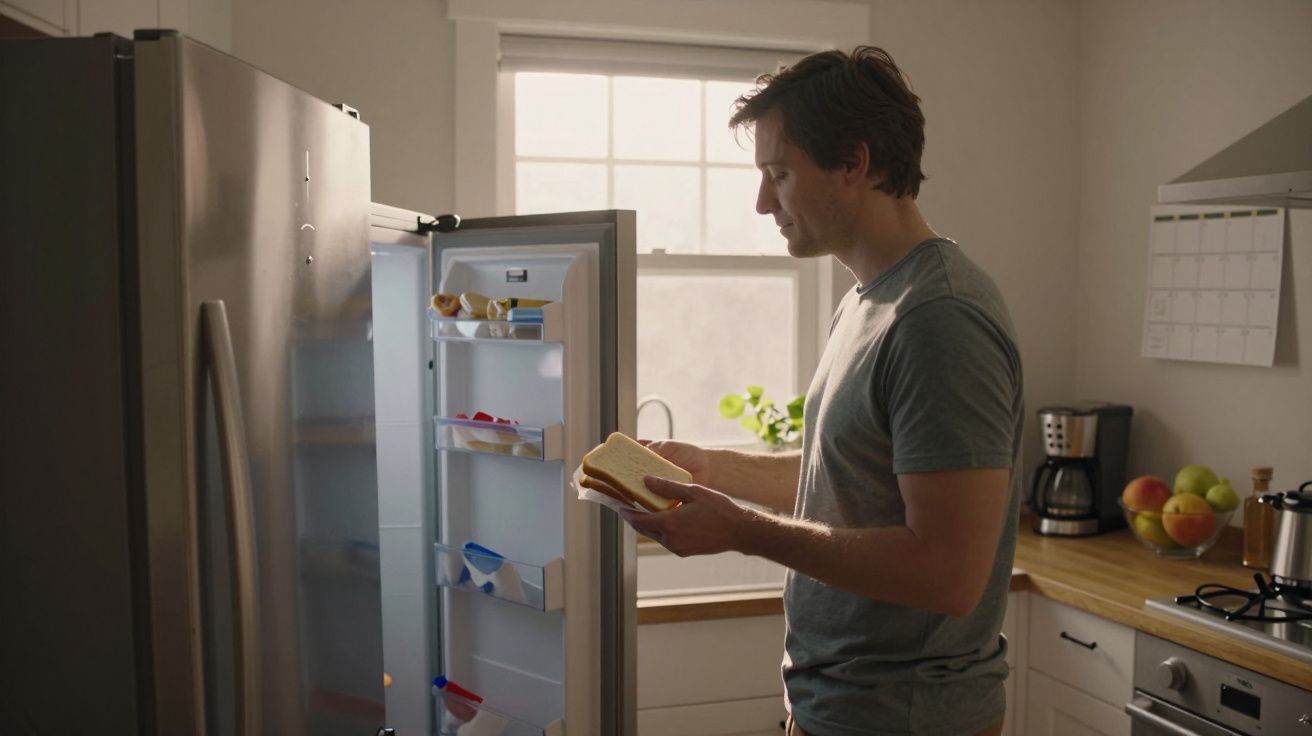
By Wednesday my packed lunches were already giving up. I’d pull a sandwich from my bag on the 7:42, feel the clingfilm stick to the bread, and know exactly what I was about to eat: damp, flattened, slightly warm disappointment. By Friday I’d given in and queued for an overpriced train-station meal deal, telling myself I’d “try again next week”.
Then one evening, scrolling half-asleep, I saw someone calmly stacking sandwiches in their freezer like books on a shelf. No elaborate containers, no special ingredients-just sandwiches, wrapped and frozen completely flat. In the comments, people were claiming they stayed fresh, didn’t go soggy, and were saving them £15–£20 a week on work lunches.
I didn’t quite believe it, but I tried it. Four sandwiches, made on Sunday night, wrapped tightly and laid flat in the freezer drawer. On Monday morning I grabbed one, slid it into my bag still frozen, and forgot about it. At 12:30, I unwrapped it at my desk and blinked. It looked… normal. Soft bread, chilled filling, no sad damp patches.
Freezing sandwiches flat didn’t feel like a compromise. It felt like finally getting the packed lunches I’d been trying to have all along.
The oddly simple trick that fixes soggy sandwiches
The idea is almost offensively straightforward: you make your sandwiches in advance, wrap them well, and freeze them laid completely flat. No stacking on their side, no shoving into a corner of the freezer to curve themselves around the peas. Flat like a book, not like a ball.
Because they’re flat, they thaw evenly on your commute or in the office fridge. By the time you’re ready to eat, you have a chilled, firm sandwich instead of a squashed one that’s sweated in clingfilm all morning. The bread hasn’t had hours for moisture to creep from the filling into the crust.
For commuters, shift workers and anyone who leaves home in the dark and comes back in the dark, this is huge. You batch the effort once, you skip the daily faff, and you quietly remove the main excuse for spending £4–£6 a day on something you could have made for £1.
Why freezing flat works (and your bread stays bouncy)
When you freeze a sandwich, you’re pressing pause on all the things that usually ruin it: moisture creeping, bread compacting under its own weight, fillings warming up and going clammy. Cold stops that slow slide into sogginess.
Flat is the important bit. When a sandwich freezes in a neat, even layer:
- Ice crystals form more uniformly, so the bread doesn’t get patchy and hard in some spots and soggy in others.
- The filling doesn’t slump to one end-there’s no “top heavy” side leaking into the crust.
- When it thaws, it does so from edge to middle in a predictable way, so you don’t end up with a half-frozen centre and wet corners.
Think of it like freezing a tray of berries instead of a solid block of smoothie. The shape you choose at the start decides how usable it is later.
Laid flat in a freezer bag or wrapped snugly in foil, the bread is held in its original shape. It’s far less likely to compress in your rucksack, and the chill keeps bacteria growth slow while you travel. You get that just-made softness at lunchtime, not the “sat in a warm office for five hours” flop.
How I prep a week of sandwiches in 20 minutes
The habit only stuck when it stopped feeling like a whole extra job. This is the version that fits into a Sunday night without drama.
Pick the right bread.
Go for medium-thick sliced bread, rolls, or wraps. Flimsy sliced white tends to go limp; seedy loaves, wholemeal and part-baked baguettes hold up beautifully.Add a moisture barrier.
Spread both slices lightly with butter, mayo, pesto or hummus-something with fat that slows liquid from the filling soaking into the bread.Layer smart, not tall.
Use thin, even layers of filling rather than one huge wedge. Flat cheese slices, shredded chicken, thin ham, or mashed chickpeas work better than big lumps.Skip the wet salad (for now).
Leave out tomato, cucumber and soft lettuce. You can add fresh salad at your desk in 30 seconds, or pack it in a separate little tub.Wrap tightly.
- First in clingfilm, baking paper or a beeswax wrap.
- Then into a freezer bag or a reusable container, pushing out as much air as you can.
Press lightly with your hand so the sandwich sits flat.
- First in clingfilm, baking paper or a beeswax wrap.
Freeze in a single layer.
Lay them on a tray or directly on the freezer shelf, not stacked. Once they’re solid, you can stand them up like files, but the first freeze should be flat.Grab-and-go in the morning.
Take one straight from the freezer, pop it in your bag or lunchbox. It’ll usually be perfectly thawed after 3–4 hours at room temperature, 5–6 in a cool bag or fridge.
Fillings that freeze well – and what to avoid
You don’t have to reinvent your usual sandwiches, just tweak them slightly.
Great in the freezer:
- Ham and cheese (or any cured meat + cheese)
- Chicken, turkey or tuna with a light mayo mix
- Hummus with roasted peppers or roasted veg
- Peanut butter (with or without jam)
- Cheddar with chutney or pickle (in a thin layer)
- Egg mayo that’s fairly thick, not runny
Best added fresh in the morning:
- Sliced tomato, cucumber and soft lettuce
- Lots of raw onion (it can get sharp and overpowering)
- Very wet condiments in big blobs (relish, salsa, etc.)
If you love a stacked salad sandwich, freeze the “base” version, then throw in tomato and leaves from a bag when you make your morning tea. It’s still quicker than starting from scratch, and the bread stays dry.
The quiet maths: how this saves up to £20 a week
Most of us don’t blow money on lunches because we’re careless. We do it because we’re tired, running late, or genuinely fed up with soggy food. Freezing sandwiches flat removes half the reasons you’d reach for a shop-bought option.
Here’s how the numbers roughly line up for a typical commuter:
| Lunch option | Approx cost per day | Cost per week (4 days) |
|---|---|---|
| Shop sandwich / meal deal | £4.50–£5.50 | £18–£22 |
| Home-made frozen sandwich | £1.00–£1.50 | £4–£6 |
Even if you only swap four days out of five, that’s £12–£18 saved each week. Over a month, it’s easily £50+. Over a year, it’s somewhere between “city break” and “that train season ticket you’ve been dodging”.
And that’s without counting the coffees and snacks that mysteriously appear when you’re already in the queue.
What changed when my sandwiches started waiting for me
The money was nice. The real difference was mental. There was no 7am debate about whether I had time to assemble something half-decent, and no 11:45 internal bargaining about “just this once” buying lunch out.
Opening my bag and finding a sandwich that actually looked appetising did something small but important: it made me feel looked after by a past version of myself. Like someone had quietly made future-me a favour and left it in the freezer.
Afternoons also felt steadier. A sandwich that starts cold and thaws slowly is less likely to be a sleepy, beige carb bomb. I wasn’t fighting a post-lunch slump so hard, and because I’d spaced out my spending, I felt less guilty about the coffee I actually wanted.
Freezing sandwiches flat doesn’t make you virtuous. It just makes the “sensible” option nicer than the default one.
Little tweaks that make it feel like a café lunch
Small upgrades stop your frozen sandwiches feeling like emergency rations.
- Use good bread: sourdough slices, bakery rolls, seeded wraps. The base does a lot of the work.
- Toast or lightly grill the bread before assembling if you like a firmer bite once thawed.
- Pack a tiny pot of something zingy-gherkin slices, slaw, rocket-to add at the last minute.
- Rotate fillings by batch: week one is chicken and pesto, week two is hummus and roasted veg, week three is cheese and pickle with spinach.
- Keep a small stash of napkins and a sharp knife at work so you can cut and plate it instead of eating out of foil.
Design it so that opening your lunchbox feels more like opening a packed picnic than rummaging through leftovers.
FAQ:
- How long can I keep frozen sandwiches before they taste odd?
Most fillings taste best within 3–4 weeks of freezing if they’re well wrapped. After that, they’re still safe if kept frozen, but the bread can pick up freezer smells or feel a bit dry around the edges.- Will the sandwich be safe if it thaws in my bag all morning?
Yes, as long as your kitchen hygiene is decent and it’s not sitting in direct sun or a hot car. Treat it like any other packed lunch: aim to eat within about 6 hours, and use an insulated bag if your office or train is very warm.- Can I microwave a frozen sandwich?
You can, but do it gently-short bursts at low power, checking often. Too much heat turns the bread tough and the filling greasy. For most savoury sandwiches, letting them thaw naturally gives a nicer texture.- Do wraps, bagels and rolls freeze as well as sliced bread?
Usually, yes. Wraps and flatbreads freeze brilliantly because they’re already thin and flat. Bagels and crusty rolls should be sliced before filling so they freeze and thaw more evenly.- What if I forget to take one out of the freezer the night before?
That’s the beauty of freezing flat-you don’t have to. Take it straight from the freezer in the morning; it doubles as an ice pack for the rest of your lunch and will be ready by lunchtime.

Comments
No comments yet. Be the first to comment!
Leave a Comment