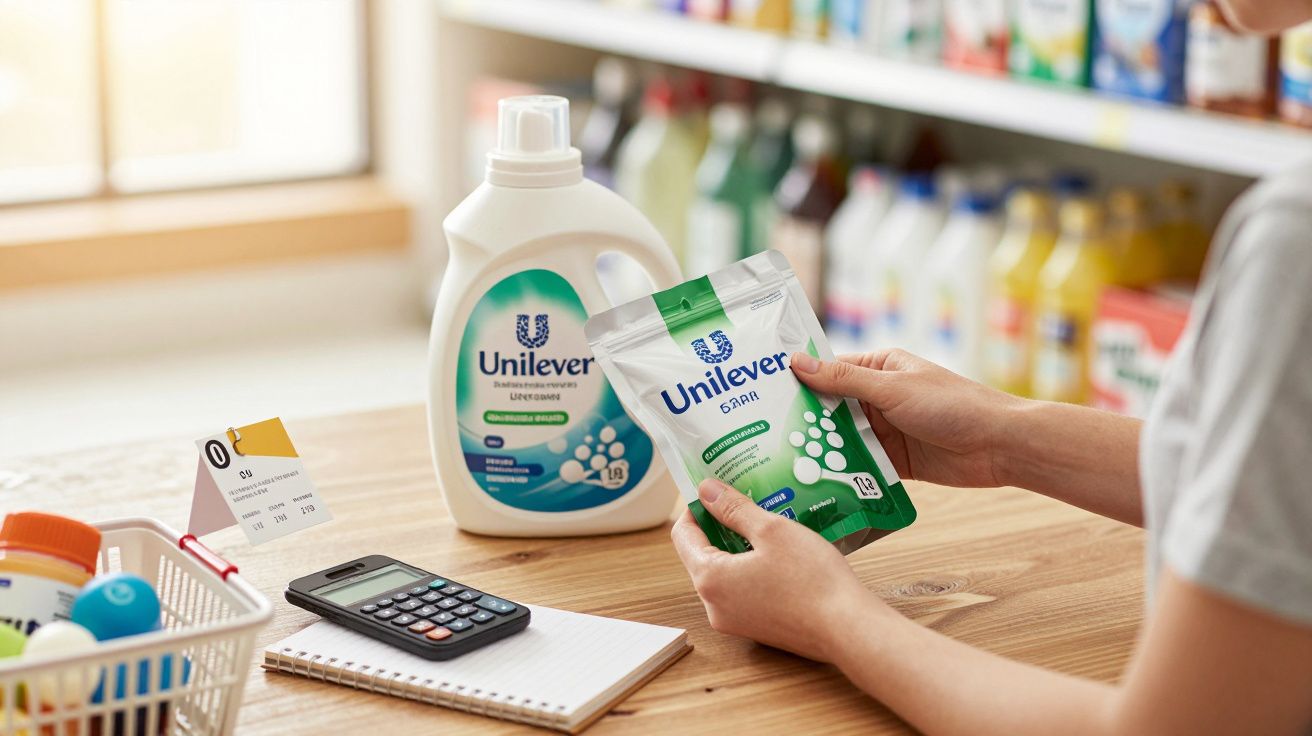
Unilever sits in the everyday gaps of a UK home: the bottle by the sink, the tub in the shower, the ice cream in the freezer. This year, Unilever shoppers - and (no secondary entity) - are changing how they buy those staples in ways that barely register as “new behaviour”, yet add up to a meaningful shift in baskets and brand loyalty. It matters because these are repeat purchases: tiny decisions, repeated weekly, are where household budgets quietly get rewritten.
You can see it in the small hesitations. People still want familiar products, but they’re less willing to pay “autopilot prices”, and more willing to swap formats, wait for deals, or move a brand into the “only when it’s on offer” category.
The habit change isn’t dramatic - it’s procedural
No one is making a speech in the detergent aisle. The change is more like a new set of rules: buy when it’s discounted, stretch what you already have, and keep a few favourites while trimming the rest.
The cost-of-living hangover plays a part, but so does the new supermarket experience. Prices move faster on electronic shelf labels, apps push personalised vouchers, and shoppers have learned that patience can be worth more than brand preference.
The quiet shift: fewer “default” buys, more “mission” buys - only what you need, when the price looks right.
What “quietly changing” looks like in practice
- Waiting for multibuys or clubcard-style prices, then stocking up on favourites
- Switching to own-label for basics, keeping one or two “can’t quit” brands
- Choosing concentrated or refill formats to cut cost per use
- Buying smaller packs to manage the weekly shop, even if the unit price is worse
- Rotating between retailers (Aldi/Lidl for staples, a big supermarket for specifics)
Promotions have become the real product
For many households, the brand isn’t Persil or Dove in the abstract - it’s “Persil when it drops below £X” or “Dove when there’s a two-for deal”. That mindset is spreading from treats (ice cream, snacks) to necessities (laundry, deodorant, shampoo).
Retailers have encouraged it. App pricing and loyalty schemes train shoppers to expect a “best price” that isn’t the shelf price, and Unilever-heavy categories are exactly where that dance is most visible: laundry, personal care, home cleaning.
The result is a more tactical trolley. People aren’t necessarily buying less, but they’re spacing purchases out, and using promotions to time them.
The new mental arithmetic: price per wash, price per week, price per hassle
Laundry is a good example because it’s measurable. Shoppers are increasingly comparing:
- Cost per wash (even if the bottle price stings)
- Dosage habits (capsules feel easier to overuse than liquids)
- Temperature and cycle choices (a “cold wash” routine changes how fast you get through product)
If you’re counting pennies, a product that “lasts longer than it should” starts to feel like a win, even if it’s not the cheapest on the shelf.
Smaller homes, smaller shops, smaller baskets
A second pressure is space - both at home and in the rhythm of shopping. More people now shop little-and-often, whether because they’re commuting again, living in smaller homes, or leaning on discounters for frequent top-ups.
That pattern nudges Unilever purchases away from big “family-size” stock-ups and towards whatever fits the moment: a mid-size deodorant instead of a multipack, a smaller bottle of conditioner, a couple of single tubs rather than a freezer load.
It’s not just about money. It’s about friction. If you’re doing a five-minute shop on the way home, you buy what you can carry, not what makes the most economic sense per 100ml.
| Old habit | New habit | What it changes for Unilever |
|---|---|---|
| Weekly “big shop” restock | Frequent top-up missions | More switching, less loyalty |
| Buying the biggest pack | Buying the right-now pack | Higher sensitivity to visible price |
| Same supermarket routine | Rotating across retailers | Brands must “win” repeatedly |
“Trade-down” doesn’t mean “trade-out”
A lot of shoppers are making a subtle distinction: they’ll compromise on some categories to protect the ones that matter to them.
Someone might swap branded washing-up liquid for own-label, then still insist on a specific deodorant (Lynx), a specific sauce (Hellmann’s), or a specific comfort item (Magnum, Ben & Jerry’s, or a nostalgic jar of Marmite). That’s not irrational. It’s a budget strategy with a human centre.
This is where Unilever’s breadth becomes both an advantage and a problem. If a household “keeps” two Unilever brands and drops three, the cupboard still contains Unilever - but the overall share quietly erodes.
The “hero product” effect
You can often spot the hero products because they’re defended with oddly firm language:
- “I’ll cut back elsewhere, but I’m not buying a different mayonnaise.”
- “That detergent actually works, so it stays.”
- “The cheap deodorant doesn’t last.”
Unilever shoppers aren’t always loyal to the company. They’re loyal to one solution that reliably behaves the way they want.
Refills and concentrates are shifting from niche to normal
The most meaningful long-term habit change is format. Refills, concentrates, and “less plastic” options used to be a minority purchase that signalled virtue. Now they’re increasingly framed as practicality: less bulky, fewer trips, and often a better price-per-use if you trust yourself not to over-pour.
In home and personal care, this “format shift” changes how people think about shopping. You don’t buy “a bottle” - you buy a system: one nicer container, then refills when needed. That reduces impulse buying and makes households less open to switching on a whim.
It also changes the shelf battle. A refill pouch must justify itself against own-label on price and against branded “full bottles” on convenience and perceived hygiene.
Shoppers are auditing waste - not just spending
A parallel trend is a low-key “waste audit” at home. People are throwing away fewer half-used bottles, finishing what they started, and simplifying cupboards. Some of that is cost pressure. Some of it is just fatigue with clutter.
This is the same mindset that shows up in energy bills: once you start measuring, you stop guessing. The household that checks what’s actually running on standby is often the same household that realises it owns three half-empty shower gels and doesn’t need another one “just because it’s on offer”.
In other words, the consumer is becoming slightly more forensic - and forensic shoppers are harder to sell to with noise alone.
What Unilever shoppers can do (without turning life into a spreadsheet)
If you recognise yourself in any of this, the goal isn’t to optimise everything. It’s to pick the few habits that deliver real value without constant effort.
- Decide your “non-negotiables” (the two or three brands you genuinely prefer)
- Buy everything else on a rule: only on promotion, only in refill, or only own-label
- Compare by use, not by bottle (washes, weeks, servings)
- Avoid accidental duplicates by keeping spares visible and grouped
Small systems beat constant willpower. Most people don’t need a new brand. They need fewer random purchases.
FAQ:
- Are Unilever products actually losing shoppers, or just seeing different buying patterns? Often it’s the pattern: people still buy the same brands, but less frequently, more on promotion, and with more switching between retailers.
- Is buying smaller packs always worse value? Usually per unit, yes - but it can be better for weekly cash flow, storage space, and reducing half-used waste if you’re prone to product “pile-up”.
- What’s the simplest way to cut spend without sacrificing favourites? Keep one or two “hero” products you truly notice, and make everything else conditional: only buy it when discounted, or swap it to own-label.
Comments
No comments yet. Be the first to comment!
Leave a Comment