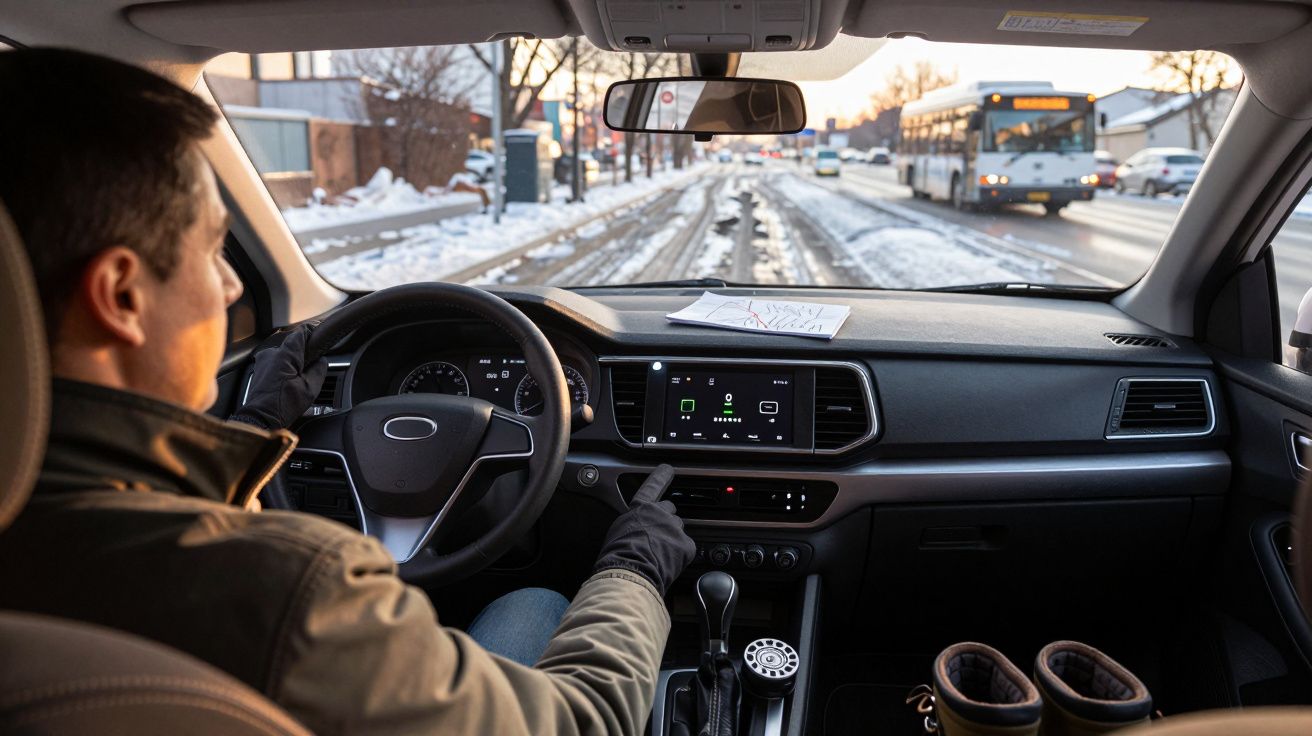
The first time winter bites, it rarely does it on a test track. It does it on a damp B-road at 6.30am, with low sun in your eyes, and a van parked half on the verge where the gritter never reached. That’s why professionals who spend their working lives driving in winter-often switching between winter tyres and all-season tyres-tend to rethink what “safe” actually means under real-world conditions.
They don’t overcomplicate it. They just treat winter as a different surface, a different visibility problem, and a different decision-making speed than the one you’re used to in October.
The gap between “winter conditions” and actual winter
Most people picture snow. Professionals often worry more about what you can’t see: thin ice in shade, standing water that turns to slush, a glossy layer of diesel at a roundabout, or compacted snow polished by traffic.
Real winter driving is messy because conditions change within a mile. A motorway can be merely wet, while a slip road is frozen solid, and the car park at the end is a churned-up mix of slush and grit.
The professional mindset shift is simple: assume grip is inconsistent, and drive like the next corner is worse than the last.
What experienced drivers adjust first (and why)
1) Speed isn’t the main control-space is
Professionals reduce speed, but the bigger change is how much room they give themselves. Space buys you time to see, time to react, and time to brake gently enough to keep the tyres working.
In winter, “I can stop in time” turns into “I can stop without triggering ABS every time”. That’s a meaningful difference, because ABS helps you steer, but it doesn’t magically create grip.
2) They stop trusting the car’s confidence
Modern cars feel composed right up to the point they don’t. Traction control and stability systems are excellent, but in low grip they can also disguise how close you are to the limit until you’re already asking too much.
Professionals drive as if the electronic aids are there to tidy up small mistakes, not to let them carry extra speed into bends.
3) They plan routes like a service, not a gamble
Gritted roads, hills, shaded cuttings, and wind-exposed bridges matter more than the “fastest” satnav line. If you drive for work, getting stuck isn’t just inconvenient-it’s a missed appointment, a recovery call-out, or a safety incident.
A slightly longer route that stays on treated roads is often the fastest route overall.
The small checks that prevent the big day going wrong
This is where professionals quietly win time and reduce stress. Not by buying exotic kit, but by making boring checks automatic.
- Tyres: enough tread to clear slush and water (and no mismatched tyres across an axle). Winter tyres help in cold temperatures; all-season tyres are a compromise that can still be a big step up from summer tyres in the cold and wet.
- Pressures: cold weather drops pressures; under-inflation can make braking and steering worse, and increases the risk of damage in potholes hidden by water.
- Screenwash: proper winter mix, not “whatever was in the garage”, because road spray plus salt film can blind you quickly.
- Lights and demist: you don’t want to discover a slow blower motor when the windows fog at the first junction.
- Fuel or charge: keep a buffer. Winter traffic means more idling, more heater use, and slower journeys.
If you only do one thing, do this: clear all the glass, mirrors, lights, and roof. Half-cleared snow doesn’t just block your view-it can slide down onto the windscreen when you brake, or off the roof onto the car behind.
A simple way to read the road like a pro
Professionals use a kind of running commentary: where is grip likely to be better, where is it likely to vanish, and what will other drivers do badly here?
Here’s a compact guide that mirrors how they think:
| Road cue | What it usually means | What professionals do |
|---|---|---|
| Shaded bends, under trees | Ice can linger long after roads look “fine” | Brake early in a straight line, ease off inputs |
| Bridges and overpasses | Freezes quicker than surrounding road | Hold steady speed, no late steering/braking |
| Roundabouts and junctions | Polished surface, diesel, constant braking | Approach slower than feels necessary, leave an escape gap |
This isn’t about being timid. It’s about reducing surprises.
Braking, steering, and the one habit that changes everything
Professionals build winter driving around one principle: do one thing at a time.
- Brake in a straight line where possible.
- Turn with light, steady steering.
- Accelerate only once the car is settled.
That separation matters because tyres have a limited amount of grip to “spend”. If you ask for heavy braking and sharp turning on a slippery surface, you run out of grip and something gives-usually the front tyres first.
What about engine braking and gears?
Using a higher gear and gentle throttle can help reduce wheelspin, especially when moving off on snow. But professionals avoid aggressive downshifts that can jolt the driven wheels and start a skid.
Automatics are usually good at smoothing things out, but the same rule applies: keep inputs gentle and predictable.
Skids: what training actually changes
Many drivers have heard “steer into the skid” and stop there. Professionals go further: they focus on not creating the skid in the first place, and if it happens, they avoid adding extra problems.
If the car starts to slide:
- Look where you want to go, not at the hazard. Your hands tend to follow your eyes.
- Ease off the pedals smoothly (especially the throttle). Sudden lifts can worsen balance.
- Steer with small corrections, then unwind the steering as grip returns.
Stamping on controls, fighting the wheel, or panicking mid-corner tends to turn a small slide into a big one.
The goal isn’t heroics. It’s getting the tyres rolling again so they can steer and brake.
Why “confidence” is the wrong winter metric
Professionals don’t aim to feel confident. They aim to feel unhurried.
An unhurried drive has deliberate gaps, earlier decisions, and fewer last-second manoeuvres. It means you’re not relying on the car in front to show you where the ice is, and you’re not arriving at every junction already committed.
If you notice other cars overtaking you in winter conditions, professionals don’t treat that as a challenge. They treat it as information: someone else is taking a risk you don’t need to share.
A winter set-off routine that takes five minutes
This is the sort of routine fleets and experienced drivers default to because it’s fast and repeatable:
- Clear the car fully (glass, lights, roof, number plates).
- Check tyres visually (tread, obvious damage, “looks low” pressure).
- Set heating and demist before moving off.
- Pick a route that favours treated roads over shortcuts.
- Tell someone your ETA if conditions are actively worsening.
It’s not dramatic, but it’s how you turn winter driving from a daily gamble into a managed task.
FAQ:
- Do winter tyres make you “safe” in snow and ice? They improve grip in cold conditions and can shorten stopping distances, but they don’t override physics. You still need slower speeds and bigger gaps.
- Are all-season tyres worth it in the UK? For many drivers, yes-especially if you regularly drive in cold, wet conditions and occasionally see snow. They’re a compromise, but often far better than summer tyres in winter temperatures.
- Should I use cruise control in winter rain or on icy roads? Many professionals avoid it in low-grip conditions because it can add throttle when you don’t want it. Keeping direct control helps you respond smoothly to changing traction.
- What’s the biggest professional habit shift in winter? Leaving more space and making earlier, gentler inputs-braking sooner, steering less sharply, and accelerating later.






Comments
No comments yet. Be the first to comment!
Leave a Comment