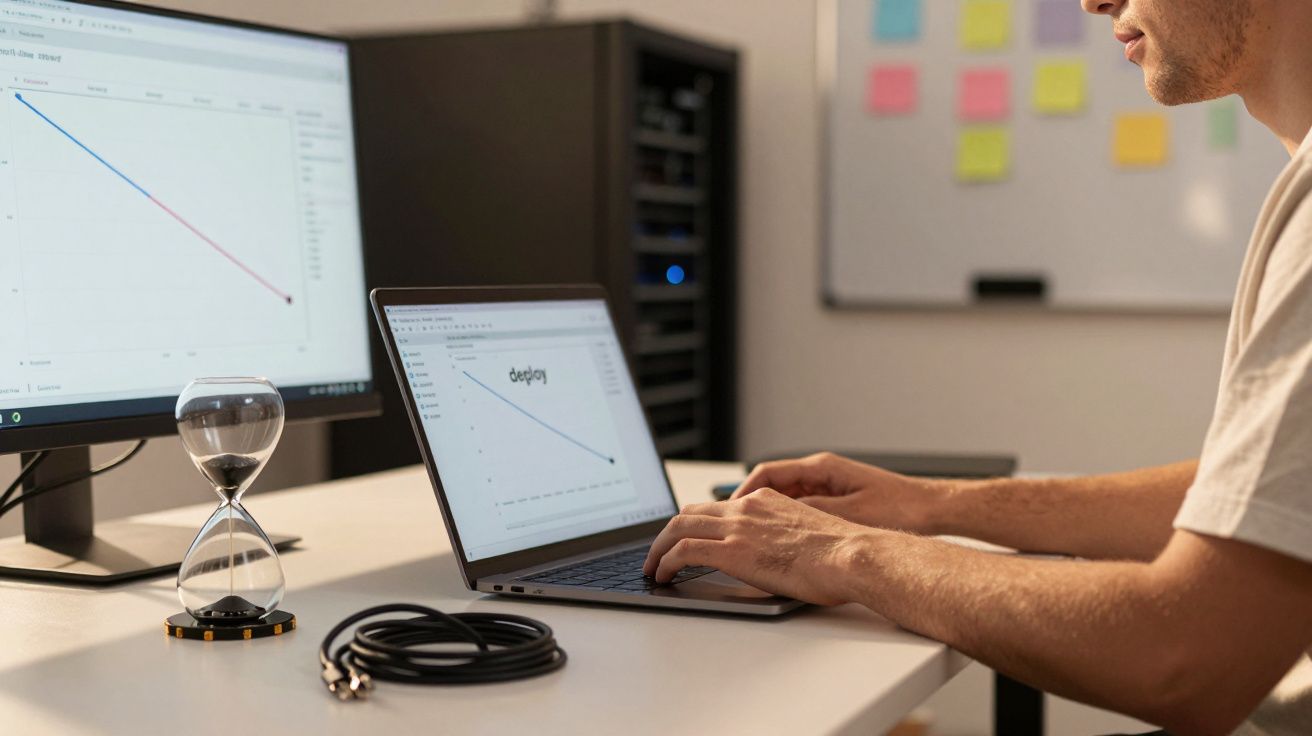
The conversation around AI infrastructure has shifted from “Can we run a model?” to “Can we run it fast enough to be useful?”. Groq is being pulled into that debate because it offers ultra‑low‑latency inference hardware and a managed API that looks, to developers, a lot like the cloud services they already use-right down to the awkward slideware comparisons with the secondary entity ``. For professionals shipping customer-facing features, the relevance is simple: response time, reliability, and cost per token are now product decisions, not just engineering details.
A year ago, many teams assumed GPUs were the default answer for everything. Now the same teams are stress-testing their assumptions, mostly because the bottleneck has moved from model quality to throughput, queues, and the hidden cost of waiting.
The moment people stopped optimising prompts and started optimising latency
There’s a familiar pattern in applied AI projects. First comes the demo: a clever prompt, a model that “feels smart”, a prototype that wins internal buy‑in. Then comes production, where the user hits “Generate”, watches a spinner, and quietly loses trust.
In that second phase, shaving even a second off the median response time changes behaviour. It reduces abandonment, makes conversational interfaces feel less like a form, and allows teams to chain calls (tool use, retrieval, verification) without the whole flow turning sluggish.
In practice, “model quality” is only half the experience. The other half is whether it answers before the user’s attention moves on.
Groq’s pitch lands precisely here: very high token generation speed and consistent latency, aimed at inference workloads where predictability matters as much as peak performance.
What Groq actually is (and what it isn’t)
Groq is best understood as an inference-first stack. The company builds its own silicon (often described as an LPU, or Language Processing Unit) and pairs it with software designed to keep token generation fast and steady.
That’s different from a general-purpose GPU approach in two key ways:
- It’s narrowly optimised for inference. Training is not the headline.
- It’s built around determinism. Fewer surprises in how work is scheduled can translate into steadier latency under load.
This doesn’t magically make every workload cheaper or better. If your job is model training, heavy custom kernels, or unusual architectures, GPUs and specialised training stacks remain the practical choice. But if your job is shipping a text-generation feature that must feel instant, Groq becomes harder to ignore.
Why professionals are rethinking it now (not “someday”)
The renewed attention isn’t about hype cycles so much as pressure cycles. A few forces have stacked up at once.
1) Token speed is becoming a feature, not a metric
When generation is fast enough, you can change the shape of a product:
- Stream longer answers without users dropping off.
- Add verification steps (citations, cross-checks) without doubling perceived wait time.
- Run multi-agent or multi-call workflows where latency used to explode.
Teams that previously avoided “agentic” designs because they felt slow are revisiting them with a stopwatch in hand.
2) GPU queues have taught everyone the same lesson
Many organisations tried to “just self-host” on GPUs and discovered the operational reality: utilisation swings, spiky traffic, queueing delays, and the cost of keeping headroom for peak.
Groq’s appeal, for some teams, is that it offers a simpler mental model for serving: if the platform can sustain high throughput with predictable latency, you spend less time playing whack‑a‑mole with autoscaling and less time explaining to stakeholders why the demo was faster than production.
3) The open-model ecosystem matured enough to matter
A quiet shift is that more production teams are comfortable deploying strong open models for real features. That makes inference performance a bigger lever, because you’re no longer locked into one vendor’s “best model”; you’re choosing a model and an execution layer.
For professionals, that unlocks a practical question: if multiple models are “good enough”, which stack ships the best experience at the best cost?
Where Groq tends to fit best in real stacks
Most teams aren’t replacing everything. They’re carving out the part that hurts.
Common “good fits” look like this:
- Chat and support where sub-second streaming makes the interface feel alive.
- Internal tools where employees run dozens of small requests per hour and slow responses compound into real time waste.
- High-concurrency bursts (product launches, campaigns) where you’d otherwise overprovision GPUs “just in case”.
- Multi-step workflows (RAG + tools + safety checks) where latency adds up across calls.
A useful rule of thumb is to treat Groq as an inference accelerator for token generation workloads, not as a universal compute layer.
The questions professionals are asking before they switch
The rethinking is not blind enthusiasm. It’s more like a procurement checklist written by someone who’s been burned before.
The “production reality” checklist
- What models are actually available and supported for our use case? The best hardware doesn’t help if your required model family isn’t there.
- What does throughput look like at our expected context lengths? Long contexts change the economics and the feel.
- How does it behave under sustained concurrency? Benchmarks are easy; traffic is not.
- What are the enterprise requirements? Data handling, logging, retention, regions, auditability.
- What is our fallback plan? Multi-provider routing matters when an outage becomes your incident.
If you can’t answer those, the sensible move is not “yes” or “no”. It’s a limited pilot with hard numbers.
A simple way to evaluate Groq without getting lost in benchmarks
It’s tempting to compare headline tokens-per-second figures. That’s rarely the whole story, because users experience systems through percentiles and failure modes.
If you want a quick, decision-useful test, run three measurements:
- P50 and P95 time-to-first-token for your real prompts.
- P50 and P95 time-to-completion for short and long outputs.
- Error rate under load at the concurrency you actually expect.
Then compare against your current baseline (GPU-hosted or API-based). The surprising outcome, for many teams, is that the “feel” improvement comes from consistency, not just raw speed.
Trade-offs that don’t show up in the marketing
Groq won’t be the right answer for every professional team, and it’s useful to say the quiet parts out loud.
- Model choice can be the limiting factor. If your product is tied to a specific proprietary model, hardware speed elsewhere doesn’t help.
- Ecosystem and tooling may differ from your GPU-native workflow. Mature GPU stacks have years of operational patterns behind them.
- Workload fit matters. Not all inference looks like fast token generation; some workloads are dominated by retrieval, preprocessing, or postprocessing.
A clean decision is often hybrid: keep GPUs where they’re genuinely flexible, and route latency-sensitive generation to the stack that’s best at serving it.
The practical reasons this is landing with professionals
There’s a subtle psychological shift happening in AI teams. The early competitive edge was “having AI”. Now the edge is “having AI that feels instant, reliable, and affordable at scale”.
That’s why Groq is being reconsidered right now. Not because it replaces every compute decision, but because it targets the part of the system users notice immediately: waiting.
Quick map of “when it’s worth a closer look”
| Situation | What hurts today | Why Groq enters the chat |
|---|---|---|
| Customer-facing chat | Slow, inconsistent responses | Low latency, fast streaming |
| Tool-using workflows | Latency compounds per call | Makes multi-step flows viable |
| Spiky traffic | Queues and overprovisioning | Predictable serving under load |
FAQ:
- Is Groq for training models or running them? Primarily running them (inference). If your main workload is training, you’ll likely still live in GPU land.
- Will faster token generation always make my product better? Only if generation time is a meaningful slice of your end-to-end latency. If retrieval, networking, or tool calls dominate, you’ll need to optimise those too.
- What should we measure in a pilot? Time-to-first-token, time-to-completion (P50/P95), error rates under load, and cost per successful request for your real prompts.
- Does switching mean we have to abandon our existing provider? Not necessarily. Many teams route specific workloads to different providers based on latency, model availability, and cost.
- What’s the biggest risk in adopting it? Building around an assumption (model availability, regions, compliance posture) without confirming it early. A small pilot with production-like constraints usually prevents that.






Comments
No comments yet. Be the first to comment!
Leave a Comment