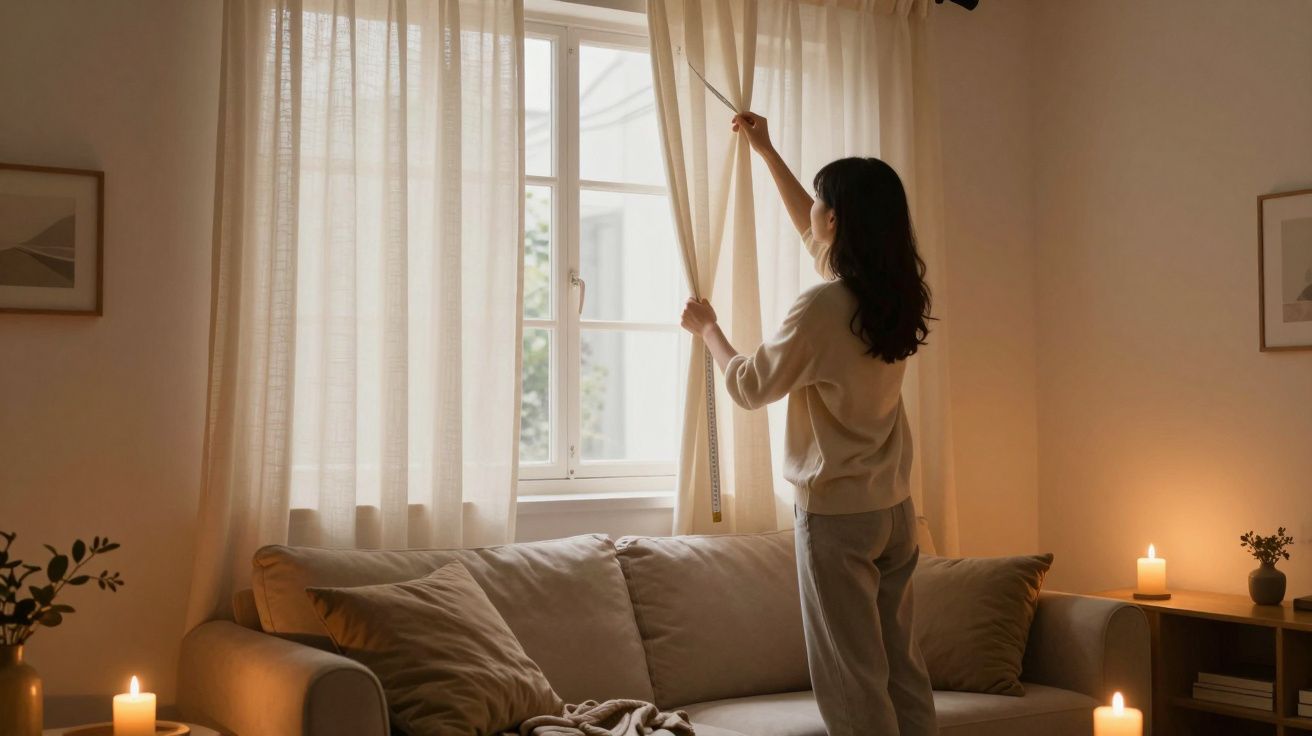
The radiator’s been on for an hour, the candle is doing its best, and yet the room still feels a touch…thin. The sofa throw is in place, the cushions are fluffed, but your eye keeps snagging on the same thing: two narrow curtains starting exactly where the window frame ends, skimming politely above the sill. A band of bare wall hovers awkwardly above the glass like someone forgot to finish getting dressed.
Later, you’re scrolling through photos of “cosy living rooms” and something niggles. The spaces that look genuinely warm – not staged, not hotel-like – all seem to share the same quiet trick. The curtains start higher. Sometimes a little, sometimes almost at the ceiling. There’s more fabric, more vertical sweep, and the room seems to tuck itself in.
The next evening you stand in your own living room, tape measure in hand, and realise that we’ve all been hanging curtains where the window tells us to – not where the room wants them. Interior designers have been nudging the poles upwards for years, not just because it looks expensive, but because it changes how warm a room feels before you’ve even touched the thermostat.
It isn’t magic. It’s sightlines, draughts, and a few centimetres of fabric doing a very specific job.
Why raising the curtain line makes a room feel warmer
Interior designers will tell you that warmth starts in the eyes long before it reaches your fingers. Your brain reads “cosy” or “cold” from a handful of visual cues: how much bare glass you see, where dark and light areas sit, how enclosed the walls feel around you. Curtains are one of the biggest signals.
When the pole sits just above the frame, you’re left with a visible strip of wall and a clear outline of the window. That strong rectangle of glass screams “outside”, especially on grey days. Light pools low, contrast is harsh, and the wall feels visually chopped up. Your brain quietly files that as: thin barrier, chilly edge, don’t relax too much.
Shift the curtains even 8–15 centimetres higher and the picture changes. The window suddenly feels taller, the wall more continuous, the fabric more like a coat than a scarf. You soften the hard join between glass and plaster with a band of textile. The line of “outside starts here” moves up and blurs. Your eye registers more wall and more fabric, less bare glazing.
There’s a subtle psychological trick going on too. High-hung curtains act like a brim on a hat: they create a sense of shelter over the windows. That extra vertical sweep suggests the room is wrapped, contained, held. Designers talk about “giving the room a hug”; in practice, you’re just eliminating those skinny, exposed bands that make walls feel underdressed.
And then there’s the light. When curtains start higher, they intercept and diffuse glare that would otherwise slice straight across the top of the room. Softer light reads as warmer light – think lamplight in a pub versus strip lighting in a waiting room. You haven’t changed the wattage, but you’ve changed the mood.
The not-so-glamorous physics: fabric as insulation
Perception is half the story. The other half is air.
Windows are where rooms lose heat and where cold air sneaks back in. Even with double glazing, the glass surface is cooler than your walls, and the air right next to it drops in temperature, falls, and creeps along the floor as a subtle draught. Short, light curtains that barely cover the frame do very little to interrupt that loop.
Hang curtains higher, and you almost always end up hanging them better. To reach that raised pole, you choose a longer drop, a fuller pair of panels, and usually a lining. That extra fabric acts like a soft baffle, slowing the cold air that tumbles off the glass and reducing the chilly current that brushes your ankles.
Raise the pole and extend it a little wider, and you can also cover more of the wall around the window, including the gap above and to the sides of the frame where tiny draughts often leak. The fabric traps a layer of air, the same way a good winter coat does. It’s not a miracle insulation system, but it can make the difference between “I need the heating a notch higher” and “this is fine”.
Designers quietly exploit this. In older homes with single glazing, you’ll often see ceiling-height curtains, interlined and generously wide, starting well above the frame and kissing the floor. The goal isn’t just elegance. It’s to create a padded envelope round the coldest part of the wall so the room feels comfortably warm at a slightly lower actual temperature.
Your thermostat measures degrees. Your body measures draughts. Higher, heavier curtains reduce those invisible chills.
How interior designers actually hang “warmer” curtains
The good news: you don’t have to rebuild your windows. A few centimetres and some smarter proportions go a surprisingly long way.
Here’s how designers tend to do it:
Raise the pole 8–20 cm above the window frame
In an average room, 10–15 cm is the sweet spot: high enough to change the feel, low enough to avoid hitting coving. In rooms with high ceilings, going to a few centimetres below the cornice or ceiling line can be transformative.Widen the pole 10–20 cm beyond each side of the frame
This lets the curtains stack mostly off the glazing when open, so you’re not blocking light, but when they’re closed they cover the wall and frame completely. That wider “wrap” is what makes evenings feel snug.Choose enough fabric to look generous, not starved
As a rough guide, the total curtain width should be 1.5–2 times the width of the pole. Skimpy, stretched-flat curtains look mean and do little for warmth. Folds and pleats trap air and read as luxe.Let the fabric touch the floor
Designers usually aim for curtains that just “kiss” the floor or break by 1–2 cm. Floating hems – 5 or more centimetres off the floor – let draughts scoot underneath and visually lighten the room in a way that reads colder.Add a lining (and, if you can, an interlining)
A simple cotton or thermal lining thickens the curtain and helps block heat loss. In particularly draughty rooms, an interlining – a hidden layer between fabric and lining – turns your curtains into soft duvets for the wall.Think texture and colour as well as height
Nubbly linens, wool blends, velvet, brushed cotton – these all look and feel warmer than thin, shiny synthetics. Warm neutrals (oatmeal, tobacco, rust, olive) close to the window soften the boundary between inside and out.
Let’s be honest: nobody enjoys re-drilling holes in plaster for fun. If you’re renting or avoiding big changes, even a modest move – lifting the pole by 5–8 cm and swapping in a lined pair that actually meets the floor – can noticeably change the room’s mood.
Common curtain mistakes that make rooms feel colder
You can spend a lot on fabric and still end up with a chilly-looking space if the basics are off. Designers see the same issues again and again.
Hanging the pole exactly on top of the frame
This leaves that awkward band of wall and shouts “builder-basic”. It chops the room in two and keeps the window visually separate from the rest of the wall, which emphasises the coldest surface.Curtains that are too short or too narrow
A high pole with curtains that stop above the skirting looks like trousers worn three years too late. It also exposes the coldest parts of the wall and floor. Narrow panels pulled tight go flat and let more air leak around the sides.No lining at all
Single-layer, very light curtains can be lovely in summer, but in winter they offer almost no thermal help and tend to billow, which draws attention to any draughts. They also let more streetlight and grey daylight glare in, which often reads as “cold brightness” rather than “soft glow”.High-contrast walls and windows
Dark walls with very stark white, short curtains; cold blue-grey sheers on pale walls – these combinations can exaggerate the sense of chill. Blending curtain colour slightly towards the wall colour calms the contrast and makes the whole envelope feel thicker.Stopping at the window board when you don’t have to
Sill-length curtains over a full-height radiator or blank wall cut the room visually and thermally. Where radiators allow, full-length, higher-hung curtains nearly always feel warmer and more intentional.
Small changes, noticeable warmth
| Tweak | What changes | Warmth effect |
|---|---|---|
| Raise pole by 10–15 cm | Window looks taller, wall feels wrapped | Room reads more “enclosed” and snug |
| Add lining & full length | More fabric, fewer draught paths | Perceived temperature rises without extra heating |
| Extend pole wider | Curtains cover wall, not just glass | Evenings feel cocooned, less edge-of-window chill |
The quiet comfort of a higher curtain line
When you see it side by side – old height, new height – the difference is almost embarrassing. The window hasn’t moved, the furniture hasn’t changed, but the room you walk into feels thicker, calmer, less like you’re perching next to the weather.
Designers aren’t chasing some abstract rule about hanging curtains “right”. They’re trying to control how your body relaxes at 8 p.m. They raise the line so the windows stop shouting for attention, so the light softens, so the coldest parts of the wall get a soft shield.
Your heating system can only do so much. The rest is what your eyes believe about how protected you are from what’s on the other side of the glass. A few extra centimetres of height, a little more fabric, and suddenly your room stops feeling like it’s tolerating winter and starts feeling like it’s ready for it.
FAQ:
- Does hanging curtains higher actually make the room physically warmer, or just look it? Both, to a degree. The biggest impact is psychological – you feel warmer because the room looks more enclosed and less glass-heavy. But longer, lined curtains also reduce draughts and slow heat loss around the window, which can make the space marginally warmer in real terms.
- How high is “too high” for a curtain pole? If you’ve got coving or a picture rail, aim a few centimetres below it. With no architectural features, most designers stop 5–10 cm below the ceiling. Poles mounted tight to the ceiling can look harsh unless the room is very tall or you’re using a track that’s meant to disappear.
- What if I have radiators under the windows? You can still raise the pole. If the radiator is directly below, opt for sill-length curtains or ones that stop just above the radiator, but keep them higher and a little wider so they still soften the wall and frame. Use lined fabrics and consider a separate blind for extra insulation.
- Can I get the same effect with blinds instead of curtains? You can get some of it. Hanging Roman or roller blinds a little above the window frame makes the opening look taller and can help with draughts if the blind is well-fitted and lined. Curtains, however, add more visible softness and better side coverage, which is why they often feel warmer.
- Is it worth changing perfectly good curtains just to hang them higher? If your room consistently feels a bit bare or chilly despite decent heating, it can be. You might be able to reuse the fabric by re-heading the curtains or adding a border to lengthen them. Raising the line is one of the most cost-effective ways to make a space feel properly finished and comfortable.




Comments
No comments yet. Be the first to comment!
Leave a Comment