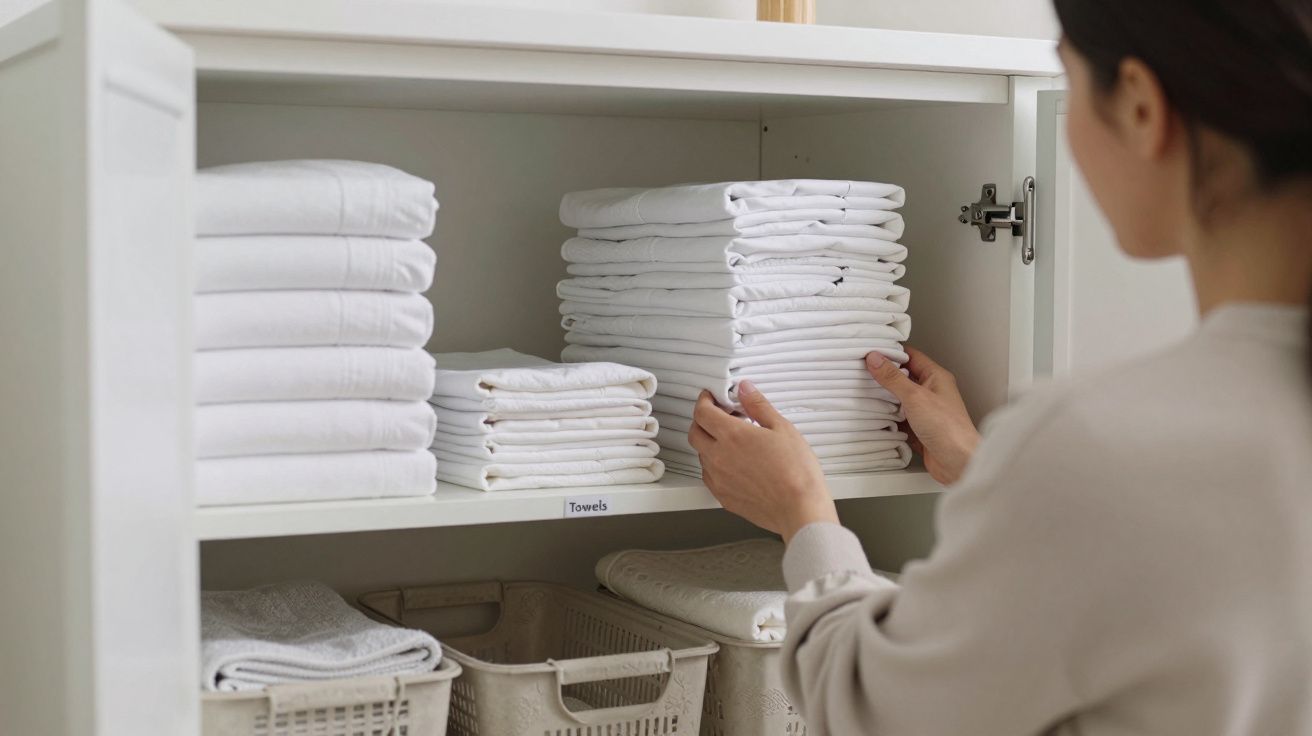
The door wouldn’t quite close. A fan of fitted sheets bulged out just enough to catch on the frame, a soft barricade of elastic and cotton. You pressed, shuffled a few corners, tried to flatten one tower with your forearm, and promised yourself that this time you’d keep the airing cupboard “under control”. Two laundry days later, it looked exactly the same.
It isn’t that you own too many sheets. It’s that they’re the wrong shape for your shelves. Professional organisers see the same thing in house after house: beautifully folded duvet covers and pillowcases in neat piles, and then a chaotic drift of fitted sheets, some rolled, some vaguely folded in quarters, all of them eating far more space than they should. The fix isn’t new shelving. It’s changing how you fold by a single fraction.
You don’t need a bigger cupboard; you need smaller rectangles.
Why your fitted sheets swallow a whole shelf
Fitted sheets behave badly because they look like circles when you’re holding them. All elastic and no obvious “edge”. Most people either roll them into a ball or do a polite fold in half, then half again, until they’re roughly square. It feels tidy in your hands. On a shelf, those squares stack into short, wobbly towers that sprawl sideways the moment you take one out.
Professional organisers will tell you the pattern is boringly consistent. Quarter-folded sheets sit shallow and wide, so you can only build three or four high before the stack leans. The piles creep forwards and backwards, blocking whatever lives behind them. You end up giving an entire shelf over to fitted sheets simply because they refuse to sit upright.
Our eyes read that as clutter. When every other linen stack is crisp and vertical, the soft heap of elastic suggests you own “too much”, even when you don’t. One organiser in Leeds, Samira, puts it bluntly: “People blame the number of sheets. Nine times out of ten, it’s the fold.”
The geometry that’s wasting your linen cupboard
Here’s what’s going wrong. Folding in quarters gives you a near-square: wide footprint, short height. It looks reasonable on a table, but on a typical British shelf - 30–40 cm deep, 25–35 cm high - that squat square hogs depth without ever reaching the full height. You’re filling the floor, not the air.
Folding in thirds flips the proportions. You create a slimmer, taller rectangle that either stacks more stably or, crucially, can stand on its side like a book. That one change lets you “file” fitted sheets vertically instead of laying them flat. The same number of sheets suddenly fits in half the footprint, and the edges become visible spines instead of hidden layers.
Professional organisers almost all work in thirds. Thirds match how most duvet covers are folded, and they line up with the depth of standard shelves and baskets. When everything folds to the same narrow rectangle, you can:
- Stand sheets up, book-style, in a bin or on the shelf
- Slot sets together (fitted, flat, two pillowcases) as one grab-and-go bundle
- Use the full height of the cupboard instead of just the bottom slice
One London organiser, Ben Patel, measures it with clients: “In a small airing cupboard, switching from quarters to thirds on fitted sheets alone typically frees about 25–30% of the shelf. That’s one whole shelf gained for most families - either for towels or for bulky duvets.”
How to fold a fitted sheet in thirds (the organiser way)
Once you’ve done this three or four times, your hands remember it. Put on a podcast, clear a bit of bed or table, and work sheet by sheet.
Find the corners and tame the elastic
- Hold the sheet lengthways, with one short end in each hand, inside-out.
- Slide your hands into the two “top” corners like puppet gloves.
- Bring those corners together and tuck one over the other, so they nest.
- Repeat with the remaining two corners, so you have all four corners stacked in one hand.
- Hold the sheet lengthways, with one short end in each hand, inside-out.
Make a long, neat rectangle
- Lay the sheet flat on the bed with the elastic side up.
- Smooth the elastic edge inwards so it creates a straight(ish) line. Don’t chase perfection; you’re aiming for a rough rectangle.
- Fold the long sides in so that the elastic is hidden and you’re left with a clean-edged strip running lengthways.
- Lay the sheet flat on the bed with the elastic side up.
Fold in thirds along the length
- Imagine the strip divided into three equal sections along its length.
- Fold one end in towards the middle, then the other end over the top, like folding a letter.
- You now have a compact, thick rectangle.
- Imagine the strip divided into three equal sections along its length.
Finish in thirds across the width
- Turn the rectangle so the longest edge faces you.
- Fold one side in by a third, then the other over it.
- Press gently and smooth out the air; you’re aiming for something that stands up without unfolding.
- Turn the rectangle so the longest edge faces you.
You should end up with a firm, book-sized block, edges tidy, elastic fully contained. It’s smaller than a quarter fold, but denser. That density is what makes it stand upright in a basket or in a row on the shelf.
For matching sets, tuck the fitted sheet, flat sheet (folded to the same third-based rectangle), and pillowcases together and slide the whole bundle into one of the pillowcases. The “pillowcase packet” then also folds in thirds, so every set shares the same footprint.
How thirds free up a whole shelf
It helps to picture the shelf as a short bookcase. Quarter-folded sheets are like coffee-table books lying flat; they hog space and you only see the one on top. Third-folded sheets are paperbacks standing in a row; you can see each spine and pull one without toppling the rest.
Once everything is folded in thirds, you can:
- Store vertically. Line sheets up like files, either directly on the shelf or inside a shallow box or basket. Vertical storage doubles what you can see and roughly doubles what you can fit in the same footprint.
- Standardise sizes. Because the fold is the same for singles, doubles and kings, you can store by bed rather than by size. One shelf for all double-bed sets, for example, instead of one shelf per type of linen.
- Limit the maximum height. With sheets standing like books, you stop building risky towers that slump into dead space above. The top 5–10 cm of shelf height becomes usable air, not a tipping hazard.
In a typical UK airing cupboard with three shelves, that shift is enough to consolidate what used to sit on two shelves of sheets into one. The newly liberated shelf can absorb towels, spare duvets or seasonal bedding that used to live in under-bed bags.
One client in Bristol sent a photo to her organiser after refolding: three tidy rows of third-folded fitted sheets standing in one basket, where there had previously been two unpredictable piles sprawled across the entire shelf. The basket took up half the width. The other half became “towels only”. No extra carpentry. Just different rectangles.
Small tweaks that make it work every week
The fold is only half the story. A few tiny habits make the thirds system stick on busy laundry days.
- Assign each bed a zone. Label the shelf edge or basket “King – Main Bedroom”, “Single – Kids”, and put whole sets there. Your brain stops searching sizes and just looks for the right label.
- Keep a gentle limit. Decide how many sets each bed needs (often two for adults, three for kids) and let the shelf hold you to it. When the row is full, extras have to earn their place or leave.
- Use containers as rails. In deep cupboards, use shallow bins or handled baskets as “drawers” that pull out. Third-folded sheets file neatly into these so you’re not digging at the back.
- Face the fold. Always store with the clean folded edge facing outwards. It’s easier on the eye and lets you spot at a glance if one has escaped the system.
If you share laundry duties, stick a quick sketch of the thirds fold on the inside of the cupboard door. It doesn’t need to be art. A simple “long rectangle, then thirds, then thirds” keeps everyone close enough to the system that the shelves stay calm.
When organisers reach for thirds first
Ask a professional organiser what they do in a chaotic airing cupboard and most will say the same thing: they touch the fitted sheets before they touch the shelves. It’s a fast, visible win, and it changes how every other item behaves.
Here’s how they tend to break it down:
- Time: 20–40 minutes to refold a family’s fitted sheets in thirds
- Cost: £0–£25 if you add a couple of baskets or labels
- Tools: a clear bed, your hands, and a mildly stubborn mood
- Result: up to one full shelf freed, with sheets that stand up instead of sliding out
They’ll also tell you it feels far more satisfying than it sounds. There’s a quiet click in your brain when you slot the last third-folded bundle into a neat row and realise you can actually see the back of the shelf again.
The small change that calms your whole cupboard
Tidy linen isn’t about becoming the sort of person who irons pillowcases. It’s about not dreading the moment you open the cupboard, late on a Sunday, hunting for a dry king-size sheet that isn’t tangled at the back. Thirds do that. They take the single most unruly item in your airing cupboard and give it edges and rules.
Once you’ve seen what thirds do to fitted sheets, you start using them elsewhere - towels, T-shirts, even throws. You notice that most shelves behave better when everything inside is the same rough shape. The cupboard door closes without persuasion. The stacks stop slumping. You reclaim a shelf you thought you’d outgrown.
You didn’t need more storage. You just needed your bedding to fold the way your shelves think.
| Fold style | How it sits on the shelf | Best use |
|---|---|---|
| Rolled / balled | Bulky, unstable, hard to stack | Camping, not cupboards |
| Folded in quarters | Wide, shallow, stacks topple | Quick fixes, large drawers |
| Folded in thirds | Slim, dense, can stand upright | Airing cupboards, baskets |
FAQ:
- Will folding in thirds really make that much difference to space?
In most standard cupboards, yes. Thirds create denser bundles that can stand upright, so you use height as well as depth. Clients commonly gain around a third more usable space on the “sheet shelf”, enough to move towels or duvets there and free a whole extra shelf.- What if my fitted sheets are very deep or super-king size?
The method is the same, but you may need one extra fold along the length before you go into thirds. Aim to finish with a rectangle that’s similar in size to your other bedding, so everything still files neatly together.- My shelves are very shallow - will thirds still work?
If the shelf is shallow, fold to thirds across the shortest side first, then again as needed so the final rectangle matches your shelf depth. The principle stays: aim for slim, tall bundles that can stand or stack without spreading.- I can’t get the corners perfect. Does that matter?
Not much. Hidden elastic is more important than crisp edges. If the corners are roughly stacked and the elastic is inside the folds, the finished rectangle will still be compact enough to store well.- Can I mix thirds-folded sheets with my existing quarter-folded duvet covers?
You can, but it’s neater if everything eventually matches. Many people start with fitted sheets, see the space gain, then switch duvet covers and pillowcases over to thirds on the next laundry cycle so all their bedding stacks into the same-sized bundles.




Comments
No comments yet. Be the first to comment!
Leave a Comment