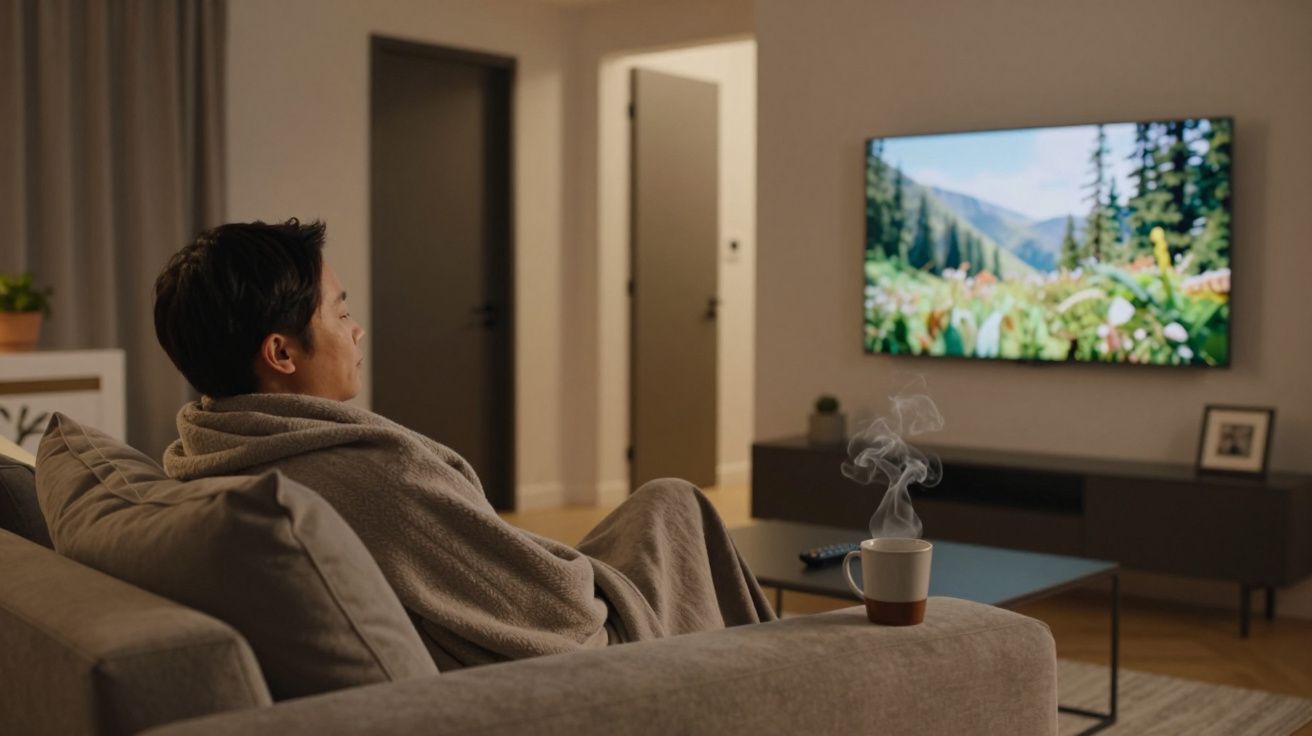
You drop your bag, kick off your shoes and walk into the living room already knowing exactly where you’re going to land. Not just “on the sofa”. On your bit of the sofa. Left-hand corner, throw within reach, decent sightline to the TV. If someone’s sitting there, you feel that tiny, irrational flicker of annoyance.
Most of us treat this as a harmless quirk. But when behavioural scientists follow people at home, they talk about favourite seats the way meteorologists talk about pressure systems – as low-key but surprisingly accurate indicators of what’s going on underneath. Where you naturally gravitate to after a long day is often a snapshot of how much stress you’re carrying, and what your nervous system is quietly trying to do about it.
They’re not talking about personality types or neat little boxes. They’re interested in the way your body keeps choosing the same patch of fabric, night after night, and what that reveals about how safe – or on edge – you feel in your own living room.
Why your sofa habits are a quiet stress barometer
From the outside, “favourite spot on the sofa” looks like pure habit. From the inside, it’s often your brain doing three things at once: reducing effort, managing risk and seeking comfort.
Stress researchers describe modern life less in terms of “work–life balance” and more as constant negotiation with your nervous system. After a day of emails, traffic, childcare and background worries about money or health, your brain is craving cues of safety – predictable, controllable, familiar. The place you flop in the evening becomes part of that safety map.
In observation studies, people under higher reported stress don’t necessarily sit less. They sit more strategically. They pick spots with a wall behind them, clear line of sight to the room, easy access to exits, or maximum control over the remote and lighting. It’s not a conscious plan. It’s your ancient threat-detection system quietly arranging the furniture.
At the same time, your body is trying to downshift from “doing mode” into “rest and digest”. Certain positions – tightly curled in a corner, sprawled across cushions, perched on the edge – either help that downshift or fight it. Over weeks, those micro-choices solidify into “my seat”.
Behavioural scientists see those patterns less as “this means you’re X type of person” and more as “this might be how your stress is currently organising your evenings”.
The most common sofa spots – and what they tend to signal
Everyone’s home and history are different. The same seat can mean slightly different things in different lives. But across households, a few patterns show up again and again.
1. The corner nest
You go straight for the corner of the sofa or the bit backed by a wall. You like armrests, cushions and throws around you. Ideally, you can see both the TV and the doorway without turning your head.
Behaviourally, this is the “contain and decompress” setup. Under chronic stress, many people gravitate to positions where their back is protected and their field of view is wide. It’s the living-room version of taking the corner table in a café. Your nervous system gets to relax a notch because there are fewer unknowns behind you.
Researchers who track posture at home notice that corner-sitters often tuck their legs up or curl slightly forwards. It looks cosy, but it can also be a physical “shell” – a way of shrinking your surface area after a day of being mentally available to everyone else.
What to watch for:
- Do you find it hard to leave that corner, even to go to bed?
- Do you need background TV or scrolling to fully switch off once you’re there?
- Do you feel oddly exposed on chairs without arms or backs?
None of this is “bad”. It may simply mean your system is working hard in the day, and needs strong signals of safety at night. But if the corner becomes more bunker than nest, it can be a sign your stress never really powers down.
2. The end near the door (or with the clearest view)
You don’t necessarily sit where it’s comfiest. You sit where you can see the whole room, the hallway, maybe even the front door. You know exactly who’s coming and going, where the kids are, whether the oven light is still on.
In lab terms, this is classic vigilance behaviour. People in higher-alert states – parents of toddlers, carers, those in noisy house shares, people fresh out of a difficult relationship – often choose “command” positions unconsciously. They want speed and visibility more than deep relaxation.
One behavioural scientist described a client who always sat closest to the living-room door, even though the other end of the sofa was softer and warmer. When she drew her living room from memory, she placed herself as a kind of gatekeeper. “If anyone needs anything, they call me,” she said. Her seat simply honoured that role.
What to watch for:
- Do you find yourself half-listening for sounds elsewhere in the house?
- Do you stay half-upright, ready to get up at any moment?
- When the house is empty, do you still choose that seat?
If your favourite position is a miniature control tower, your stress may be less about volume of tasks and more about responsibility. Your brain is on “just in case” duty, even in front of Netflix.
3. The middle of the sofa
You happily drop right in the centre, legs out, arms loose. You don’t need a wall at your back, and you’re not fussed about being nearest the door. You use cushions, but you don’t build a fortress out of them.
Behaviourally, the middle seat is about social connection and ease. In families and flatshares, people who choose the middle often describe themselves as “the bridge” – between kids, between housemates, between different corners of the household.
In stress terms, this can go either way. In some people, it’s a genuine sign of feeling safe and settled at home. In others, it reflects a subtle pressure to always be available: emotionally, conversationally, physically. You’re literally placing yourself where everyone can reach you.
What to watch for:
- Do you actually relax there, or do you end up mediating conversations?
- On nights alone, do you move to a different spot?
- Do you feel guilty taking up the middle if someone else wants to lie down?
The middle seat can be a lovely marker of ease – or a reminder to sometimes slide to the side and let someone else be “centre”.
4. The separate chair (or the floor)
You avoid the main sofa altogether. You prefer an armchair in the corner, the dining chair with a laptop, or you end up on the floor with a rug and cushions, slightly off to the side.
In field studies, people who consistently sit away from the main sofa often fall into two broad groups. The first are overstimulated: the sofa is where TV, chatter and snacks happen, so they retreat to the edge of the room for quieter processing. The second group feel slightly out of sync with the household – different schedule, different interests, or simply needing more space than the sofa politics allow.
Stress-wise, this can be a smart act of self-preservation. Your system says, “I can’t properly recharge in the middle of this, I need my own mini-zone.” It’s often how introverts or highly sensitive people carve out rest in busy homes.
What to watch for:
- Do you choose that chair even when the sofa is empty?
- Do you feel like a guest in your own living room?
- Does your body drop more deeply when you’re away from the main “action”?
If your favourite spot is slightly separated, your stress may be less about threat and more about overwhelm. Your evenings might improve more from reducing inputs than from adding another cushion.
5. The edge-of-the-cushion percher
You technically sit on the sofa, but only just. You’re near the front of the cushion, feet planted, upper body angled forwards. You can spring up in a second. Sometimes you stay like that for entire episodes.
Behaviourally, perching is “in-between” posture. In motion-tracking experiments, people perched on the edge of seats show similar muscle patterns to those waiting at a gate or standing in a lift: they’re not truly resting, they’re anticipating the next thing.
Perchers at home are often the ones who say, “I’ll just quickly…” all evening. Quickly tidy, quickly answer an email, quickly check something online. Their sofa use mirrors their day – functional, slightly rushed, rarely surrendered to.
What to watch for:
- How long does it take you to actually lean back?
- Do you feel oddly uncomfortable lying down, even when tired?
- Do you perch more on stressful weeks?
Perching isn’t a character flaw. It’s a cue. Your sofa is telling you that “relaxation” hasn’t quite made it to your body yet.
A quick sofa map: seat, pattern, stress signal
| Seat choice | Typical pattern | Stress signal to notice |
|---|---|---|
| Corner nest | Curled, back protected, lots of cushions | Needing strong safety cues before you can unwind |
| End near door/view | Clear sightlines, easy exit, half-upright | Subtle hypervigilance and high responsibility load |
| Middle of sofa | Sprawled, central, socially placed | Either genuine ease or pressure to be “available” |
| Separate chair/floor | Slightly away from main action | Overstimulation, craving your own micro-territory |
| Edge percher | On the front of cushion, ready to move | Difficulty shifting from doing-mode to rest-mode |
None of these automatically mean “you’re stressed”. The point is to pair where you sit with how you feel, and see if the picture lines up.
How couples and housemates silently negotiate sofa stress
Watch a household long enough and you’ll notice that the sofa has its own choreography. One person automatically reaches for the corner with the lamp and blanket. Another claims the end near the plug socket. A third hovers, never quite laying full claim to a spot.
Behavioural scientists call this “territorial choreography” – the unspoken way people divide space to balance comfort, status and responsibility. Under stress, that choreography often tightens. The burnt-out partner clings more fiercely to their corner. The worrier slides nearer the door. The person feeling excluded moves further away, or stops sitting at all.
In couples therapy, it’s not unusual for a practitioner to ask, “Where do you sit in the evenings?” and get a whole relationship’s worth of data. One partner sits upright on the edge, laptop open. The other lies down, feet across the cushions. That’s not just about sofa height; it’s about who’s on duty, who’s switching off, whose stress gets priority.
The good news: small, conscious tweaks in sofa layout can change the emotional weather more than you’d think. Swapping sides for a week. Adding a second lamp so both ends feel cosy. Creating a designated “no devices” corner that signals genuine downtime. These are behavioural nudges, not grand gestures – but they give your nervous systems new options.
Tiny experiments to try with your own sofa this week
You don’t need to overhaul your living room. Just treat your sofa like a mini stress lab for a few evenings.
- Swap spots for three nights. Sit where you never sit and notice what your body does. More relaxed? More on edge? Bored? This isn’t about finding the “right” place, just about making your patterns visible.
- Change your posture, not your cushions. If you always perch, deliberately lean all the way back for one full episode. If you always curl tight, try stretching your legs out and opening your chest. See how long it takes before you unconsciously return to your usual pose.
- Adjust the view. Move the coffee table, angle the sofa slightly, or shift a lamp so your favourite spot feels less like a command centre and more like a cocoon, or vice versa, depending on what you need.
- Create one clearly “off-duty” seat. A corner where the phone doesn’t come, or the laptop doesn’t land. Not forever. Just for a week. Notice whether your stress drops faster there.
- Use the sofa as a check-in prompt. When you sit down, ask yourself: “Am I here to rest or to recover?” Rest is light, optional, pleasant. Recovery is heavier, catching up after overload. Your answer tells you more than any personality quiz.
Soyons honnêtes : personne ne fait vraiment ça tous les jours. But doing one or two of these on rough weeks can leave you noticeably less wired by bedtime.
Your sofa as a small act of self-respect
Once you start noticing your favourite seat, it’s hard to unsee it. You clock how quickly you rush to claim it, how you arrange cushions like small defensive walls, how uneasy you feel when someone else is in “your” bit. You realise you’re not just sitting; you’re signalling something to yourself.
Changing where you sit isn’t about forcing yourself into the “relaxed person” pose. It’s about shrinking the gap between what your body is asking for and what your evening actually gives it. If your nervous system is craving safety, you build that into the corner. If it’s craving less responsibility, you step away from the doorway seat. If it’s desperate to stop doing, you practise leaning all the way back.
On a Tuesday night in February, when work has been relentless and the news feels heavy, that might be one of the few levers you can actually pull. You finish the washing up, walk into the living room, and instead of collapsing on autopilot, you pause for half a second and choose. Corner, middle, chair, floor – whatever genuinely matches what your stressed body needs.
It’s a tiny decision. But over weeks, those tiny decisions turn your sofa from “where I end up” into “where I help myself breathe again”.
FAQ:
- Is there real science behind sofa seats, or is this just pop psychology? There aren’t randomised trials on “left cushion vs right cushion”, but there are robust findings on territoriality, vigilance, posture and stress. Behavioural scientists connect those dots by observing how people use space at home. Your seat isn’t a diagnosis – it’s a clue.
- What if I don’t have a sofa, just a bed or a single chair? The same principles apply. Notice where you naturally end up, how your body arranges itself, and whether you choose positions that prioritise safety, control, connection or speed. The furniture matters less than the pattern.
- Can changing my usual spot actually reduce stress? On its own, no sofa can fix deep burnout or serious anxiety. But shifting how and where you rest can support your nervous system – especially if it helps you move from half-alert perching to genuine downshift a bit earlier each evening.
- What if my favourite seat is already taken most nights? That in itself is useful information. If you constantly give up the spot where you relax best, you may be signalling to yourself that other people’s comfort always comes first. Creating even a small alternative nook that feels truly yours can help balance that.




Comments
No comments yet. Be the first to comment!
Leave a Comment