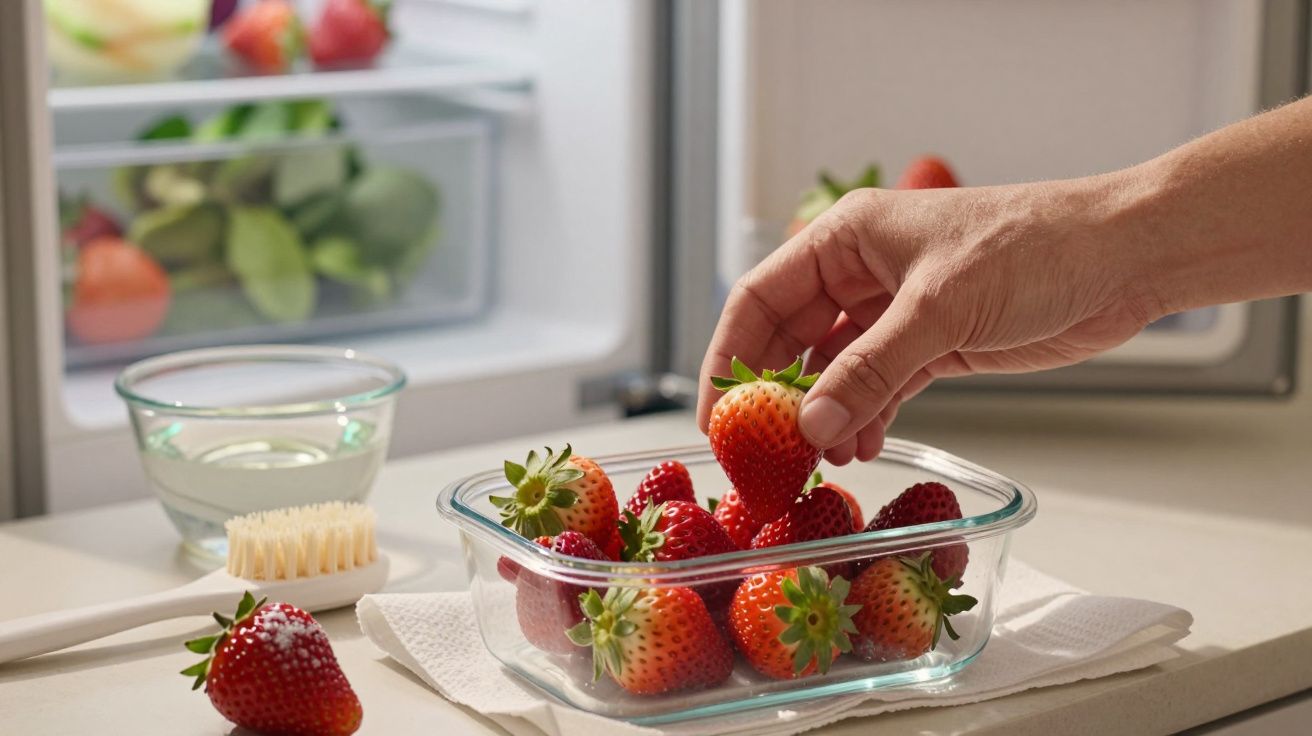
Strawberries show up everywhere from breakfast bowls to Wimbledon desserts, yet they’re also one of the most frequently mishandled items in the fruit drawer. They matter because they’re expensive, highly perishable, and-when treated well-genuinely taste like summer rather than damp sugar.
This is an article about strawberries, with no secondary ingredient in the supporting role, because most of the confusion comes from how we treat the fruit itself: how it ripens, how it’s stored, and what “fresh” actually means when you bring a punnet home.
The biggest misunderstanding: “They’ll ripen on the counter”
People treat strawberries like bananas. They’re not.
Strawberries are non-climacteric, meaning they don’t keep ripening after picking in the way bananas, peaches or avocados do. They can soften and smell stronger on the counter, but that’s mostly ageing, not improvement. If they were picked under-ripe, time won’t turn them into the sweet, fragrant version you hoped for.
“Once a strawberry is picked, you can’t add sweetness-only lose water and texture,” as post-harvest specialists often put it.
What to do instead: buy the ripest punnet you can find, then focus on slowing decline rather than “finishing” them at home.
How to spot flavour without eating one in the aisle
Perfect strawberries look obvious until you’re holding two punnets that both claim to be “extra sweet”. A quick visual check helps, but aroma and texture cues matter more than people think.
- Look for full colour: red right up to the shoulders (white tops often mean less developed flavour).
- Check the leaves: fresher green caps tend to track with better handling, not necessarily sweetness-but limp brown caps are a warning.
- Sniff the punnet: a gentle strawberry scent is a good sign; a strong fermented smell means they’re tipping over.
- Avoid wet shine: moisture trapped in the pack accelerates mould.
Misunderstanding #2: “Wash them as soon as you get home”
Washing feels virtuous. With strawberries, it can be self-sabotage.
Extra water clinging to the surface and pooling in the punnet is basically a welcome mat for mould. Strawberries have delicate skins and lots of nooks; once they’re wet, they tend to stay wet unless you dry them properly.
The simplest rule that food safety educators repeat is: wash right before you eat. If you want to prep ahead, you need to do it in a way that respects moisture.
If you insist on washing early, do it like you mean it
If your household snacks constantly and you want “grab-and-go” fruit, you can wash in advance-but the drying step is the real work.
- Rinse quickly in cold water (don’t soak).
- Spread on clean tea towels or kitchen roll in a single layer.
- Air-dry until no visible moisture remains.
- Store with a dry paper towel in the container to absorb humidity.
A vinegar rinse gets discussed a lot. It can reduce some surface microbes, but it’s not magic, and it won’t rescue berries that were already bruised or stored warm.
Misunderstanding #3: “Fridge ruins them, so keep them out”
This one splits people into two camps: “never refrigerate” and “always refrigerate”. Both are half-right.
Cold temperatures protect strawberries from rapid mould growth and softening. The trade-off is aroma: very cold air can mute fragrance, so a strawberry eaten straight from the fridge may taste less expressive.
The practical middle path is boring but effective: store cold, eat closer to room temperature. Take out what you’ll eat and give it 15–30 minutes on the counter.
| Goal | Best move | What to avoid |
|---|---|---|
| Slow mould and mush | Fridge storage (dry, covered but ventilated) | Leaving them on a warm windowsill |
| Maximise flavour | Temper 15–30 mins before eating | Eating ice-cold straight from the back of the fridge |
| Prevent “one bad berry” | Remove bruised/mouldy berries promptly | Letting a leaky berry sit in the punnet |
Misunderstanding #4: “Mouldy ones are fine if you just pick them out”
With firm foods (say, a hard cheese), trimming can be reasonable. With soft fruits, it’s different.
Strawberries are high in moisture and delicate inside. If you see mould on one berry, microscopic growth may already be present on neighbours even if you can’t see it yet. That doesn’t mean you must bin the whole punnet at the first hint of fuzz-but it does mean you should act fast and be choosy.
- Remove the mouldy berry immediately (and any that were touching it).
- Check the base of the pack; mould often starts where juice collects.
- If several berries show mould, the safe call is to discard the lot.
Misunderstanding #5: “Bigger strawberries taste better”
Bigger often means more impressive, not necessarily more flavourful.
Size can reflect variety, growing conditions, and how much water the fruit took up. Some large strawberries are genuinely excellent; others taste diluted. Conversely, small berries can be intensely flavoured-particularly in season-because the sugar-to-water balance can feel more concentrated.
A better heuristic than size is density and aroma. A good strawberry feels plump but not puffy, fragrant but not boozy.
Misunderstanding #6: “Hull them early to save time”
It’s tempting to top a batch for tomorrow’s breakfast. It’s also a fast track to soggy fruit.
Removing the green cap opens up the berry and encourages juice loss. That juice then pools, softens the flesh, and invites mould. If you’re prepping for a few hours ahead, keep the caps on until the last moment.
A small technique change helps too: instead of slicing the top off (wasting fruit and opening a wide surface), twist or use a straw to core neatly.
Misunderstanding #7: “British strawberries are always best”
Local and seasonal is a strong advantage-less travel time, less handling, and often better variety choices for flavour rather than transport toughness. But “British” on the label isn’t a guarantee of ripeness or careful storage between field and shelf.
What makes strawberries good is a chain of small decisions: picked at the right stage, kept cool, not crushed, sold quickly. A well-handled imported punnet can beat a poorly handled local one.
The better question is: how were these treated between farm and fridge? You can’t see the full story, but you can read clues: dry punnet, minimal bruising, strong natural scent, and uniform ripeness.
The boring truth experts keep returning to: strawberries are fragile by design
They bruise easily, they mould quickly, and they don’t forgive “I’ll deal with it later”. The win isn’t perfection-it’s a simple routine that matches how the fruit behaves.
A quick, low-faff approach that works for most homes:
- Open the punnet the day you buy it.
- Remove any bruised berries (eat those first).
- Add a dry piece of kitchen roll to manage humidity.
- Store in the fridge, ideally in a shallow container so berries aren’t stacked.
- Bring a portion out before eating to lift flavour.
FAQ:
- Can strawberries ripen after I buy them? Not in the true sense. They can soften and smell stronger, but they won’t meaningfully get sweeter once picked.
- Should I store strawberries in the fridge or on the counter? Fridge for keeping quality; take them out 15–30 minutes before eating for better flavour.
- Is it safe to eat strawberries from a punnet with one mouldy berry? Remove the mouldy berry immediately and inspect the rest; if multiple berries show mould, discard the punnet.
- Should I wash strawberries before storing? Ideally no-wash just before eating. If you wash early, dry thoroughly and store with a paper towel to reduce moisture.
- What’s the quickest way to stop them going off? Keep them dry, remove damaged berries early, and avoid stacking or leaving them warm.



Comments
No comments yet. Be the first to comment!
Leave a Comment