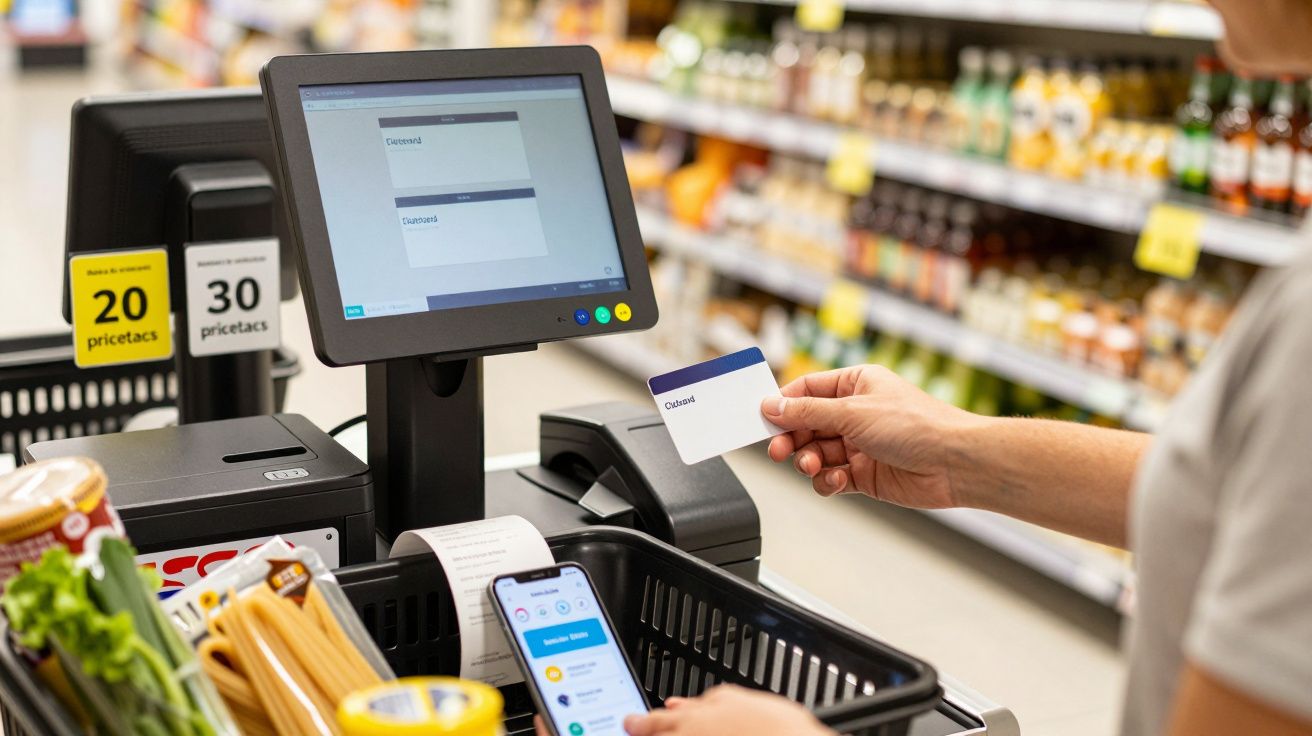
Tesco has been a normal part of UK life for so long that most people only notice it when the receipt looks odd or a favourite product quietly disappears. There isn’t a single secondary player in this story, because the change is less about a head‑to‑head rivalry and more about how Tesco now expects you to shop: with an account, a barcode, and a data trail. It suddenly matters because the gap between “member” and “non‑member” prices has become a real, repeatable cost on the weekly shop.
You can still walk in, grab milk and pasta, and pay at the till like it’s 2015. But the experience around you-offers, signage, checkout prompts, even what counts as “good value”-has shifted in a way that’s easy to miss until it adds up.
The quiet shift: Tesco moved from “offers” to “access”
For years, supermarket promotions worked like weather: they came and went, and everyone in the shop lived under the same sky. Tesco’s big change was making a growing slice of its best prices conditional.
That’s what Clubcard pricing really is: not a perk at the edges, but a gate in the middle. The poster price becomes the “with Clubcard” price, and the “without” price is effectively the surcharge for staying anonymous.
This isn’t a moral judgement on loyalty schemes. It’s just the new logic of the shop floor, and it changes the maths for anyone who:
- doesn’t want another app
- is shopping in a hurry (or for someone else)
- is uncomfortable with data collection
- is trying to budget without surprises at the till
What changed in practical terms
The most useful way to understand the shift is to translate it into behaviours Tesco now nudges, repeatedly, every time you shop.
The shop now has two price tracks
You’ll see it on shelf edges, end caps, and “big yellow” signage: two numbers, one meaning “logged in” and one meaning “not”.
That does two things at once. It makes the deal feel bigger (because it’s framed against the higher price), and it makes opting out feel like losing.
Discounts became a reason to identify yourself
At the till, the question is no longer “Do you have a loyalty card?” as a pleasant afterthought. It’s baked into the total.
Once you accept that, the rest follows naturally: app prompts, digital vouchers, personalised offers, and the quiet feeling that the supermarket is running a membership model without calling it one.
The data loop got tighter
When a retailer ties the best prices to identification, it isn’t only about rewarding loyalty. It’s also about learning what you buy, when you switch brands, what you do when prices rise, and which offers actually change your behaviour.
You don’t need to be paranoid to see why that matters. It affects what ends up in the “value” range, what gets promoted, and how aggressively prices can be tested.
Why it suddenly matters now (even if you’ve ignored it so far)
A lot of people tolerated loyalty pricing as a minor annoyance. The “suddenly” comes from accumulation: more lines now have member‑only deals, and the savings are no longer pennies.
If you’re shopping for a household, the difference can show up as:
- a few pounds here and there that become £15–£25 across a full trolley
- budgeting that feels unreliable because the shelf price isn’t the price you’ll pay
- a steady drift towards buying what’s promoted rather than what you planned
There’s also a social layer. When “best price” is linked to having the right phone, the right app, the battery charge, and the confidence to use it, the scheme stops being neutral.
A quick “before vs now” snapshot
| Then (traditional promos) | Now (Clubcard-first logic) |
|---|---|
| Offers were broadly available | Many headline prices are conditional |
| Loyalty points felt optional | Loyalty ID often changes your total |
| Pricing felt like one system | Pricing feels like two systems at once |
What to do if you want the savings without the stress
The point isn’t to tell you to love or hate the model. It’s to make it workable, especially if you’re trying to keep food costs predictable.
1) Decide your own rule once, not every visit
If you’re comfortable using Clubcard, treat it like a keys‑wallet‑phone habit. Keep a physical card in your wallet, not just the app, so you’re not held hostage by signal or battery.
If you’re not comfortable, accept that you’re choosing simplicity and privacy over the lowest possible price, and plan around it by shopping more from stable‑price ranges (own label, frozen staples, multipacks where you know the unit cost).
2) Watch the unit price, not the yellow sticker
Clubcard deals are loud; unit pricing is quiet and usually more honest. When you compare £/100g or £/litre, you can spot the “deal” that isn’t really a deal.
A useful quick check in the aisle:
- compare the “with Clubcard” unit price to the own‑label unit price
- compare pack sizes (big packs can be worse value if the “deal” is mostly framing)
- be cautious with “was/now” style signage that encourages impulse
3) Make substitutions intentional
The new pricing model can nudge you into switching brands simply because the discount is in front of you. If that’s fine, great-but do it on your terms.
Try a simple boundary: only switch if it improves one of these clearly:
- taste/quality
- nutrition (e.g., lower salt, higher fibre)
- unit price
Otherwise, it’s just promotion steering.
The bigger picture Tesco is betting on
What looks like pricing is also a strategy. Tesco is increasingly building a shopping system where the default customer is an identified customer, and the reward is immediate money off rather than distant points.
For shoppers, that means the weekly shop becomes a little more like an airline fare: the headline price assumes you’ve opted into the right scheme, at the right time, in the right way.
Once you notice that, the change is hard to unsee. And that’s why it suddenly matters: not because Tesco became a different supermarket overnight, but because the “normal” way to pay the lowest price quietly stopped being anonymous.




Comments
No comments yet. Be the first to comment!
Leave a Comment