
Your body already has a built‑in reset button for acute stress: the physiological sigh, and it shows up in the data through changes in heart rate variability (HRV). You use it in everyday moments-before a meeting, after a sharp email, when you can feel yourself speeding up-because it tells your nervous system “we’re safe enough to downshift” without needing to think your way out of the feeling. The relevance is simple: shifting the signal you send (not the story you tell yourself) can change how fast your stress response settles.
Most people try to calm down by adding effort: more planning, more scrolling for reassurance, more internal debate. That often keeps the alarm system switched on, just with better arguments.
A smaller move works better: change the breath pattern so your body receives a clear “stand down” cue.
The simple shift: let the exhale do the talking
When you’re stressed, you tend to breathe higher in the chest, with shorter, choppier exhales. That pattern isn’t just a symptom-it’s a message, and your brain listens to it.
Lengthening and “finishing” the exhale flips that message. It nudges the autonomic system away from mobilisation (fight/flight) and towards settling, which is why people often feel a noticeable drop in urgency within a minute.
Think of it as signalling calm first, then letting your thoughts catch up.
What the physiological sigh actually is (and why it works so fast)
The physiological sigh is a specific two‑part inhale followed by a long exhale. It’s common in sleep, crying, and after a fright-your body uses it to rebalance oxygen and carbon dioxide and to release physical tension.
It also tends to be easier than “deep breathing” because you’re not trying to hold a perfect rhythm. You’re just doing one clean pattern that the body recognises.
The pattern
- Inhale through the nose (normal breath in)
- Top up the inhale with a second, shorter sip of air (same inhale, small extra)
- Exhale slowly and fully through the mouth (longer than the inhale)
Most people notice their shoulders drop on the exhale without forcing it. That’s the point: the shift should feel like release, not performance.
How to use it in real life (without making it weird)
You don’t need a yoga mat, an app, or a silent room. What matters is that you do a few rounds when you first notice the stress spike-early is easier than “already overwhelmed”.
A quick, repeatable protocol
- Do 1 physiological sigh and pause for a moment.
- Do 2 more at a comfortable pace.
- Return to normal breathing and check: has the urgency dropped even 10–20%?
If it has, stop there. If it hasn’t, do another set of three and then move your body-stand up, walk to the sink, step outside for 30 seconds. Breath plus a small change in posture tends to stick.
Good moments to deploy it
- Right before you hit “send” on an emotional message
- When you’re about to walk into a difficult conversation
- After a near‑miss (a close call on the road, a sudden fright)
- When you catch yourself speed‑reading, jaw clenched, shoulders up
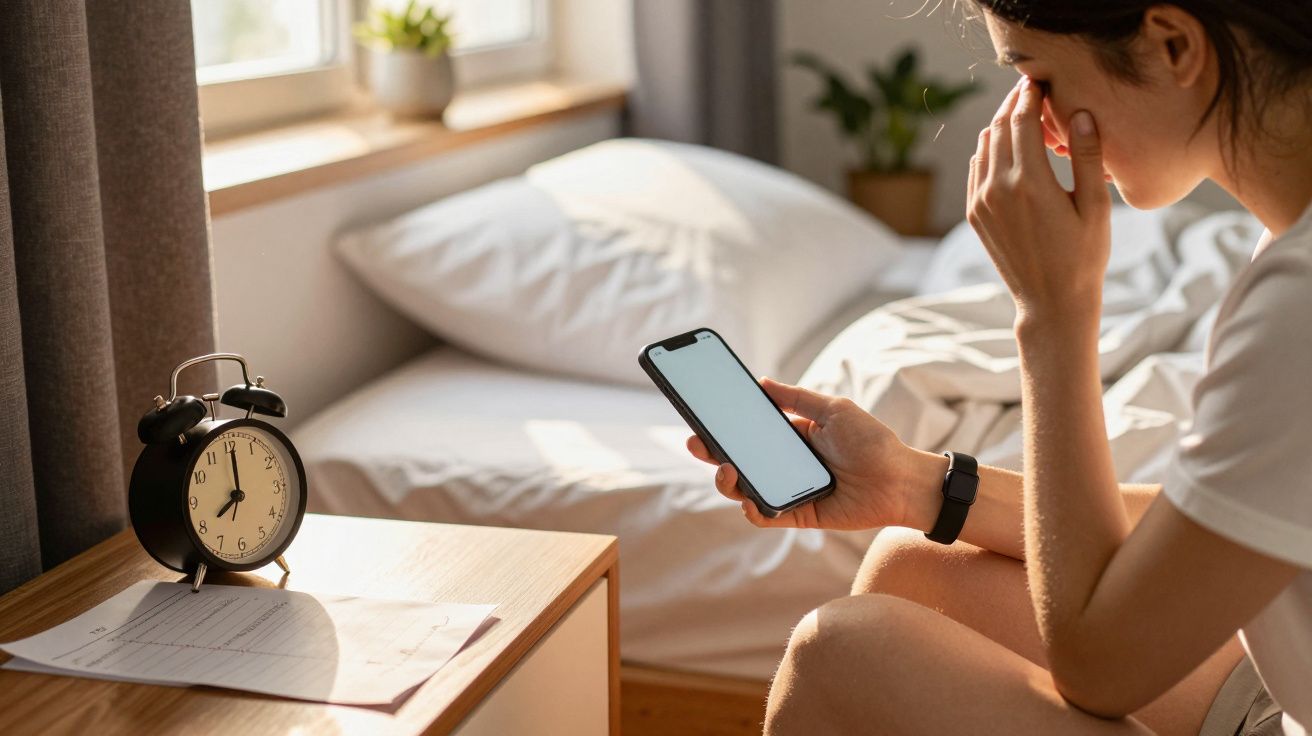
- During a nighttime spiral, before you start negotiating with your thoughts
Why this delivers outsized results (compared with willpower)
Stress is not only a mental event. It’s a body state, and body states have inputs: breath, posture, vision, movement, temperature, and social cues.
The physiological sigh is powerful because it’s a clean input. It reduces the “noise” of rapid breathing and gives your system a pattern it already associates with recovery.
Here’s the practical lens: you’re not trying to convince yourself you’re calm. You’re giving your physiology evidence.
Small upgrades that make it even more effective
Once the sigh is familiar, tiny additions can amplify it without turning it into a whole routine.
- Drop your gaze slightly on the exhale (less scanning = less threat signalling)
- Unclench the tongue from the roof of the mouth (jaw tension often drives the whole loop)
- Exhale as if fogging a mirror (soft, steady airflow tends to slow the breath naturally)
- Pair it with a “finish line” (exhale until you feel the breath end, then rest for a beat)
If you’re doing it right, you’ll feel a subtle shift in speed: thoughts still exist, but they stop sprinting.
Common mistakes that make it less calming
People don’t usually “do it wrong” so much as turn it into another task.
- Forcing huge inhales and getting light‑headed (keep it moderate)
- Rushing the exhale (the exhale is the signal-let it be longer)
- Doing twenty in a row and expecting perfection (use small sets; reassess)
- Only trying it at full panic (practise at low stress so it’s available at high stress)
A simple way to remember it
| Cue | Do this | How many |
|---|---|---|
| Stress spike | Two inhales + long exhale | 3 rounds |
| Tension returning | One round, then normal breathing | 1–3 |
| Before sleep | One round, then breathe quietly | 1–2 |
The goal isn’t to eliminate stress. It’s to shorten the time your body stays in the high‑alert lane after life inevitably hits “send” on something difficult.
Safety notes worth being adult about
If you have respiratory conditions (such as asthma or COPD), a history of fainting with breathwork, or you’re currently having chest pain, keep it gentle and speak to a clinician about what’s appropriate.
And don’t use deliberate breathing techniques while driving if they make you light‑headed. In that moment, a slow, ordinary exhale is enough.
FAQ:
- Is this the same as box breathing? No. Box breathing uses equal counts and holds; the physiological sigh is two inhales followed by one long exhale, aimed at a quick downshift.
- How quickly should I feel it? Many people notice a change within 30–90 seconds, but “working” can simply mean the intensity drops a notch, not that you feel blissful.
- Can I do it in public without looking obvious? Yes. Keep the second “top‑up” inhale subtle and exhale slowly through slightly parted lips; it reads as a normal settling breath.
- Will this fix chronic stress on its own? It’s best for acute spikes. Chronic stress still needs basics-sleep, movement, workload boundaries, social support-but this helps you stop re‑triggering the system all day.

Comments
No comments yet. Be the first to comment!
Leave a Comment