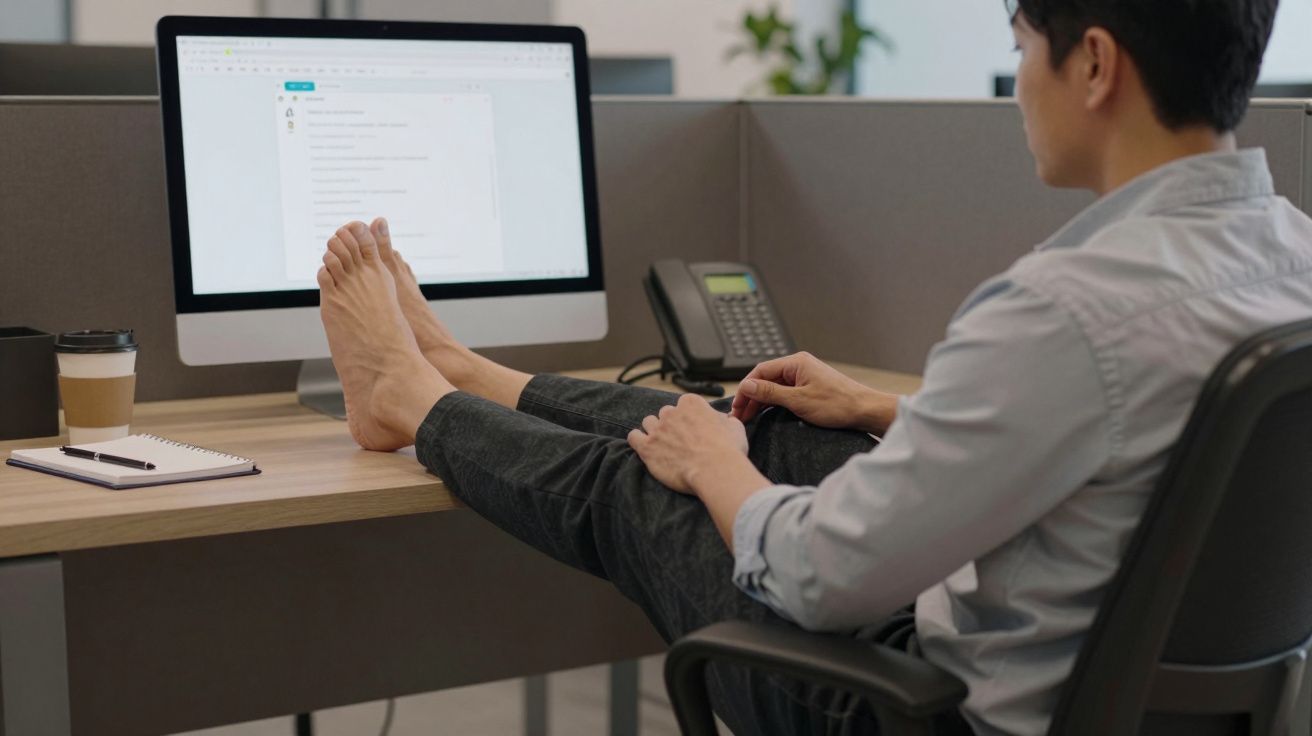
Mid-afternoon, email window open, camera off on yet another call. Under the desk, your socks are carving neat ridges into your skin. By 5 p.m., shoes feel half a size smaller, and the walk to the station has that dull, balloon-like ache in the ankles that you tell yourself is “just sitting too long.”
At her third workstation assessment that day, a physio watched this scene in real time. Same posture, same static legs, same quiet swelling that nobody mentions in the wellbeing brochure. She didn’t start with a lecture about 10,000 steps. She started with one small thing: a barely visible foot movement you can do without anyone noticing, that turns your lower legs back into the pump they’re meant to be.
“Think of your calves as your second heart,” she said, nudging the chair a little higher. “This move switches them back on.” Under the table, the worker lifted heels, then toes, in slow rhythm. Two minutes later, colour had crept back into the skin. Nothing dramatic - but the physiology had changed. Gravity no longer had the whole say.
Why long desk days leave ankles puffy
When you sit or stand still for hours, blood has to fight gravity to get back from your feet to your heart. Veins in your lower legs rely on surrounding muscles - especially the calves - to squeeze and push blood upwards. Every time you flex your ankle, that “calf pump” fires.
Park your feet flat and motionless on the floor, and the pump powers down. Fluid seeps into the soft tissues around the ankle. Shoes feel tighter, socks leave deeper marks, and by the end of a long shift your lower legs can look and feel heavier, even if you never left your chair.
It’s not just a “circulation problem” for older people or those with a diagnosis. Long-haul flights, back-to-back meetings, standing tills, hot days in heavy shoes - they all stack the odds towards swelling (oedema). Over months and years, that strain can contribute to varicose veins, stiffness, and higher risk of clots in vulnerable people. The good news: the fix is movement, not marathon training.
Meet the micro-move: the discreet ankle pump
Office physios tend to come back to one staple because it’s simple, subtle and effective: the under-desk ankle pump. No equipment. No leggings. No special room booking.
Sit tall, feet under your knees. Lift your heels so you’re on the balls of your feet, then slowly lower them and lift your toes so your heels dig gently into the floor. Back and forth, like a soft pedal. The motion runs through your ankles and calves, not just your toes.
To anyone across the desk, you look completely still. Under the surface, your calf muscles are rhythmically squeezing the veins, pushing blood back up the leg. That helps limit fluid pooling, gives your joints some movement, and changes the message your body gets from “stuck” to “moving”.
“If you remember only one under‑desk move, make it this one. Ankles gently flexing, calves pumping - it’s your anti‑swelling switch.”
How to do it: the two‑minute ankle pump
Try this sequence once an hour for two minutes. Set a quiet timer, or pair it with regular tasks like checking email or waiting for a meeting to start.
Set up your seat
- Sit towards the back of the chair with your back supported.
- Adjust height so your hips are slightly higher than your knees.
- Place both feet flat, roughly under your knees, hip‑width apart.
- Sit towards the back of the chair with your back supported.
Start with heel lifts
- Keeping toes on the floor, slowly raise your heels as high as is comfortable.
- Pause for one second at the top, feeling your calf muscles tighten.
- Lower heels smoothly back to the floor.
- Keeping toes on the floor, slowly raise your heels as high as is comfortable.
Swap to toe lifts
- Now keep your heels grounded and lift your toes towards your shins.
- You should feel a stretch along the front of your ankle and shin.
- Lower toes with control; avoid slapping them down.
- Now keep your heels grounded and lift your toes towards your shins.
Create a steady rhythm
- Alternate: 4 heel lifts, 4 toe lifts, repeat.
- Breathe normally; no need to synchronise your breath.
- Aim for 30–40 total repetitions per leg over two minutes.
- Alternate: 4 heel lifts, 4 toe lifts, repeat.
Progress gently
- Once it feels easy, press lightly into the floor as you lift to increase muscle work.
- You can also add a gentle squeeze: imagine hugging your calf muscles towards the bone at the top of each lift.
- Once it feels easy, press lightly into the floor as you lift to increase muscle work.
Most people feel their feet warm slightly and the tightness in the ankle ease after a couple of rounds. That’s the circulation shift you’re after, not a burn or a sweat.
Variations physios use to keep it interesting
Once you’ve got the basic pump, mix in these under‑desk options through the day. They target slightly different structures but share one aim: keep fluid moving.
Ankle circles
Sit tall, lift one foot just off the floor. Gently draw circles with your toes, 10 times clockwise, 10 times anticlockwise. Swap legs. Keep the movement smooth, using the whole ankle, not just wiggling the toes.Toe alphabet
With your heel lightly resting on the floor, “write” the alphabet in the air with your big toe. Small, slow letters are enough. This mobilises the ankle in multiple directions, ideal after long typing sessions.Seated calf squeeze
Cross one ankle over the other. Press the bottom foot into the floor while gently pulling the top foot up, as if they’re arm‑wrestling. Hold for 5 seconds, relax for 5, repeat 5–8 times, then switch sides. This works the calf without moving the feet much - useful during calls where you want to stay really still.
You don’t need all of them every hour. Rotate through during the day so your ankles never spend more than 30–40 minutes completely still.
Common mistakes - and easy fixes
Physios see the same handful of pitfalls in offices and home set‑ups. Most are simple to correct once you notice them.
Only moving the toes
Tiny toe wiggles don’t shift much in the calf. Focus on lifting from the ankle joint so you feel activity in the lower leg.Going too fast
Rapid, bouncy movements use momentum, not muscle. Slow it down; a controlled one‑to‑two second lift and lower is ideal.Chair cutting into the back of the knee
If the seat is too long or too high, it can press on blood vessels and nerves. Adjust depth or add a small cushion so the edge of the chair doesn’t dig into the back of your knees.Legs tucked under the chair
It’s common when concentrating, but it kinks the veins and makes pumping less effective. Bring your feet back under your knees or slightly forward.Doing the move… and then not getting up at all
The ankle pump is a complement, not a replacement, for actual walking. Stand or walk for a couple of minutes at least every hour if you can.
Soyons honnêtes : personne ne fait vraiment ça toutes les heures on the dot. The goal is “more often than never”, not perfection.
Pair the foot move with these tiny habits
The ankle pump works best as part of a small toolkit against swelling and stiffness.
Add micro‑walks
- Take the stairs for one floor.
- Walk to the furthest loo or printer.
- Pace gently during phone calls (camera off is your ally).
- Take the stairs for one floor.
Hydrate smartly
Adequate water helps your circulation and stops your body clinging to fluid unnecessarily. A rough guide is to keep your urine a pale straw colour, unless told otherwise by a clinician.Rethink footwear
Very tight shoes or high heels compress the forefoot and restrict ankle movement. Opt for a roomy toe box and a moderate heel for long desk days.Consider compression
For some people, graduated compression socks reduce ankle swelling and support veins. They’re not for everyone, and fit matters, so ask a pharmacist, GP or physio if they’re right for you.Tweak your workstation
A footrest can help shorter legs reach the floor comfortably. For standing desks, shift weight, step on and off a small block, or alternate one foot on a low stool to keep ankles and calves working.
When swelling is a warning sign, not just an annoyance
Mild puffiness that comes and goes with long days and eases overnight is common. Still, physios are trained to spot red flags where “just a bit of swelling” could be something more serious.
Seek urgent medical advice (NHS 111, GP same day, or A&E if severe) if you notice:
- Sudden swelling in one leg, especially with redness, warmth or pain.
- Unexplained shortness of breath, chest pain, or coughing up blood.
- Swelling that is significantly worse on one side after travel, surgery, or illness.
- New, persistent swelling during pregnancy, particularly with headache, visual changes or upper abdominal pain.
Book a routine check with your GP or practice nurse if:
- Your ankles are swollen most days and it doesn’t fully settle overnight.
- You have a history of heart, kidney or liver problems and notice a change.
- The skin around your ankles looks shiny, discoloured, or feels tight for weeks.
The under‑desk moves are there to support healthy circulation, not to self‑treat serious conditions. When in doubt, get it checked.
| Situation | First move | When to seek help |
|---|---|---|
| Mild, end‑of‑day puffiness both ankles | Ankle pumps + hourly walking | If it stops improving overnight |
| Sudden swelling in one calf | Stop, elevate leg, note symptoms | Same day urgent medical advice |
| Swelling plus breathlessness or chest pain | Stop activity | Call 999 / emergency services immediately |
A small habit that quietly changes your day
The ankle pump will never make a wellness reel. It’s not glamorous. No one will compliment you on your form, because they can’t even see you doing it. Yet over a week, it’s hundreds of small squeezes of your calf pump. Over a year, it’s thousands of micro‑moments where your veins got a little extra help.
You still send the emails, sit through the meetings, commute on the same train. But your shoes feel less like a vice at 6 p.m., your ankles look more like they did that morning, and stairs don’t bite quite as much. That’s the scale of change we’re playing for here: not heroics, just comfort and quiet protection.
Next time you open your laptop, let it be your cue. Feet under knees. Heels up, toes up, slow and steady. Your message can wait one more minute; your ankles have work to do.
FAQ:
- How often should I do under‑desk ankle pumps? Aim for 1–2 minutes every 30–60 minutes of sitting or standing still. If that feels too much, start with three sessions a day and build up.
- Can I do these moves if I already have varicose veins? Gentle ankle and calf movements are usually encouraged, but if you have significant varicose veins, previous clots or are under specialist care, check with your GP or vascular team for personalised advice.
- Do I still need them if I use a standing desk? Yes. Standing completely still also reduces calf pump activity. Alternate between sitting and standing, and use the ankle pump and heel raises in both positions.
- Will ankle pumps stop blood clots on long flights? They can help circulation and are commonly recommended alongside walking the aisle regularly, wearing suitable clothing, staying hydrated and following any medical advice. They reduce risk but do not guarantee prevention.
- What if my ankles hurt when I move them? Ease off the range, keep the movement small and pain‑free, and see if comfort improves over a few days. If pain persists, worsens, or comes with heat, redness or sudden swelling, seek medical assessment rather than pushing through.
Comments
No comments yet. Be the first to comment!
Leave a Comment