You know that satisfying moment when you’ve “sorted” a cupboard with a few clever hacks and everything finally disappears from view. In that moment, gets treated like the hero of the house, and becomes the silent back-up plan you promise you’ll use “later”. The problem is that the most common storage tricks can hide one small warning sign that matters more than labels, baskets, or vacuum seals.
It usually shows up weeks after the tidy-up, when you go to grab a jumper, a pack of rice, or the Christmas decorations and something feels… slightly off. Not a disaster. Just a hint that your neat solution is quietly turning against you.
The storage hacks people love because they “work” instantly
Storage advice online is built for quick wins: decant, stack, compress, and tuck everything into dead space. It looks clean on camera, and it feels like you’ve bought yourself time.
The most repeated hacks tend to be:
- Vacuum bags for clothes and bedding
- Clear plastic boxes for lofts, garages, and under-bed storage
- Decanting pantry staples into jars and dispensers
- “Airtight” tubs for pet food, flour, and snacks
- Cardboard boxes for keepsakes because they’re free and stackable
None of these are inherently bad. The risk is that the hack becomes the goal, and the condition of what you’re storing becomes an afterthought.
The subtle warning sign most people ignore: trapped moisture
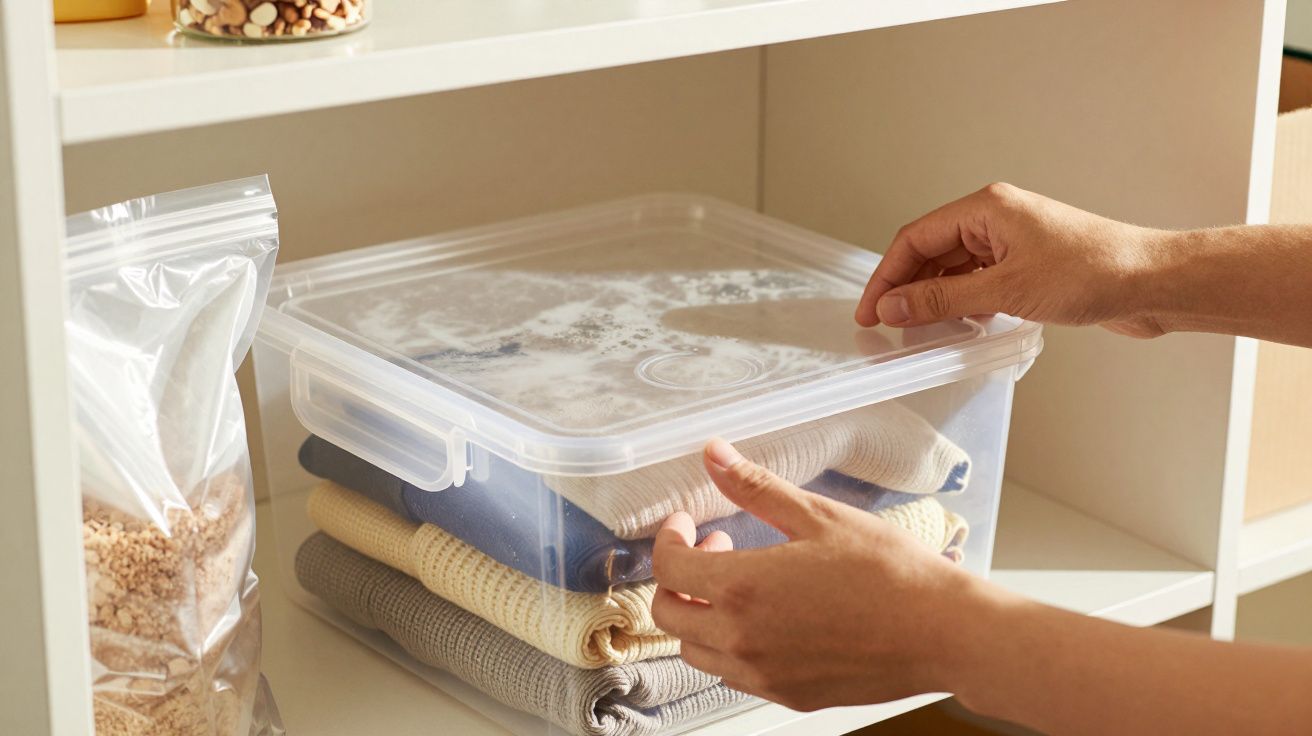
The quiet tell is condensation, or anything that suggests moisture is building up where you can’t see it. Sometimes it’s literal droplets under a lid. More often it’s softer than that: a slightly fogged corner, a label that’s beginning to ripple, a cardboard flap that feels a bit “spongy”, or a smell you can’t quite name.
Moisture is the one thing storage systems accidentally do really well: they trap it.
And trapped moisture doesn’t just mean mould. It also means:
- Fabric fibres breaking down faster (that “stored clothes” smell that never fully washes out)
- Rust on tools, bike parts, and metal decorations
- Clumped flour, stale cereal, and weevils that suddenly appear “from nowhere”
- Warped photos and paper keepsakes that curl at the edges
If your storage looks perfect but anything inside feels damp-adjacent, that’s your cue to pause.
Where it usually shows up first (and why)
Vacuum bags that feel “puffy” again
Vacuum bags aren’t magic; they’re a tight plastic envelope. If you compress clothing that isn’t fully dry (or you store it somewhere with temperature swings), moisture has nowhere to go. The bag can slowly re-inflate, not dramatically, but enough to feel less crisp.
A bag that’s gone slightly puffy is often telling you the seal isn’t perfect or the contents are off-gassing moisture. Either way, it’s not “fine”.
Clear plastic boxes with a faint haze
Lofts and garages run hot, then cold. That creates condensation inside containers, especially if you pack warm items straight after drying, or if the box sits on a cold floor.
Look for:
- A misty film on the inside walls
- Droplets under the lid ridges
- Paper labels that wave instead of lying flat
That haze is your early warning, long before you see mould.
Pantry decanting that creates clumps, not calm
Decanting flour, rice, oats, and pet food looks tidy, but it changes how you notice problems. In the original packaging, you might spot a tear, a best-before date, or tiny specks that shouldn’t be there. In a jar, everything looks “clean” until it doesn’t.
Subtle moisture signs in dry goods include:
- Small clumps that don’t shake loose
- A stale, slightly sweet smell when you open the container
- Powdery residue around the rim (from humidity cycling)
If a “dry” staple starts behaving like it’s been lightly steamed, humidity is already in the system.
Cardboard boxes that suddenly feel too soft
Cardboard is breathable, which can help, but it’s also a sponge. Put it on a concrete floor, near an outside wall, or in a loft with condensation, and it will quietly wick moisture over time.
The first sign is rarely visible mould. It’s a corner that bends too easily, or a box that feels heavier than it should.
Why this matters more than pests, mess, or aesthetics
Most storage failures aren’t caused by laziness. They’re caused by time and sealed environments.
Moisture is also the one issue that spreads. One slightly damp box can raise humidity in a small cupboard. One musty coat can perfume everything around it. One jar with clumped flour can become the place pantry moths decide to settle.
The frustrating part is that the container often looks immaculate. It’s the inside microclimate that’s gone wrong.
A quick “spot it early” checklist
The next time you open a tub, bag, or jar, do this before you rummage:
- Pause and smell first. Any musty, sweet, or “cellar” note is information.
- Run a finger under the lid rim. If it feels damp or tacky, treat it as condensation.
- Check the coldest corner. Moisture shows up on edges and bottoms first.
- Look at paper. Wrinkled labels and curled instructions are early humidity meters.
- Shake dry goods. If they don’t move like they used to, don’t ignore it.
It takes 20 seconds, and it catches the problem while it’s still fixable.
Simple fixes that don’t require buying new containers
You don’t need to throw out your whole system. You just need to stop sealing dampness into it.
- Air things out before re-packing. An hour on a clothes horse beats weeks in a damp bag.
- Let warm items cool completely. Especially bedding straight from the dryer or dishwasher-cleaned kitchen gear.
- Keep containers off cold floors. A low shelf or even a few strips of wood can reduce condensation.
- Add a moisture buffer where appropriate. Silica gel packets for tools and decorations; food-safe options only for food storage.
- Don’t store “maybe still slightly wet” items. That includes swimwear, trainers, tea towels, and mop heads-common culprits.
If you’re using vacuum bags, re-check the seal a day later. A slow leak is still a leak, and it usually means humidity will creep in.
The hacks most likely to trigger moisture problems (and what to watch for)
| Storage hack | Subtle warning sign | Quick adjustment |
|---|---|---|
| Vacuum-bagging clothes | Bag slowly re-inflates, musty smell | Re-dry, re-seal, store somewhere temperature-stable |
| Plastic tubs in loft/garage | Foggy sides, rippled labels | Raise off floor, add desiccant for non-food items |
| Decanting dry goods | Clumping, stale smell | Smaller batches, keep original date info, avoid humid spots |
When the warning sign means “stop” rather than “fix”
If you see any of the following, assume the contents need more than a quick wipe-down:
- Visible mould on fabric, cardboard, or paper
- Food that has clumped, smells off, or shows signs of insects
- Rust that’s flaking (not just a small surface spot)
- Photos or documents that feel tacky or fused at the edges
At that point, your storage isn’t just untidy-it’s damaging what you’re trying to keep safe.
The takeaway that makes storage actually work
Good storage isn’t about squeezing more into less space. It’s about keeping the inside conditions boring: dry, stable, and predictable.
So if you remember one thing, let it be this: a perfectly sealed container with a hint of moisture inside is not organised-it’s incubating.






Comments
No comments yet. Be the first to comment!
Leave a Comment