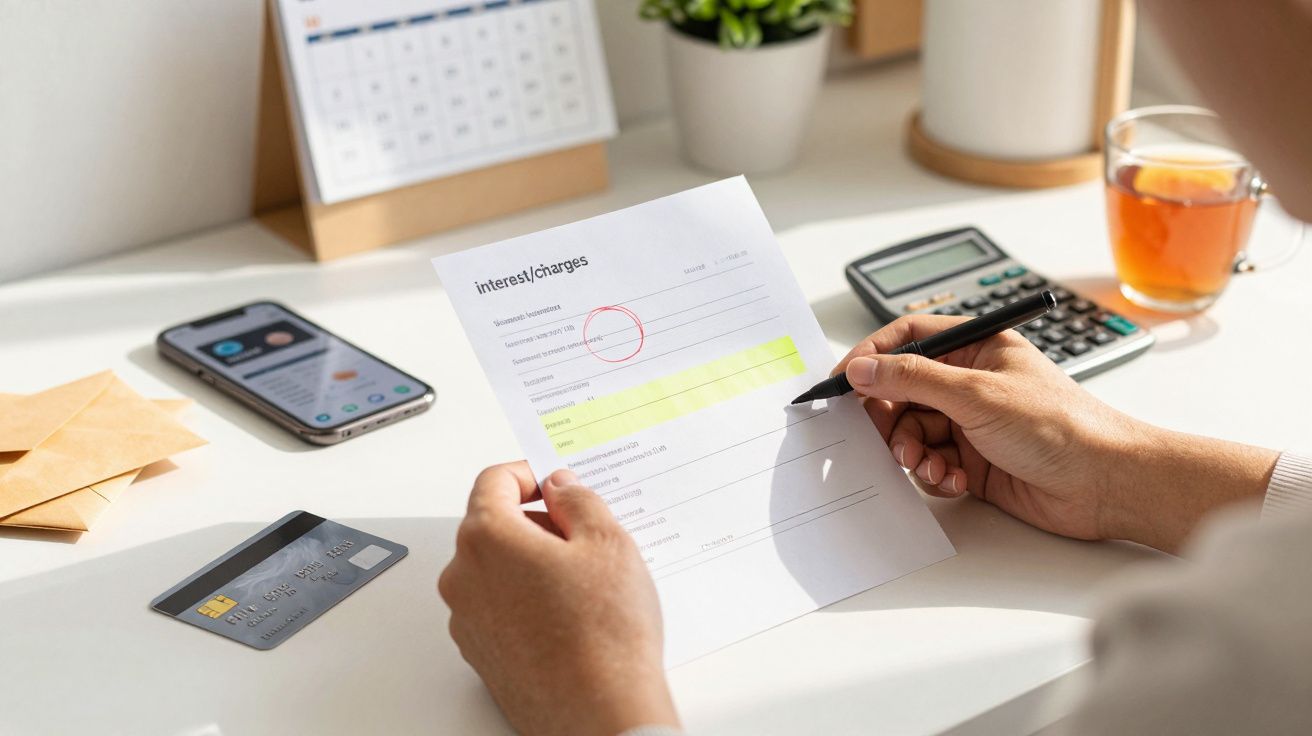
You’re scrolling through your credit card statement on a Monday morning, half-looking for the balance and the due date. The minimum payment sits there like it always does, small enough to feel manageable, and you move on. That’s exactly why the most useful warning is so easy to miss.
It isn’t a dramatic “account in trouble” message or a big red alert. It’s a quiet line that tells you the card has stopped working in your favour, and started working against you.
The line that matters more than your balance
Most people fixate on the total owed, because it feels like the headline number. But the subtle warning sign is usually this: “Interest charged this period” (or any version of it) showing a number when you thought you were paying “normally”.
If that line isn’t £0, the card is no longer behaving like a free short-term loan. You’ve either lost your interest-free grace period, slipped past a promotional rate, or you’re carrying a type of debt that accrues interest immediately.
That’s not a moral failing. It’s just maths, and the statement is trying-quietly-to tell you what’s changed.
Why it’s so easy to ignore
Credit card statements are designed to be skimmed. They give you a minimum payment, a payment due date, and a balance, and they look “fine” as long as you can afford the minimum.
The trap is that the minimum payment is built to keep you paying for a long time. When the statement shows interest, the minimum payment can still look small and harmless, even as more of it goes to interest rather than clearing what you spent.
A common pattern looks like this: you’re still paying each month, you’re not missing payments, but the balance barely moves. That’s the statement telling you the interest engine is on.
The three common reasons interest suddenly appears
1) You didn’t clear the statement balance (even once)
In the UK, you typically avoid purchase interest by paying the statement balance in full by the due date. Miss that just once-by underpaying, paying late, or paying the wrong amount-and interest can start applying to new purchases too.
That’s the part many people don’t realise. They assume interest only applies to the bit they carried over. Some cards remove or reduce the interest-free period while you’re revolving a balance.
2) A 0% deal ended (and the statement moved on quietly)
Promotional rates don’t end with fireworks. Often there’s a small note: the end date passes, the standard APR kicks in, and the first time you properly notice is when “interest charged this period” stops being £0.
If you’re only checking “amount due”, you can miss that change for months.
3) You made a cash-like transaction without noticing
Cash withdrawals are the obvious one, but so are “cash-like” transactions (depending on the card): gambling, some money transfers, certain wallet funding, and sometimes foreign cash withdrawals routed through an ATM fee.
These can accrue interest immediately and may have fees on top. On the statement they often appear as a different category, but you have to look.
A 20-second checklist on every statement
You don’t need to become a personal finance nerd. You just need to scan for the lines that reveal whether the card is costing you.
- Interest charged this period: should be £0 if you’re paying purchases off in full
- Fees: late fee, overlimit fee (rare now), cash fee, money transfer fee
- Promotional rate / expiry notes: anything mentioning an end date
- How your payment was applied: especially if you have purchases plus a transfer or cash balance
If one of those lines looks unfamiliar, it’s worth pausing before you make the next purchase on the card.
The “minimum payment” is not your friend (it’s a safety rail)
The minimum payment exists to keep you from missing a payment and damaging your credit file. It’s useful in a pinch, and it can buy you time.
But if you’re paying only the minimum while interest is being charged, you’re often in the slow lane by design: your payment covers interest first, then a small amount of the balance. It can feel like running up an escalator that’s moving down.
If your minimum payment has started creeping up while your spending hasn’t, that’s another quiet signal the balance is becoming sticky.
What to do when you spot the warning sign
Start with the goal: get back to a world where interest on purchases is £0, or where any interest you do pay is temporary and deliberate.
Step 1: Stop adding new spending to the interest-bearing balance
If you’re carrying a balance and your card charges interest on purchases, every new purchase can start accruing interest as well. Use a debit card for day-to-day spending until you’ve stabilised things.
Step 2: Pay more than the minimum, strategically
If you can, set a fixed payment that’s meaningfully above the minimum (even £25–£50 extra can change the timeline). The key is consistency.
If you have multiple cards, prioritise the one with the highest interest rate first, while keeping minimums on the rest.
Step 3: Check whether a 0% balance transfer could help
A 0% balance transfer can be a clean way to stop the interest meter, but only if you can realistically pay it down within the promotional period and you account for the transfer fee.
If you do this, avoid putting new spending on the old card “because it’s empty now”. That’s how balances boomerang.
Step 4: If you’re struggling, contact the lender early
UK lenders can offer support options, but they work best when you speak up before you miss payments. It’s not about a lecture; it’s about preventing a manageable balance from turning into a long-term problem.
A quick translation guide for the lines you’re actually seeing
| Statement clue | What it usually means | What to do next |
|---|---|---|
| “Interest charged this period” is not £0 | You’ve lost interest-free status or a promo ended | Stop new spending on the card; increase repayments; check promo dates |
| Cash fee / cash interest | Cash or cash-like transaction | Avoid repeats; repay ASAP; check if it triggered purchase interest too |
| Note about “promotional rate ends” | Your 0% window is closing | Set a calendar reminder; plan transfer or payoff before the end date |
Why this tiny detail changes how you use credit
Once you start scanning for the interest line, you see your card differently. A credit limit stops feeling like “extra money” and starts feeling like what it is: a tool with a rental cost.
That one number-£0 or not-tells you whether you’re borrowing for convenience or borrowing at a price. And it’s far easier to fix the moment it appears than six months later when the balance has hardened.
A credit card doesn’t usually shout when it becomes expensive. It whispers on the statement and waits to see if you notice.
FAQ:
- Can interest appear even if I “pay every month”? Yes. Paying every month avoids missed-payment damage, but you typically avoid purchase interest only by paying the statement balance in full by the due date.
- If I’m charged interest, does that mean I’ve done something wrong? Not necessarily. It often just means you carried a balance, a 0% offer ended, or a cash-like transaction triggered immediate interest.
- Is paying the minimum ever OK? It can be a short-term safety option. The problem is relying on it while interest is being charged, because it can keep you in debt far longer.
- Will paying in full immediately fix it? Paying the full balance usually stops ongoing interest, but some cards can still show a small “residual” interest amount on the next statement depending on timing.
- Should I close the card if I’m paying interest? Not automatically. Focus on stopping the interest and clearing the balance first; closing a card can affect available credit and credit history. Consider your wider situation before deciding.






Comments
No comments yet. Be the first to comment!
Leave a Comment