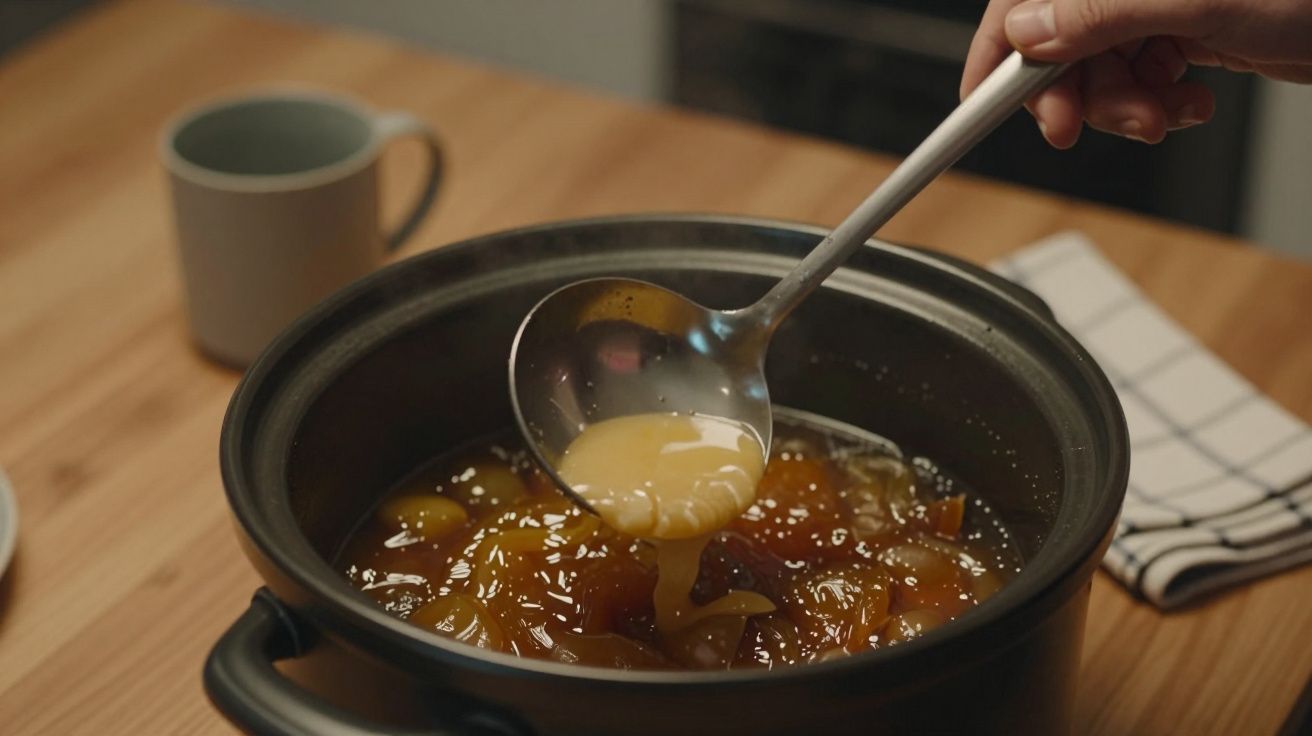
You know the moment. You’ve had a stew on since breakfast. The house smells like comfort. You lift the slow cooker lid, expecting rich, velvety gravy… and instead you’re staring at a thick orange slick floating on top. A few bubbles, a shimmer of fat, and the sinking feeling that dinner just turned into an oil slick with carrots.
You prod it with a spoon, hoping it will somehow sort itself out. It doesn’t. You tell yourself that “fat is flavour”, but in the bowl it tastes less like pub-style indulgence and more like you’ve licked the roasting tray. Everyone politely eats the meat and leaves a shiny moat around the edge. You put the leftovers in the fridge and, the next morning, that truth-telling white cap of solid fat is sitting on top. That’s the bit you all tried to politely ignore.
It doesn’t have to be like that. And no, you don’t need a new slow cooker or a cheffy fat separator jug. You just need to stop making one very normal mistake - and add a tiny 30‑second habit that quietly transforms the pot.
The “dump and go” habit that leaves a greasy film
Most of us were sold the slow cooker as the ultimate low-effort friend. Brown meat if you fancy, or don’t. Sling in whatever’s in the fridge. Come back to magic. The internet is full of “no prep!”, “no browning!”, “tip it in straight from the packet!” recipes that promise miracles.
That “no prep” bit is where the grease creeps in. Chunks of stewing beef with big seams of fat, skin-on chicken thighs, pork shoulder with its thick cap still attached - all brilliant cuts for long, gentle cooking. On the hob or in the oven, a lot of that fat renders, sizzles, and either cooks off or emulsifies into the sauce. In a slow cooker, it mostly has one job: float.
Because everything in that ceramic pot is barely burbling, not bubbling, the fat melts out of the meat and quietly rises to the top like a pond in summer. It doesn’t get blasted with heat. It doesn’t evaporate away. It simply sits there, forming a layer that coats every spoonful on the way to your plate.
It’s not that you chose the wrong meat. It’s that you never intervened.
Why slow cookers make fat more obvious
On the hob, a stew throws off steam. You can boil it hard for five minutes to thicken the sauce and drive off some of the fat. You can tilt the pan and spoon from one side. You can cheat.
A slow cooker is basically a tiny humidity chamber. The lid keeps nearly all the moisture in. Liquid that would have evaporated in a saucepan drips straight back down, diluting the sauce and helping that fat separate cleanly to the surface. You don’t get the violent agitation that breaks fat into tiny droplets and hides it in an emulsion. You get a calm pool with a shiny coat.
The long, low heat is fantastic for collagen and connective tissue - that’s why beef falls apart and cheap cuts taste expensive. But collagen melting into silky gelatin is not the same thing as big blobs of rendered fat drifting across the top. One gives you body and richness; the other gives you a greasy mouthfeel and a film on your lips.
So the slow cooker is doing its job. It’s just amplifying the consequences of that “leave all the fat on and shut the lid” decision you made eight hours ago.
The 30‑second fix that saves the pot
Here’s the tiny, boring step that changes everything:
Before you serve, skim the fat. Properly. For about 30 seconds.
Not a vague half-hearted swirl with the ladle while you’re already dishing up plates. A deliberate, end-of-cook ritual. It goes like this:
Turn the slow cooker off and let it sit for 2–3 minutes.
The fat will rise and gather; the bubbles calm down so you can see what you’re doing.Take a large metal spoon or ladle and gently drag just the surface towards one side of the pot.
Tilt the pot a fraction if you can, so the fat gathers in one corner.Scoop off the puddle of fat that collects.
Tip it into a mug or a heatproof bowl, not the sink.Repeat for 30 seconds. That’s it.
If you really want to make it fool-proof, use a piece of folded kitchen paper after that first skim: lay it gently on the surface, drag it across, and lift. It will wick up a surprising amount of remaining oil without stealing much of the sauce. Fresh square, same move, once or twice.
You’re not chasing perfection. You’re simply removing the obvious slick that overwhelms the sauce and makes every mouthful feel heavy. Those few spoonfuls of fat in the mug are the difference between “warming and rich” and “why does my tongue feel like it’s been buttered?”.
“Isn’t fat where the flavour is?”
Yes - and no. This is where slow-cooker folklore gets muddled. We’ve all heard some version of “never trim stew meat, that’s where the flavour lives”. A bit of marbling and connective tissue, absolutely. A thick strip of pure fat or chicken skin left to slowly leach into a sealed pot for eight hours? Less helpful.
Flavour lives in browned bits, gelatin, stock, alcohol you’ve reduced, vegetables you’ve properly seasoned. The slow cooker tends to skip the browning and the reduction, so we lean on fat as a crutch and then wonder why it tastes blunt rather than deep.
Think of it this way:
- You want some fat in the pot to carry flavour and keep meat moist.
- You don’t want all the rendered fat to still be there at the end.
That 30‑second skim is you editing. You’re not turning your stew into diet food; you’re removing the crude excess and leaving the good stuff behind.
If you’ve got a bit more than 30 seconds
Once you’ve built the skimming habit, a couple of small tweaks make it even easier to avoid greasy results:
Trim the obvious fat before it goes in.
You don’t have to be forensic. Just take a minute with a small knife to remove thick caps and big, flappy bits. Leaving some marbling is fine.Brown the meat hard in a separate pan.
High heat plus a dry-ish surface lets some fat render out before the meat ever touches the slow cooker. You also get those lovely browned flavours that slow pots miss.Watch your oil.
If you’ve already added fatty meat, you probably don’t need three tablespoons of extra oil to fry the onions. A teaspoon, a non-stick pan, and the rendered fat from the first batch of meat can do the job.Use the fridge when you can.
Making tomorrow’s dinner? Chill the cooked stew in its pot. Next day, the fat will be a firm disc on top. Lift it off in one go, then reheat. Zero effort, maximum smugness.
None of these are mandatory. The 30‑second skim is the non-negotiable. The rest just makes that job quicker and the end result cleaner.
A quick cheat-sheet for non-greasy slow-cooker stews
- Pick cuts with some marbling, not huge fat caps.
- Brown meat if you can; if not, at least trim the worst of the fat.
- Be stingy with added oil - the meat will bring its own.
- At the end, turn off, wait 2–3 minutes, skim for 30 seconds.
- When planning ahead, chill and lift the solid fat before reheating.
| Problem in the pot | Fast fix | Why it works |
|---|---|---|
| Orange slick on top | 30‑second skim with spoon | Removes the bulk of free fat |
| Tastes heavy, coats mouth | Blot once with kitchen roll | Wicks surface grease without thinning |
| Leftovers look waxy | Chill, lift solid fat cap | Easiest one-move fat removal |
What this tiny ritual really buys you
Strip away the recipes and you’re left with a simple trade: 30 rushed seconds at the end of a long cook versus the whole mood of the meal. That little pause - lid off, steam up, spoon hovering - is where you decide if tonight’s stew feels cosy or claggy.
You still get the ease of chuck‑it‑in cooking, the tender meat, the “I barely touched it all day” satisfaction. You’re just adding one quiet, grown-up moment of editing, the way you might taste for salt or add a squeeze of lemon. It’s not cheffy. It’s basic maintenance.
And once you’ve seen what comes off in that first skim - the bright, glossy puddle you were about to ladle straight into a bowl - it becomes difficult to skip.
FAQ:
- Do I really need to skim if I’m using lean meat?
If you’ve trimmed well and used a lean cut, there’ll be less to remove - but a quick look and a 10‑second skim is still worth it. Even lean cuts and added oil can leave a sheen on top.- Will this work for curries and chilli in the slow cooker too?
Yes. Anything long-cooked and saucy can throw up a layer of fat. Skimming won’t strip out spice or depth; it just takes away the greasy film that dulls those flavours.- Can I just add less oil at the start instead?
Using less oil definitely helps, but it doesn’t solve fat rendered from meat. Think of oil control as prevention and skimming as cure; they work best together.- Is it safe to leave the slow cooker lid off to reduce the sauce?
For the last 30–60 minutes on high, it’s generally fine to prop the lid slightly ajar to thicken and let some moisture escape, as long as the liquid is still visibly hot and simmering. Skim first, then reduce.- What do I do with the fat I skim off?
Let it cool, then bin it. Don’t pour it down the sink - it can solidify in the pipes and cause blockages. If it’s mostly pure beef or lamb fat, you can also cool and freeze it to use in roast potatoes another day.


Comments
No comments yet. Be the first to comment!
Leave a Comment