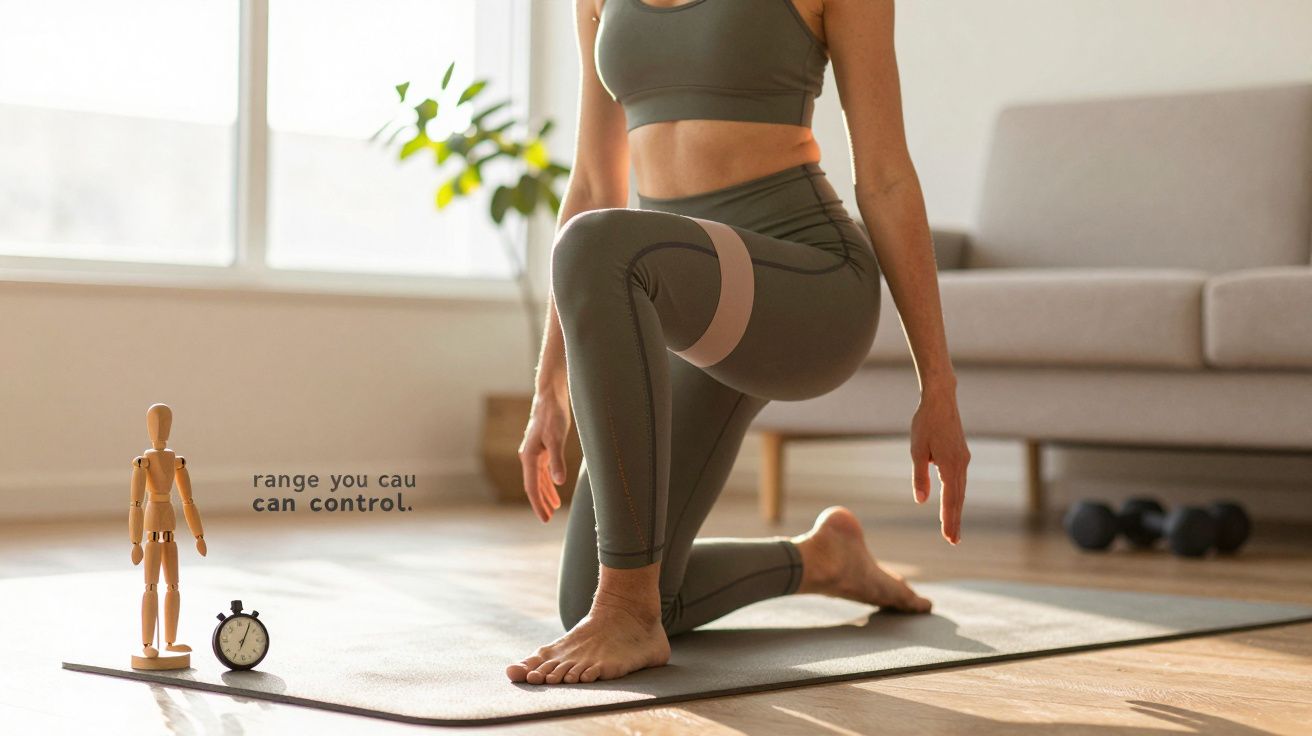
You can do ten minutes of stretching a day and still feel stiff when you stand up, squat, or reach overhead. Controlled Articular Rotations (CARs) were built for that exact gap, and they sit in a different lane to static stretching because they train active control, not just range. If you’ve been treating joint mobility as “pull on it until it loosens”, this is the science-backed reason to rethink it.
Mobility that shows up in real life is the kind your brain trusts. That trust is earned through strength and coordination at the edge of your range, not only by hanging out in a position and hoping it “opens up”.
The problem with the way most of us train “mobility”
The default plan is simple: find a tight spot, stretch it, repeat. It feels productive because the sensation is strong, and you often get an immediate bump in range right after.
But that quick win is often more about your nervous system changing the volume on discomfort than your tissues physically lengthening. In research, short-term flexibility gains are frequently explained by increased stretch tolerance (you can go further because it feels safer), not a sudden remodel of muscle and tendon.
That’s not bad news. It just means the missing ingredient isn’t “more stretch”.
If your body doesn’t feel strong and organised at end range, it may keep that range “unavailable” when you actually need it.
The science-backed shift: range is only useful if you can control it
A practical way to think about mobility is: active range of motion + control. That’s where CARs earn their reputation.
When you move a joint slowly, on purpose, and under tension, you’re giving your nervous system clean information: where the joint is, how stable it feels, and whether you can create force there. Over time, this tends to improve usable range because it reduces the brain’s need to put the brakes on.
Static stretching can still have a place, but on its own it often builds “passive range”: positions you can be pushed into, not positions you can own.
Why “loose” doesn’t always mean “mobile”
Some people are already flexible and still get cranky hips, pinchy shoulders, or a lower back that does too much work. That’s commonly a control problem, not a length problem.
If a joint can’t produce force near its end range, the body borrows motion somewhere else. The borrowed motion might come from the lower back, the knees, or the neck-places that weren’t meant to take that load repeatedly.
CARs in plain English: what they are and why they work
Controlled Articular Rotations are slow circles at a single joint, done with as much tension as you can manage while keeping the rest of the body still. The point is not to “make a big circle”. The point is to make a clean circle you can control.
Think of them like a daily joint check-in:
- What range is there today?
- Where does it feel sticky, weak, or noisy?
- Can you create smooth motion without cheating?
That information matters because it guides what you train next. And the act of doing CARs is training in itself: coordination, end-range strength, and joint capsule health signals.
What CARs are not
They’re not ballistic swings. They’re not a warm-up where you mindlessly flap a limb around.
Done properly, they’re closer to strength work than stretching-just at lighter loads and with more precision.
A simple way to spot if you’ve been “stretching around” the issue
Try this quick test: after your usual stretch, can you actively lift your leg, rotate your hip, or reach overhead into that new range without momentum?
If the answer is “not really”, you likely gained passive range without building control. That’s where CARs (and a small amount of end-range strengthening) tend to change the story.
The three levers that actually move the needle
Most effective mobility programmes, whether they call it CARs or not, usually pull on the same three levers.
| Lever | What it trains | What it looks like |
|---|---|---|
| Passive range | Tolerance and relaxation | Static stretching, long holds |
| Active range | Strength at end range | Slow lifts, holds, controlled reps |
| Motor control | Clean joint motion | CARs, pauses, “no cheating” reps |
The rethink is not “never stretch”. It’s “stop betting everything on passive range”.
A 6-minute daily CARs routine that covers the joints most people complain about
Do this once a day, ideally after a brief warm-up (a brisk walk counts). Keep each rep slow, smooth, and as large as you can control without twisting the rest of your body.
1) Spine (30–45 seconds)
- Slow cat-cow, then add gentle segment-by-segment rolling if you can.
- Aim for control, not depth.
2) Shoulders (60 seconds each side)
- Make a slow arm circle, but keep ribs down and avoid arching your back.
- Imagine your shoulder blade moving, not just your hand.
3) Hips (60–90 seconds each side)
- Hip CARs from standing (holding a wall): lift knee, open out, rotate, extend, then reverse.
- Go slow enough that you can feel where the hip wants to “skip”.
4) Ankles (45–60 seconds each side)
- Draw controlled circles with the ankle while keeping the knee still.
- Don’t let the foot collapse in and out to fake range.
5) End-range “own it” hold (60 seconds total)
Pick one joint that felt limited today and add:
- Two 10–15 second holds at the edge of your active range, with steady breathing.
- Keep the effort at about 6–7/10. No shaking, no grimacing.
This last piece is where your body learns: “this range is safe because I can produce force here”.
Common mistakes that make mobility feel like it “doesn’t work”
A few patterns show up again and again:
- Going fast. Speed hides weak spots. Slow motion exposes them and trains them.
- Chasing sensation. A strong stretch feeling isn’t the goal; controlled movement is.
- Letting other joints compensate. If your hip is stuck, your lower back will happily “help”. Don’t let it.
- Doing mobility only when you’re already tight. Treat it like teeth brushing: small, daily, boring, effective.
When static stretching still makes sense
If you love static stretching, keep it-just put it in the right place.
It tends to work best: - after training, when tissues are warm - for sports or skills that demand passive range (certain yoga shapes, gymnastics positions) - as a downshift tool for stress and sleep
But if your goal is to move better under load-squats, running, lifting, even carrying shopping-pair stretching with active control work like CARs.
A good rule of thumb to know you’re on the right track
Within a couple of weeks, you’re looking for changes like:
- the same joints feeling “quieter” in the morning
- less pinching at the edge of a movement
- smoother transitions (getting up from the floor, stepping into the car)
- slightly more range that you can access without warming up for 20 minutes
Progress in mobility is rarely dramatic day to day. It’s the accumulation of small rehearsals where you prove to your body that the range is not just available-it’s controllable.
FAQ:
- Isn’t mobility just flexibility with a new name? Not quite. Flexibility is often about passive range (how far you can be moved), while mobility is about usable range you can control.
- How often should I do CARs? Most people do well with 5–10 minutes daily, especially for hips, shoulders, and ankles. Consistency beats long sessions.
- Should CARs hurt or click? Mild noise without pain can be normal, but pain is a stop sign. Reduce range, slow down, and consider getting assessed if pain persists.
- Can I do CARs if I lift weights or run? Yes-CARs usually pair well with strength and endurance training because they support joint control and help you find restrictions before they become problems.




Comments
No comments yet. Be the first to comment!
Leave a Comment