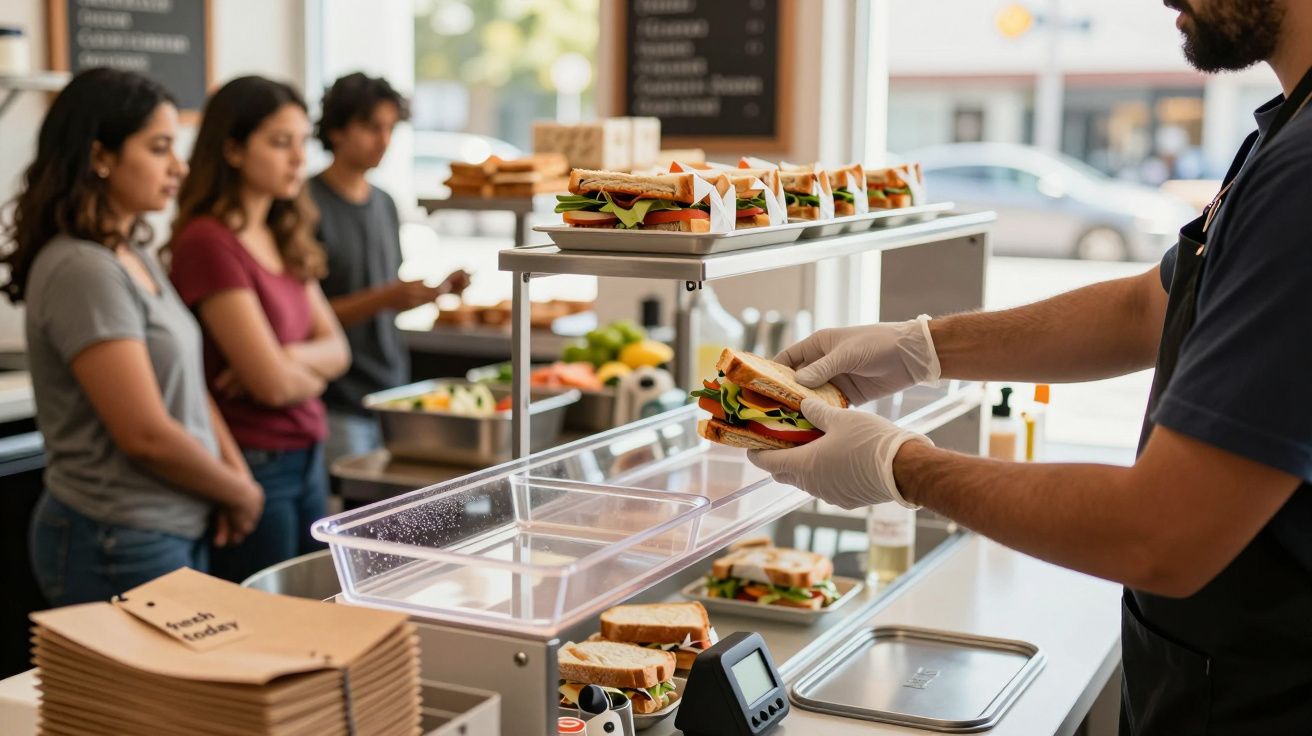
You walk into a Pret A Manger at 12:40, already picturing the same baguette you bought last week, and it’s gone. The mood shift is familiar - and so is the assumption that Pret A Manger is being awkward on purpose, or that this particular shop “just can’t be bothered”. The real reason is less personal and more structural, and it becomes clearer once you notice how Pret is designed to run alongside `` in everyday UK high streets and commuter hubs.
Pret matters because it’s one of the few places people rely on like a utility: quick breakfast, emergency lunch, predictable coffee. When it behaves “differently” - sells out early, changes recipes, varies by branch - it feels like the rules have moved without telling you.
The misconception: people think Pret works like a normal café
Most of us approach a food chain with a simple mental model: there’s a menu, there’s a kitchen, and if you’re willing to pay, the thing can be made. That’s roughly how a restaurant behaves, and even many coffee shops work that way with toasties and pastries.
Pret is closer to a high‑volume food retail operation that happens to have seating. A lot of what looks like inconsistency is actually the visible edge of a system built around speed, limited space, and selling through what’s already been produced.
Pret doesn’t “run out” in the way a café runs out. It sells through in the way a supermarket meal-deal shelf sells through.
That distinction changes everything: what gets made, how many get made, and what staff can realistically do at 1pm when the queue is stacked and the fridge space is already full.
The real reason it behaves differently: the fresh‑first, sell‑through model
Pret’s brand promise has long leaned on freshness. Freshness sounds like a nice-to-have until you realise it forces a completely different daily rhythm than “keep it frozen and heat on demand”.
In a fresh‑first model, you make (or receive) a finite number of items, you hold them for a limited window, and you aim to sell most of them without ending the day with loads of waste. That creates the “why is it never there when I want it?” effect.
Why your favourite sandwich disappears by lunchtime
If a branch makes (or stocks) a smaller run of a popular line, it can be gone before the rush is over. That isn’t always a mistake - sometimes it’s the least-bad outcome in a system where the alternative is overproducing, binning food, and taking a financial hit.
A few things quietly drive that decision:
- Footfall is spiky, especially near stations and office clusters, so “normal” demand is hard to define.
- Fridge and counter space is limited, so you can’t just double everything without crowding out other sellers.
- Waste targets are real, and branches are under pressure not to overproduce.
Once you see it that way, the sell-outs stop looking like random incompetence and start looking like a deliberate trade-off: better to disappoint some people at 1pm than to throw away dozens of unsold items at close.
Why staff won’t “just make one more”
From the customer side, it sounds reasonable: you can see the ingredients, there are staff behind the counter, and you’re standing right there. But many Pret branches don’t operate like a made-to-order sandwich bar during peak times because it breaks the throughput.
During rush periods, the job is often to keep the front moving: restock what’s ready, handle payments, manage coffee volume, and keep the shelves safe and presentable. Making one bespoke item can slow the line, pull someone off another task, and create a ripple effect that looks small to you and huge to the team.
It’s not rudeness; it’s a system protecting speed.
Why the same item can taste slightly different in different shops
People assume one central recipe equals one identical outcome. In reality, fresh assembly plus human hands equals natural variation, and small supply substitutions can show up as “this used to be better”.
Even when recipes are standardised, differences creep in through:
- Ingredient batches (produce and bakery items vary more than people expect).
- Assembly timing (something made earlier in the morning will eat differently at 2pm).
- Local execution (how full a spoon is, how evenly something is spread, how quickly it’s wrapped and chilled).
That’s the hidden cost of food that isn’t just defrosted and reheated to spec.
The branch isn’t a clone: local constraints shape what you see
A Pret in a tight railway unit behaves differently from a Pret with a bigger footprint near a university, even if the branding looks identical. The physical setup dictates what’s possible.
Small branches are often fighting:
- Tiny storage (less backstock, more “when it’s gone, it’s gone”).
- One bottleneck station (coffee, till, or fridge access becomes the choke point).
- Hard closing routines driven by landlord rules, security shutters, and staffing.
That’s why some shops feel like they “give up early” in the afternoon: they’re not making a statement, they’re hitting a limit.
Price and product changes aren’t random - they’re survival maths
When people complain that Pret has become “weirdly expensive” or keeps nudging portions and bundles, they’re often reacting to the same pressure points that shape the shelves: rent, labour, and ingredient volatility. These don’t rise smoothly, and they don’t hit every site equally.
A central truth of UK high-street food is that convenience is what you’re paying for. Pret’s promise is not just “sandwich”; it’s “sandwich that exists here, now, quickly, with a toilet and a seat, near where you already are”.
That leads to behaviour that can feel cynical but is usually practical:
- Pushing higher-margin lines (certain drinks, add-ons, limited specials).
- Reducing slow sellers (less variety late in the day, fewer niche items).
- Testing changes (rolling out tweaks in some locations before others).
From the outside, it looks like inconsistency. From the inside, it’s a chain trying to stay viable in multiple micro-markets at once.
The bit people miss: “different” is also how Pret manages waste and reputation
Pret gets judged on two things at the same time: how fresh the food feels, and how much food it throws away. Those goals are in tension, and most of the odd decisions customers notice sit right on that fault line.
That’s also why end-of-day behaviour can feel abrupt. Late in the afternoon, the system is no longer optimising for abundance; it’s optimising for closing cleanly, safely, and with minimal waste.
If a shelf looks sparse at 4pm, it doesn’t always mean the shop is failing. Sometimes it means it planned not to be left holding perishables.
How to use this reality to your advantage
Once you stop expecting Pret to behave like a made-to-order café, you can time it like a sell-through counter. That small shift makes the experience less frustrating.
- Go earlier for the “iconic” items. The most popular lines can be morning-heavy; treat lunchtime as the risky window.
- Use quieter windows strategically. Mid-morning and mid-afternoon are often better for availability than peak noon.
- Learn your branch’s pattern. Some sites are consistent in what sells out first; two visits can teach you more than the menu board.
- If you’re flexible, scan for what’s abundant. The full stacks are usually there because they’re moving well and were produced in larger runs.
- Ask a specific question. “Is there another batch coming out soon?” gets a better answer than “Why is it always gone?”
The headline lesson is simple: Pret isn’t trying to surprise you. It’s trying to move fresh food through a small space at high speed, without drowning in waste or queues.
FAQ:
- Why does Pret sell out of popular sandwiches so early? Because many shops stock finite runs designed to sell through, and fridge space plus waste limits stop them simply doubling everything.
- Why won’t they make me a sandwich when the shelf is empty? At peak times, Pret is optimised for fast service from ready items; made-to-order slows the line and can clash with how the branch is staffed and set up.
- Why does the same item vary by branch? Fresh assembly, ingredient batch variation, and the realities of timing and handling can all change the final taste and texture.
- Is Pret “worse now”, or just different? Often it’s responding to higher costs and changing footfall patterns; what customers experience as “different” is usually the chain rebalancing availability, speed, and waste.


Comments
No comments yet. Be the first to comment!
Leave a Comment