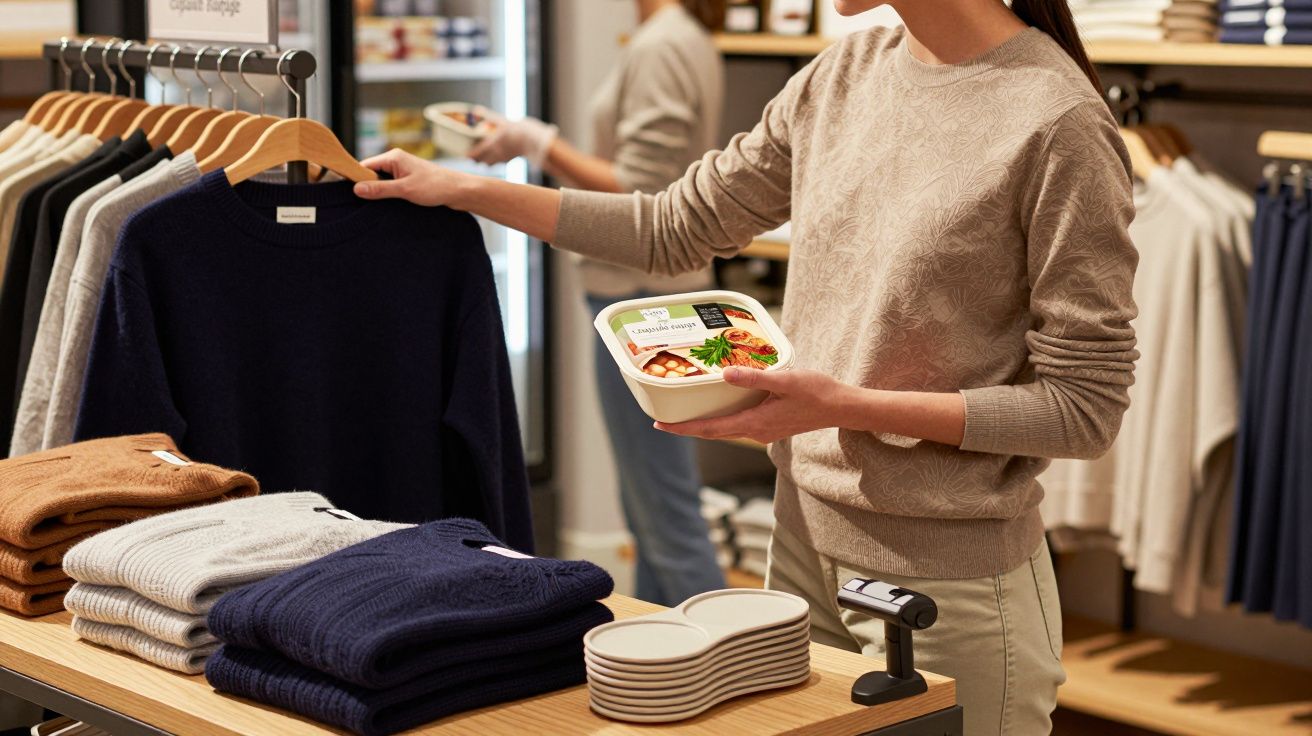
You notice it at the till, not in the adverts. A pack of sandwiches priced like a treat, a sensible jumper that sells out in a weekend, then a seemingly random range that disappears without warning. Marks & Spencer sits in the middle of everyday British shopping, and it behaves in ways people don’t expect because no secondary entity is steering it behind the scenes-its quirks mostly come from how it’s built.
That matters if you shop there, invest in it, or even just wonder why your local branch feels sharper than the one across town. The “real reason” is less about mood swings and more about a business model that’s unusually self-contained, unusually brand-led, and split across two very different retail worlds.
The assumption people make, and why it keeps failing
A lot of us file M&S into one tidy box: either “posh supermarket” or “your mum’s clothing shop”. Once you do that, decisions start to look inconsistent-why push premium food while tightening clothing ranges, or why hold the line on certain prices but discount aggressively elsewhere?
The problem is that M&S isn’t set up like most supermarkets, and it isn’t run like most fashion chains either. It’s a hybrid, and hybrids don’t behave neatly.
The confusion comes from expecting one set of retail rules, when M&S is running two-often at the same time.
The real reason: M&S is a brand manufacturer hiding in a retailer’s coat
The biggest difference is simple: Marks & Spencer mostly sells itself.
That sounds obvious until you compare it with stores that mainly resell other brands. M&S is heavily own-label in food and overwhelmingly own-label in clothing and home. That makes it closer to a manufacturer with shops than a shop with suppliers.
That one fact changes everything:
- It carries the full responsibility for quality and trust. When something disappoints, there’s no “it was the supplier’s brand” buffer.
- It can’t copy-paste ranges across competitors. Every product choice is a design, sourcing, and forecasting decision.
- It runs on repeat purchase and reputation. That rewards consistency in staples, even when trends scream for constant novelty.
Why Food feels confident while Clothing sometimes feels cautious
To shoppers, the Foodhall can feel like it’s always “on”. Clothing can feel like it’s either brilliant or oddly restrained, with gaps in sizing or colours that vanish quickly.
That’s because the clocks are different.
Food runs on rhythm and replenishment
Food has predictable weekly demand and short product lifecycles. If a line works, it can be repeated, tweaked, and rolled out fast. The feedback loop is immediate: sell-through is visible in days, not months.
Food also benefits from “trust momentum”. If you’ve had five good ready meals in a row, you’ll risk the sixth without needing a discount to convince you.
Clothing runs on bets made months ago
Clothing is ordered far in advance, exposed to weather swings, trend shifts, and returns. The safest way to protect margins is to be selective: fewer lines, clearer winners, less “just in case” stock.
That can look like M&S “doesn’t try”, but it’s often the opposite. It’s trying to avoid the classic fashion trap: drowning in unsold product and then training customers to wait for markdowns.
The hidden lever: range discipline is the strategy, not the symptom
One of the most misunderstood behaviours is range curation. People see a popular item vanish and assume incompetence, or they see fewer options and assume decline.
More often, it’s a deliberate trade-off: less breadth, better hit-rate.
You’ll notice it in small ways:
- Seasonal collections drop, then move on quickly instead of lingering half-price for weeks.
- Bestsellers get repeated in new colours rather than replaced by totally new shapes.
- Some “boring” staples stay almost unchanged because they anchor trust (and reduce returns).
That discipline is also why M&S can look conservative even when it’s performing well. A business trying to rebuild margins doesn’t chase every micro-trend; it doubles down on what it can deliver reliably.
Why the prices and promos feel “odd” compared with other shops
Marks & Spencer isn’t trying to win the same price war as the big grocers, and it isn’t trying to play ultra-fast fashion’s volume game either. It tends to use value in a different way: fewer headline-grabbing reductions, more emphasis on “worth it” cues-ingredients, packaging, fit, fabric, finish.
When it does discount hard, it’s usually doing one of three things:
- Clearing seasonal clothing risk (because carrying it into next season is expensive).
- Driving trial on a newer category or format.
- Protecting perception by avoiding constant low pricing that would undermine its quality story.
A quick way to think about it is this: M&S would often rather sell fewer units at a healthier margin than more units at a thinner one, because the brand promise is part of what you’re paying for.
The store experience isn’t inconsistent-it’s locally optimised
Another common assumption is that M&S “can’t decide what it is” because one branch is mostly food, another is a full-line department store, and a third feels like a travel convenience shop with Percy Pigs.
That variation is structural. M&S runs multiple formats because different sites do different jobs:
- Foodhalls that behave like premium convenience for top-up shops.
- Full-line stores that need clothing and home to justify the space.
- Smaller clothing edits in areas where food is the main footfall driver.
So when your local seems to “change personality”, it may simply be adjusting to what that postcode actually buys.
What this means for you when you’re shopping there
If you stop expecting one universal M&S, the patterns get easier to read.
- If you love something in clothing, buy it when you see it. Range discipline means winners return, but not always in the same colour or fabric.
- In food, look for seasonal hero lines and limited editions. M&S uses them to keep excitement without diluting the core range.
- If a category feels suddenly stronger (say, denim or kidswear), it often signals a strategic focus, not a temporary fad.
The real reason Marks & Spencer behaves differently than people assume is that it’s not primarily reacting to rivals week by week. It’s protecting a brand-led system-design, sourcing, trust, and margin-that only works when it stays selective, even if that selectiveness sometimes looks like unpredictability from the outside.






Comments
No comments yet. Be the first to comment!
Leave a Comment