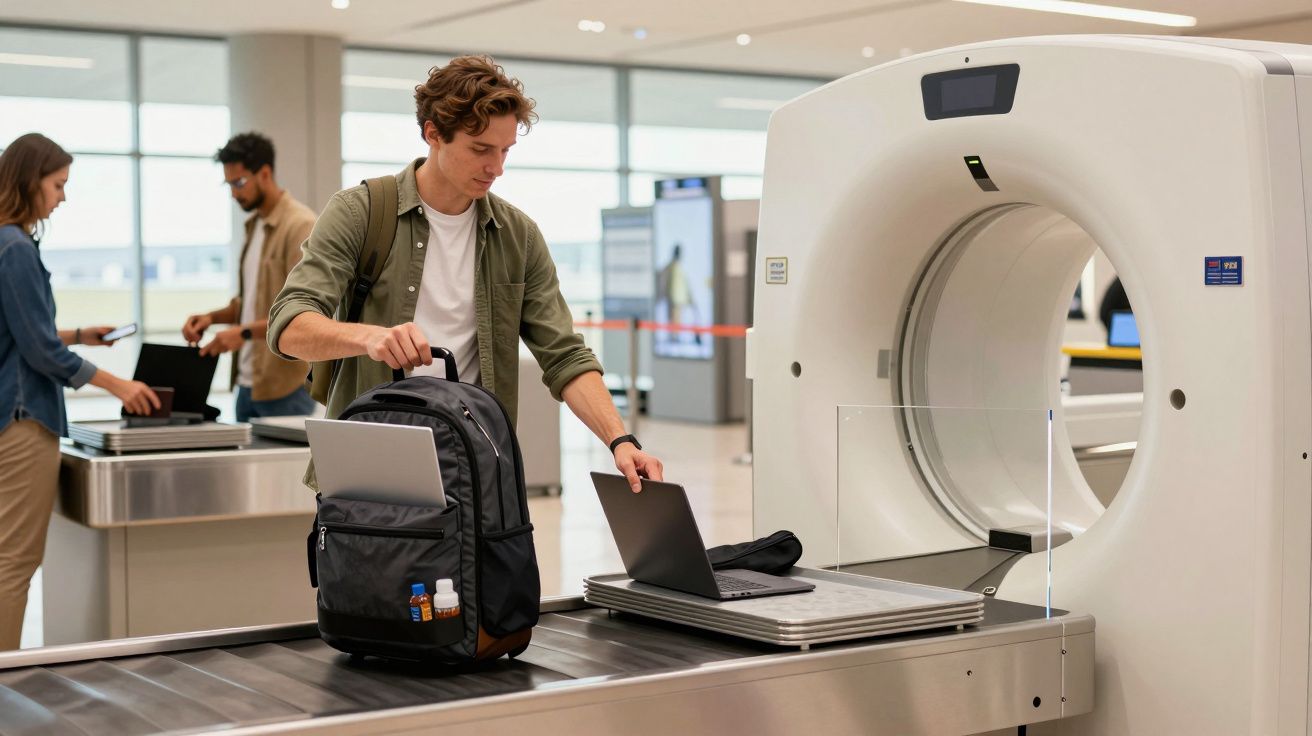
The shift you’re feeling in the security queue is being driven by Computed tomography (CT) cabin baggage scanners, with the UK Department for Transport (DfT) setting (and revising) the timeline for how and when airports can use them. These machines are changing what staff can see inside your bag, which is why some lanes now wave you through while others still demand the full “laptops out, liquids bag up” routine. For travellers, it matters because the rules are becoming less uniform just as the experience becomes more automated.
You notice it in small ways first. Fewer shouted instructions, fewer people repacking on the floor, and a growing number of lanes where the trays move like a conveyor belt in a factory rather than a bottleneck in a hall.
The quiet upgrade sitting at the front of the queue
CT scanners aren’t new in the world (hospitals have used CT imaging for decades), but their arrival in passenger security is the real story. Instead of a single flat X-ray image, CT produces a 3D view of what’s inside your cabin bag, letting officers rotate and inspect items in more detail.
That’s why, in airports that have fully switched over, you’re often told to keep electronics and liquids in your bag. The scanner does more of the “separating” work that used to be done by you, on a tray, under pressure.
The point isn’t just speed. It’s clarity: fewer ambiguous shapes, fewer manual bag checks, fewer queues that stall for one suspicious rectangle.
What passengers think is changing (and what actually is)
The public-facing headline has been simple: no need to remove laptops, and liquids rules might relax. The lived reality is messier, because airports upgrade lane by lane, and national rules don’t always change at the same pace as the hardware.
Here’s the practical version many frequent flyers have learned the hard way:
- Some lanes are “new scanner” lanes, some aren’t. You can be in the same terminal and get different instructions depending on where you’re directed.
- Staff instructions override your habits. Even in an airport you “know”, a lane might revert to old rules due to maintenance, staffing, or calibration checks.
- Liquids policy is still in a transition period. The presence of CT scanners doesn’t automatically mean unlimited liquids; airports must be operating under the relevant approval and settings.
That mismatch is why airport security feels like it’s being reshaped quietly rather than relaunched with a clean, universal reset.
Why airports are investing anyway
The obvious benefit is throughput: fewer people unloading, fewer trays per passenger, and fewer stops when someone forgets a tablet buried under a jumper. But airports have other motivations too.
CT scanners can reduce the number of manual searches because officers can interrogate the bag image more precisely. And every avoided manual search is a small win: fewer delays, fewer disputes, and less handling of personal items.
For airports under pressure from rising passenger numbers and tight terminal space, speeding up security is often cheaper than rebuilding the building.
The knock-on effect: security becomes more “hands-off”
As the tech improves, the passenger role shrinks. The trend isn’t just “faster lanes”; it’s a different relationship with the checkpoint, where the system does more interpretation and the traveller does less sorting.
That also changes behaviour. When people don’t need to take items out, they pack differently: more stays in the bag, more is carried on, and less is consolidated into one clear liquids pouch “just in case”. The queue looks calmer, but the bags can become more chaotic.
The new friction point: inconsistency
In practice, the most stressful security experiences right now often happen when travellers move between airports (or between terminals) that are at different stages of rollout.
You can see it play out in the tray-return area:
- Someone confidently leaves their laptop inside because that worked last week.
- A member of staff flags it, the bag gets pulled, and the whole line slows.
- The person isn’t being careless - they’re applying yesterday’s rule to today’s lane.
That confusion is exactly what makes this trend feel “quiet”. The technology is a step-change, but the passenger messaging is still catching up.
What to do if you want the smoothest possible pass
Treat security like a lane-specific system, not a country-wide rulebook you memorised once. Your goal is to be easy to scan and easy to check if you’re pulled aside.
A simple routine that works across both old and new setups:
- Pack liquids so you can access them fast, even if you might not need to remove them. Keep them together in an outer pocket or a small pouch near the top.
- Keep big electronics near the top of your bag, not under layers. If you’re asked to remove them, you can do it in seconds.
- Avoid “mystery bundles”: tangled chargers, wrapped gifts, dense toiletry bags. These are the shapes that trigger secondary checks.
- Expect different rules on the return journey, especially if you’re flying from a smaller airport or a non-UK departure point.
If you’re travelling with family, add one more rule: give one adult the “bag-unpacking” job and the other adult the “children-through-the-gate” job. The new lanes move faster, which means you have less time to improvise.
A quick cheat sheet: old habits vs new lanes
| Situation | What’s happening | What to do |
|---|---|---|
| You’re told “leave everything in” | CT lane is active | Keep items in bag, but follow tray guidance |
| You’re told “laptops and liquids out” | Traditional X-ray or fallback mode | Remove promptly; keep liquids accessible |
| The lane seems new but staff are strict | Mixed rollout / temporary change | Do exactly what’s said, even if it contradicts last time |
The best travellers right now aren’t the ones who “know the rules”. They’re the ones who can switch modes quickly without repacking their entire bag.
The part nobody mentions: fewer arguments, more quiet compliance
A subtle benefit of the new scanners is social, not technical. When queues move and fewer bags get stopped, the temperature drops. Less panic at the benches means fewer sharp exchanges with staff and fewer passengers feeling singled out.
At the same time, the system becomes less transparent. In the old days, you could see the logic: liquids in a bag, laptop on a tray, coat off, done. With CT and more automated decision-making, you’re more likely to be told “bag check” without understanding why.
That’s not necessarily bad - it’s just different. Airport security becomes more like a background process you pass through, until it isn’t.
What this trend is likely to change next
If CT scanners keep spreading, expect security to become more like a flow system than a ritual. The familiar choreography (decanting pockets, lining up electronics, rebuilding your bag at speed) becomes less central.
But until rollout is complete and rules settle, the dominant traveller experience will be hybrid: moments of impressive speed, followed by pockets of old-school friction.
The smartest assumption for now is simple: the future is arriving lane by lane, and your job is to stay flexible.
FAQ:
- Will CT scanners mean I can carry any size liquids through security? Not automatically. Even with CT equipment installed, the airport may still enforce liquid limits depending on the lane, current operating mode, and national policy.
- Do I still need a clear liquids bag? Sometimes, yes. Pack so you can produce one quickly if asked, even if you aren’t asked every time.
- Why did one airport let me keep my laptop in my bag but another didn’t? Airports are upgrading at different speeds, and even within the same airport some lanes may be operating with different equipment or temporary settings.
- What items most often trigger a bag search on newer scanners? Dense, cluttered pockets of electronics and cables, packed food blocks, and tightly bundled toiletries are common culprits because they create complex shapes to resolve.
- What’s the simplest way to prepare for mixed rules? Keep liquids and large electronics accessible near the top of your bag so you can switch between “leave in” and “take out” without slowing down.


Comments
No comments yet. Be the first to comment!
Leave a Comment