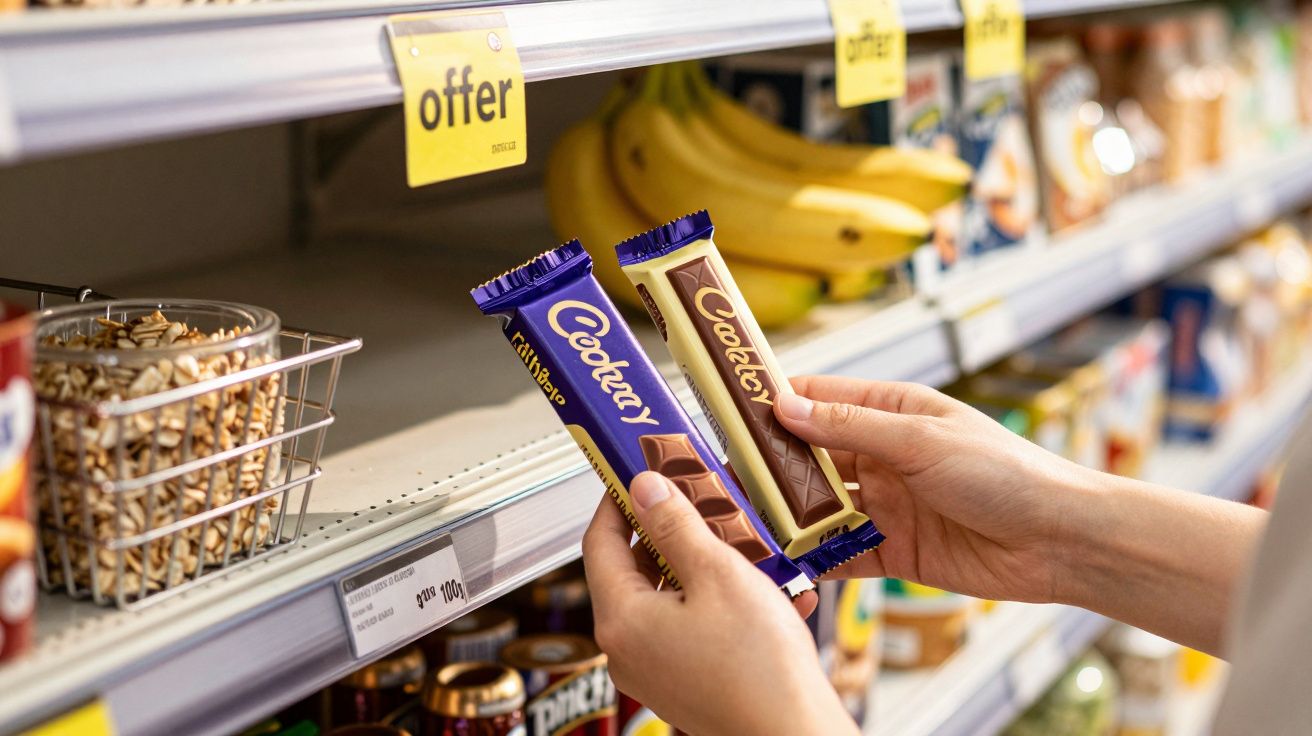
You know the feeling: you pick up a block of Cadbury for baking, a lunchbox treat, or a last‑minute gift, only to spot the exact same thing on a half‑price deal the next day. Cadbury is one of those supermarket staples that feels “safe” to buy whenever you see it, and - with no secondary entity involved - that’s exactly why it quietly drains a few pounds at a time. The fix isn’t a coupon trick or a loyalty hack; it’s a simple rule people forget to apply.
It saves money, yes, but it also saves the particular frustration of paying full price for something that’s almost always on promotion somewhere.
The overlooked rule: don’t buy Cadbury at full price unless you genuinely need it today
Cadbury is a promotion magnet. Supermarkets rotate discounts between bars, sharing blocks, chocolate bags and seasonal boxes so frequently that “full price” is often the least sensible baseline.
The rule is straightforward: if it’s not urgent, walk away and buy it on the next deal - but only once you’ve checked the unit price. That second part matters, because the offer that looks loudest isn’t always the cheapest per gram.
Treat Cadbury like soft drinks: expect a deal cycle, and only break the rule when you’re buying for right now.
This is how people end up spending more without realising. They buy the “convenient” bar at a corner shop, the eye‑level multipack that seems like a bargain, or the seasonal box because it’s “on offer” - then later see a better price in a bigger supermarket, or on a different format, a week later.
Why the unit price label does more work than the big yellow sticker
Cadbury comes in formats designed to confuse quick maths: blocks, “sharing” bars, small singles, multipacks, bags of buttons, bars with limited editions, and price‑marked packs.
If you only look at the headline price, you’ll miss the real comparison: £/100g (or £/kg) on the shelf edge label. That number is the closest thing to a universal translator when packaging sizes keep changing.
A deal can still be a poor buy if:
- the pack is smaller than the one you usually buy
- the “£1” single bar is great value only compared with a much pricier convenience-store option
- the multipack has fewer bars than it used to, or the bars are smaller
- the promotion applies to a premium filled bar, not the plain chocolate you actually want for cooking
The unit price cuts through all of it. It also stops you doing the most common thing: buying a multipack because it feels economical, even when a larger block on offer works out cheaper.
A quick way to use the rule in real life (without turning it into a project)
The aim isn’t to become a spreadsheet person. It’s to avoid the two classic traps: panic buying and “deal” buying.
1) Decide whether this is a “today” purchase or a “stock” purchase
If you need Cadbury for something happening today - brownies for a school sale, a film night, a gift you forgot - buy what’s there and move on. Paying a bit more is the convenience fee.
If you don’t need it today, that’s where the rule pays off. Put it back and wait for a better moment.
2) Compare formats, not just brands
When Cadbury is promoted, it’s often promoted in one format at a time. The winning buy changes depending on the week.
Here’s the kind of comparison that usually matters more than the retailer:
- Baking: larger plain blocks (less packaging, usually better £/100g on deal)
- Lunchboxes: multipacks can win, but only if the unit price beats blocks and you’ll actually use them
- Sharing: bags and “sharing” bars fluctuate wildly; check the unit price every time
- Gifting: seasonal boxes are rarely the best value early on, and are often discounted sharply later
3) Don’t let “price-marked” packs make the decision for you
Price-marked packs are useful when you’re in a hurry, but they can nudge you into buying a size you wouldn’t normally choose. A big “£1” on the wrapper feels like a guarantee of value, even when the unit price says otherwise.
The overlooked habit is simple: treat the printed price as marketing, and still check the shelf label.
The rotation trick: why Cadbury deals feel random (but aren’t)
Cadbury promotions tend to rotate by retailer and by product type. One week it’s blocks, the next it’s bags, then it’s multipacks - and it often flips just as you’ve run out.
So the “money and frustration” rule has a second layer: buy enough on a good deal to last until the next deal, rather than buying little bits at full price in between.
A practical approach that stays sensible:
- Keep one “back-up” bar or block at home for emergencies.
- When you see a genuinely good unit price, buy 2–4 (not 20).
- Store it properly: cool cupboard, away from light and strong smells.
- If you’ve got a warm kitchen, freezing is fine for most plain chocolate; wrap well and let it come to room temperature before unwrapping to reduce condensation.
A simple checklist that stops most overpaying
When you’re standing in front of the chocolate aisle, run this quick scan:
- Is it urgent? If not, consider waiting a week.
- What’s the unit price? Compare £/100g across the formats beside it.
- Am I buying packaging? Gift boxes and novelty formats usually cost more per gram.
- Will I actually use this format? Multipacks only “save” money if they prevent impulse buys later.
- Is it seasonal? The closer you are to the holiday, the less flexible the pricing tends to be.
The most common Cadbury buys - and what to check
| What you’re buying | What people miss | What to do instead |
|---|---|---|
| Multipacks | Smaller bars, worse £/100g | Compare unit price to blocks on offer |
| “Sharing” bags | Big discount label, small pack | Check grams, then £/100g |
| Seasonal boxes | Paying early “gift pricing” | Buy closer to markdowns (if you can wait) |
| Convenience singles | You’re paying for location | Stock a back-up bar at home |
When it’s fine to break the rule
Rules are only useful if they don’t make life harder. Pay full price when:
- it’s genuinely for today (baking, guests, a gift)
- you’re buying a specific limited edition you’ll regret missing
- you’re travelling and convenience matters more than the saving
- you’ve checked the unit price and it’s competitive anyway
The point isn’t never paying full price. It’s stopping the default behaviour where Cadbury goes in the basket on autopilot, then annoys you later when the inevitable promotion appears.
FAQ:
- Is Cadbury really on offer often enough to wait? In many UK supermarkets, yes - but it rotates by product type. If you’re flexible on format (block vs bag vs multipack), you’ll usually find a deal without waiting long.
- What’s the one number I should look at on the shelf? The unit price (typically £/100g). It’s the quickest way to compare different pack sizes fairly.
- Are multipacks always better value? Not always. They can be convenient, but they’re sometimes pricier per gram than a larger bar on promotion.
- Can I freeze Cadbury to stock up on a deal? Generally yes for plain chocolate. Wrap it well, and let it come fully to room temperature before unwrapping so moisture doesn’t affect the surface.




Comments
No comments yet. Be the first to comment!
Leave a Comment