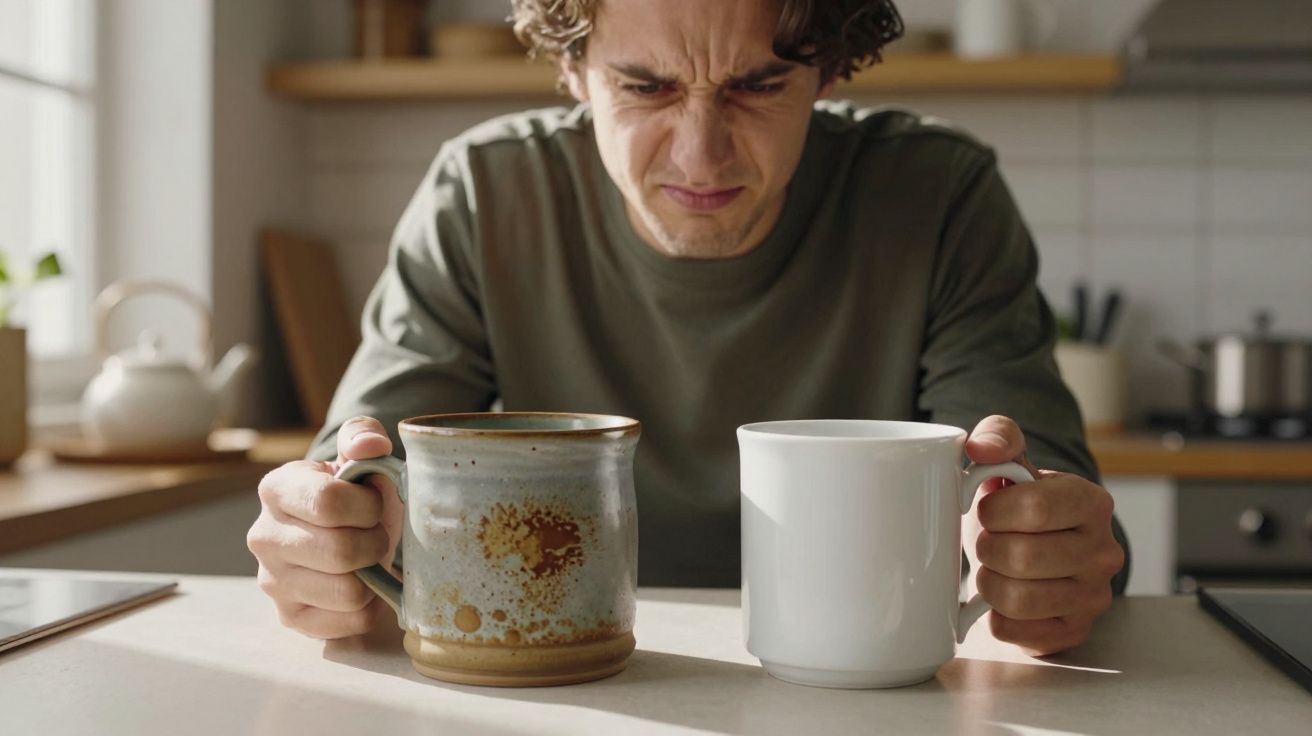
The tea had gone that particular builder’s‑brew brown you can almost stand a spoon in. You lifted your favourite mug from the rack – the big, comforting one with the matte, slightly chalky inside – and noticed, for the first time in weeks, that the ring around the bottom never really comes off now. You scrub, it lightens, but it never goes.
Later, in the dentist’s chair, you mentioned you don’t smoke, you don’t drink much red wine, you brush twice a day – so why the sudden yellow tinge at the edges? Your dentist smiled and asked a question nobody expects: “What sort of mug do you drink your tea from?”
It sounds absurd until you line your cups up on the counter. The glass one looks almost new. The shiny white china has a faint tint that wipes away with washing‑up liquid. And then there’s that mug – the one you actually use – already brown at the base again, no matter how you scrub. Dentists say it’s also the one quietly doing the most cosmetic damage to your teeth over time.
The mug dentists quietly blame
Dentists don’t care about patterns or slogans. They look at surface and contact time. The one mug in your cupboard they worry about most is usually the big, matte, rough‑glazed stoneware mug with a dark interior – the one that hangs onto tea stains like a sponge.
That slightly textured, “artisan” finish often means the glaze is more micro‑porous. Under a microscope, it isn’t glass‑smooth; it’s full of tiny pits and ridges. Those grab onto tannins and colour from tea and coffee, which is exactly why the stains on that mug need elbow‑grease rather than a quick rinse. A shiny, fully glazed porcelain mug, by contrast, is closer to glass – stains sit on top rather than sinking in and tend to wipe away more easily.
Dentists use that mug as a clue. If your cup is clinging to brown even after a wash, the drink you’re swirling around your mouth is rich in the same pigments that cling to the microscopic roughness in tooth enamel and to plaque. Enamel isn’t perfectly smooth either, and once those chromogens (staining molecules) have something to grab, they settle in.
There’s another quiet problem with that favourite stoneware beast: it’s big. A larger, cosy mug stretches one cuppa into an hour‑long sip‑session. That means more frequent tiny baths of stain‑rich liquid over your teeth, rather than a quick drink and you’re done.
How the mug changes what – and how – you drink
Dentists point out that some mugs don’t just hold more stain; they subtly change what you pour and how you drink it.
Dark‑coloured interiors make tea and coffee look paler, so people often brew them stronger to get the same visual “hit”. A white or glass mug shows you the true depth of colour much sooner. Deeper colour isn’t just Instagram‑nice; it usually means more tannins and more potential staining per sip.
Shape matters too. Tall, narrow mugs and takeaway cups keep drinks hot for longer, encouraging slow, repeated sipping. Wide, thinner porcelain mugs cool a little faster, so you tend to drink and finish rather than nurse it all morning. From a tooth‑stain point of view, ten sips in ten minutes are kinder than forty sips spread over three hours.
Then there are plastic and old metal travel mugs. Once they’re scratched inside, they become stain magnets. If yours has a permanent brown “ghost” even after a good scrub, dentists say that’s another sign your drink is aggressively pigmented – and that you’re bathing your teeth in it on every commute.
Mini‑check next time you open the cupboard:
- Does one mug never look truly clean inside?
- Is it matte or slightly rough rather than glassy?
- Is the inside dark enough to hide how strong your brew is?
- Is it the one you reach for, every single time?
If you answered yes down the list, that’s the mug most likely to be shouting at your enamel.
What your mug’s stains say about your teeth
The brown ring inside your mug isn’t a perfect replica of your teeth, but dentists say it does tell a similar story.
Tea, coffee and some herbal infusions are full of tannins and other chromogens – the same family of pigments that give red wine and berries their staining power. On a perfectly smooth surface, they swirl past. On a slightly rough or plaque‑coated surface, they catch, stack up and darken.
Teeth have:
- Microscopic grooves and ridges in the enamel.
- A biofilm of plaque that builds up between brushes.
- Tiny surface defects from everyday wear.
Pigments slip into all of these, especially if you:
- Sip all day rather than drink in short bursts.
- Skip rinsing with water afterwards.
- Brush straight after hot, acidic drinks (softened enamel is easier to mark and wear).
So dentists sometimes give a simple rule of thumb: the mug that looks the worst after a week is a rough guide to which drink, in which cup, is leaving the loudest fingerprint on your smile.
Let’s be honest: nobody is giving up tea and coffee entirely. But you can stack the odds a little more in your favour.
The mugs dentists like (and the ones they side‑eye)
Here’s how common mug types tend to behave – and what that means for your teeth:
| Mug type | Stain tendency | What it hints about teeth |
|---|---|---|
| Smooth white porcelain or glass | Light, wipes off easily | Fewer clinging pigments; smoother surface is a better friend to enamel |
| Matte, rough‑glazed stoneware, dark interior | Heavy, stubborn staining | More chromogens, more contact time, more chance of tooth discolouration |
| Old plastic or scratched metal travel mug | Patchy, permanent brown | Deeply absorbed pigments; mirrored by stains in plaque and enamel micro‑defects |
Dentists aren’t saying you must drink only from dainty china for the rest of your life. But if you swap your “forever stained” mug for a smoother, lighter‑coloured one most days, you remove one quiet, compounding factor that pushes teeth towards yellow.
How to keep your cuppa and dodge the worst staining
You do not need a laboratory or a new kettle. Small, boring tweaks add up.
- Choose smoother, lighter mugs most of the time. Keep the big, matte comfort mug for the occasional treat rather than every drink, or retire it to plant‑pot duty.
- Add a dash of milk to tea and coffee. Milk proteins bind some of the tannins, making them less likely to bind to enamel. Black tea in a giant, rough mug is the classic staining combo.
- Drink, don’t nurse. Try to finish a hot drink within about 20–30 minutes instead of sipping for hours. Fewer “exposures” equals less stain.
- Rinse with water afterwards. A quick swill of plain water after your last sip helps wash pigments away before they fully latch on.
- Wait at least 30 minutes before brushing. Hot, slightly acidic drinks can temporarily soften enamel. Give it time to reharden before you scrub.
- Use a straw for iced versions. It looks fussy, but pulling cold coffee or tea past your front teeth rather than over them really does reduce staining in that area.
Let’s be honest: you won’t remember all of that with every brew. But if you upgrade your main mug and build in just one new habit – rinsing with water or finishing the cup rather than topping it up endlessly – dentists say you’ll usually see the difference in a few months.
| Point clé | Detail | Why it matters |
|---|---|---|
| Surface trumps slogan | Matte, rough, dark‑interior mugs trap more stain than smooth, pale ones | The mug that stains fastest reflects what your drink is doing to enamel |
| Time beats quantity | Sipping for hours stains more than a quick cup | Frequent mini‑exposures give pigments more chances to stick |
| Tiny tweaks, big gain | Swap mug type, add milk, rinse with water | You keep your daily ritual but slow discolouration noticeably |
FAQ:
- Is my favourite mug actually damaging my teeth? It is not harming the tooth structure, but if it holds onto heavy brown stains, it’s a sign your drink and drinking pattern are more likely to discolour enamel and existing plaque.
- If I switch to a glass mug, will my teeth get whiter? A smoother, lighter mug reduces ongoing staining pressure, but it won’t magically lift old stains. It helps slow down further darkening; whitening or a professional clean is needed to reverse what’s already there.
- Does tea stain more than coffee? Traditional black tea is often more staining because of its high tannin content, especially when drunk black and sipped all day. Pale herbal teas and weaker coffees are usually gentler.
- Are “stain‑resistant” mugs worth it? A high‑gloss, fully glazed or glass mug is essentially that – stain‑resistant by design. You do not need special coatings; just choose smoother, non‑porous surfaces and avoid scratched, worn cups.
- Can whitening toothpaste undo what my mug has done? Whitening toothpastes help lift surface stains a little, but they are mild. Dentists usually recommend combining them with habit tweaks (like changing your mug and sipping pattern) and, if needed, a professional polish or whitening treatment.





Comments
No comments yet. Be the first to comment!
Leave a Comment