On a damp Tuesday in February, a friend sent a screenshot of her gas bill with the kind of message that only arrives late at night: “Is this… normal?”
Same house, same family, same winter. But somehow the heating costs had crept up again. No new radiators, no conservatory, no baby who insists on sleeping at 25°C.
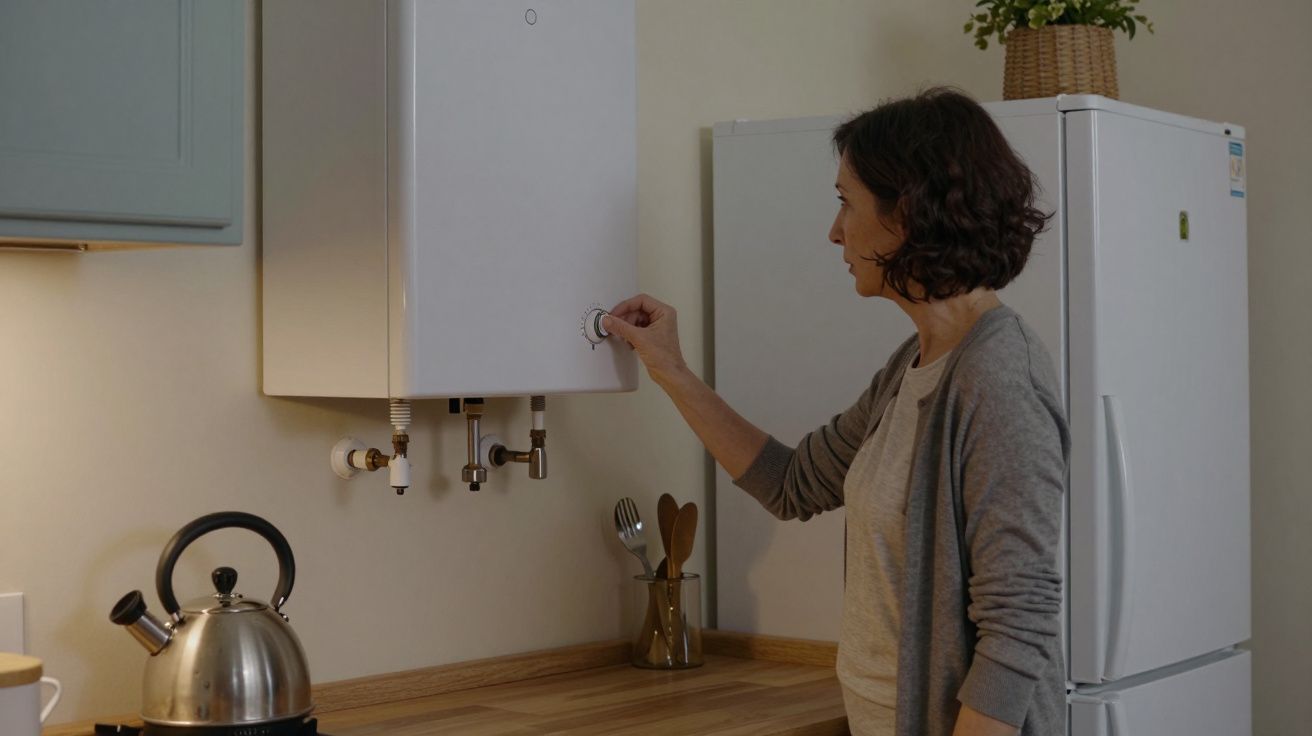
When we finally stood in front of her boiler, the culprit was a single, forgotten setting: a small number on a tiny dial, nudged up years ago and never touched since. The radiators were scalding hot. Her wallet was, quietly, doing the same.
Most of us never adjust this control. We tweak the room thermostat on the hallway wall and assume the rest is handled. Yet this little-known temperature setting on the boiler itself can easily add around £120 a year to a typical UK heating bill-without making your home any warmer.
It just makes your boiler work harder, and less efficiently, every single day.
The hidden setting that keeps your boiler burning cash
Modern gas boilers almost all fall into one category: condensing boilers. They are sold on the promise of higher efficiency, often “90%+”, and they achieve that by running their water cooler than old boilers used to.
The problem is simple: installers often leave the central heating flow temperature set high, usually around 70–80°C, because it guarantees the radiators will always “feel hot” and cut down on call-backs. Then everyone forgets about it.
That flow temperature is controlled either by:
- A physical dial on the front of the boiler (usually with a radiator icon), or
- A digital setting in the boiler’s menu or on a smart controller.
If it’s set too high, your boiler spends much of its life running like an older, non‑condensing model. You still pay the modern‑boiler price, but you don’t get the modern‑boiler savings.
For a typical home, turning that number down to a more sensible level can trim roughly 10–15% off heating gas use. On today’s tariffs, that’s right in the region of £100–£120 a year.
You don’t feel “colder”. You simply stop overheating the water that shuttles round your radiators.
Why your boiler actually prefers cooler water
Condensing boilers have a party trick. Inside the casing, hot exhaust gases from the burner pass through a special heat exchanger. When the water returning from your radiators is cool enough, those gases condense-like steam on a bathroom mirror-and the boiler captures extra heat from that condensation.
The boiler gets bonus heat from its own exhaust fumes. That’s where the higher efficiency comes from.
For this to work properly, the return water temperature (the cooler water coming back from the radiators) needs to be somewhere below about 55°C.
Set the flow temperature (the hotter water going out) very high-say 75°C-and the water often comes back too hot to condense. Your expensive condensing boiler has just become a dressed‑up version of a 1990s unit, quietly wasting gas.
Lower the flow temperature to around 55–60°C, and suddenly:
- Radiators are still warm, just not “ouch” hot.
- The water coming back is cooler.
- The boiler spends more time in condensing mode, pulling extra heat out of the flue.
Same comfort, less fuel.
How £120 sneaks onto your bill
Heating is usually the biggest part of a UK home’s gas use. That’s why even a modest efficiency gain shows up on your annual statement.
As a rough rule of thumb:
- A typical gas‑heated semi‑detached home might use 8,000–10,000 kWh a year just on space heating.
- Cutting that by 10–15% by running your boiler more efficiently saves 800–1,500 kWh.
- At around 7–8p per kWh for gas (prices vary), that’s roughly £60–£120 a year.
The exact number in your house will depend on:
- How much you use the heating.
- How high the flow temperature was to start with.
- How well your radiators and pipes move heat around.
But the logic doesn’t change: running a condensing boiler too hot turns money into wasted steam.
You feel it most on cold, long‑heating days. The boiler runs and runs, but instead of gliding efficiently, it’s sprinting with a weighted backpack.
How to find and fix the setting in five minutes
You don’t need a heating engineer to try this. You just need to know which control to touch-and which to leave alone.
Step 1: Find the right control
Stand in front of the boiler and look for:
- A dial with a small radiator symbol (not the tap symbol – that’s hot water), or
- A digital display showing a temperature next to a radiator icon.
If you have a cylinder and separate controls, there may be two temperature settings: - One for heating (radiators). - One for hot water (cylinder).
We are only changing the heating one.
Step 2: Note the current setting
If it’s sitting at 70°C or higher, that’s the classic “installer default”.
Make a note or take a quick photo, in case you want to go back.
Step 3: Turn it down sensibly
For most modern UK homes with decent radiators:
- Try reducing the flow temperature to about 60°C to start with.
- If your home is well insulated and you’re happy to heat up a little more slowly, you can experiment with 55°C.
Avoid dramatic jumps at first. This is about finding the lowest comfortable point, not seeing how cold your system will go.
Step 4: Test it on a genuinely cold day
On a cool or cold day:
- Set your room thermostat to your normal comfort level (often 19–21°C).
- Let the heating run for a couple of hours.
- Walk around:
- Are most rooms reaching the set temperature?
- Do radiators feel warm, even if they’re not scorching?
- Is the boiler cycling on and off less frantically?
If the house struggles to warm up or never reaches the target, nudge the flow temperature up a little (for example from 55°C to 60°C) and test again.
You’re looking for the lowest flow temperature that still keeps you comfortable on your coldest usual days.
What you’ll actually notice day to day
Lowering boiler flow temperature doesn’t turn your home into an ice cave. The changes are subtler, and mostly positive.
- Radiators feel “nicely warm” rather than fierce. You can rest a hand on them without flinching.
- Heat feels more even. Rooms may take a little longer to warm from cold, but they stay comfortable more consistently once there.
- The boiler runs for longer stretches, but burns gas more efficiently. It’s like cruising in a higher gear rather than constantly flooring the accelerator.
If you tend to run the heating for short, sharp bursts, you might need to start it a little earlier. In exchange, you get steadier comfort and a bill that’s doing less damage quietly in the background.
When not to touch this setting
There are a few cases where you should be more cautious.
Very old, non‑condensing boilers:
If your boiler is pre‑mid‑2000s and not a condensing model, you’re unlikely to gain much by lowering the flow temperature. Focus instead on insulation and room thermostat use.Poorly sized radiators or very draughty homes:
If your house already struggles to reach a reasonable temperature, dropping flow temperature may highlight existing problems. In that case, small tweaks (e.g. 70°C down to 65°C) and upgrading radiators or sealing draughts will help more.Hot‑water cylinder controls:
If you have a hot‑water cylinder, its thermostat is usually set around 60°C to reduce the risk of legionella bacteria. Don’t lower this without proper advice. We’re focusing on the heating circuit, not stored hot water.
A quick guide:
| Home type / situation | Flow temp to try | Notes |
|---|---|---|
| Modern, well‑insulated, good radiators | 55–60°C | Best efficiency gains; allow a bit more heat‑up time |
| Typical 1990s/2000s house, mixed insulation | 60–65°C | Often a safe starting point with little comfort change |
| Older, draughty, small radiators | 65–70°C | Go gently; consider upgrades before large reductions |
Other small thermostat tweaks that add up
Once you’ve tackled boiler flow temperature, a few quieter settings can trim your bill further without making life miserable.
Turn the room thermostat down by 1°C.
Energy Saving Trust figures suggest this can cut heating costs by around £80–£100 a year in a typical gas‑heated home. 20°C instead of 21°C is barely noticeable for most people.Use schedules, not “constant on”.
Programmes that match your routine-warm in the morning and evening, cooler overnight and when you’re out-stop your boiler gently leaking money into empty rooms.Close TRVs in unused rooms.
Thermostatic radiator valves (those numbered heads on radiators) let you keep spare bedrooms or box rooms cooler. No need to heat the whole house to the same level.
Individually, each tweak is modest. Together, they decide whether your boiler is quietly skimming from your bank account every week, or just doing its job.
Key points at a glance
| Point | Detail |
|---|---|
| Hidden culprit | Central heating flow temperature on the boiler, often left too high by default |
| Why it costs you | Stops condensing boilers from running in their most efficient mode |
| Typical saving | Around 10–15% off heating gas use, roughly £60–£120 a year in many homes |
| What to try | Lower flow temp to 55–60°C, then fine‑tune based on comfort |
| Everyday effect | Slightly cooler‑feeling radiators, steadier warmth, less wasted gas |
FAQ:
- Will lowering boiler flow temperature make my house feel colder?
Not if you stop at a level where your rooms still reach your normal thermostat setting. Radiators will feel less fierce, but the air temperature can be the same. You may just need to allow a bit more time for the house to warm from cold.- Does this affect my hot tap or shower temperature?
On a combi boiler, there is usually a separate hot‑water temperature control (often with a tap icon). Adjusting the heating flow temperature (radiator icon) does not directly change your hot tap setting. On systems with cylinders, we’re not changing the cylinder thermostat at all.- Is it safe to change this setting myself?
Yes, as long as you only adjust the user controls described in the manual and don’t open the boiler casing. You’re allowed to set temperatures; gas work itself must be done by a Gas Safe engineer.- How low is too low for boiler flow temperature?
If the house no longer reaches your chosen room temperature on cold days, or radiators stay lukewarm for hours, you’ve probably gone too far. Increase the flow temperature in small steps until comfort returns.- I have smart heating controls-do these change the same thing?
Many smart thermostats only control when the boiler runs, not the boiler’s own flow temperature. Some advanced systems can adjust both, but you’ll still often find a maximum flow temperature setting in the boiler menu that’s worth checking.

Comments
No comments yet. Be the first to comment!
Leave a Comment