The car felt fine yesterday. A bit of drizzle on the ring road, a last‑minute brake for the lights, that faint wobble you wrote off as “just the surface”. This morning you roll into the MOT bay and watch the tester frown at your front wheel. He runs a hand along the inside edge of the tyre, the bit you never really see, and shakes his head.
“Completely bald in here,” he says. “You’re lucky you didn’t hit standing water at speed.”
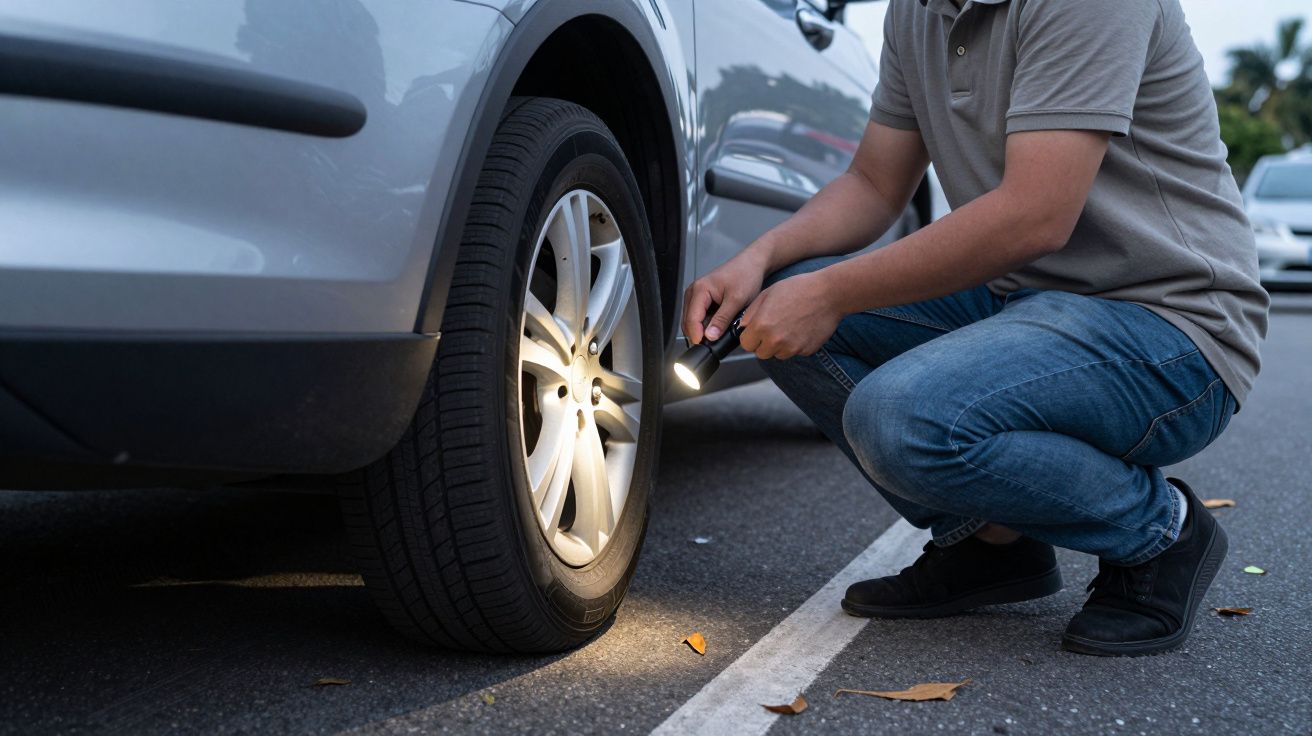
Later, in the car park, you watch another driver do something you’ve never bothered with. He crouches, flicks on a tiny torch, and sweeps it along the tread. Not straight at the wheel, but low and sideways, so the light skims across the rubber. In seconds, every ridge, groove and dodgy patch jumps into view. No gadgets, no ramp, just a cheap beam showing what bright daylight somehow misses.
That’s the trick most of us were never taught: use a simple torch, held the right way, and dangerous tyre wear stops being invisible.
The low‑angle light that shows what daylight hides
Stand next to your car at midday and your tyres look… fine. A grey blur. Maybe a bit dusty. You can’t see the inner edge without getting on your hands and knees, and the shadows inside the wheel arch do you no favours.
Tyres wear in patterns. The really nasty stuff often hides:
- On the inner edge, facing the engine.
- In shallow scallops and dips across the tread.
- In tiny cracks that don’t catch the eye until they fail.
A torch changes the geometry. Instead of blasting the wheel straight on, you hold the light low and sideways, so it rakes across the rubber. Just like sunlight at dawn shows up every bump in a pavement, that low‑angle beam throws tiny ridges and hollows into sharp relief. Raised tread blocks cast shadows; worn, shiny patches reflect back at you.
Two important shifts happen at once:
- The inside edge of the tyre, normally in shadow, suddenly glows.
- Texture pops out. You see cuts, nails, bulges and weird “waves” you’d miss in flat light.
You don’t need a fancy inspection lamp. The torch on your phone, a £3 keyring light or an old camping torch is enough. What matters is how you use it, not how much you paid for it.
How to do the one‑minute torch check on each tyre
Once you’ve done this a couple of times, it feels almost embarrassingly simple. The whole routine takes under a minute per wheel.
Park safely and straighten the wheels
Engine off, handbrake on, in gear or “Park”. Turn the steering so the front wheels point dead ahead – this exposes as much tread as possible.Grab a torch (or your phone)
Any steady white beam will do. Avoid “candle” modes that flicker.Check the front of the tyre with low‑angle light
- Crouch by the wheel.
- Hold the torch a few centimetres off the ground, pointing along the tread, not directly at it.
- Move the beam slowly from one side of the tyre to the other.
Bald or badly worn bits will look smoother and shinier, with fewer shadows in the grooves.
- Crouch by the wheel.
Repeat from the back, especially for the inner edge
Shuffle round so you’re looking at the rear side of the tyre.- Sweep the light low and across again.
- Pay close attention to the inner shoulder (the edge closest to the car).
This is where misalignment often chews rubber away while the outer edge still looks legal.
- Sweep the light low and across again.
Roll and re‑check if you can’t see the full circumference
If part of the tread is hidden by the ground, gently move the car half a wheel‑turn (on a flat, safe surface), then repeat the light sweep. You’re aiming to see the whole “belt” of tread at least once.Give the sidewall a quick torch sweep
- Hold the light slightly higher and skim it over the side of the tyre.
- Look for bulges, deep cuts, or wrinkles in the rubber.
Any bubble or egg‑shaped bulge is a red flag – the internal structure could be damaged.
- Hold the light slightly higher and skim it over the side of the tyre.
If you want a double‑check on tread depth itself, combine the torch with the old 20p coin test:
- Insert a 20p into the main grooves.
- If the outer band of the coin is visible all the way round, your tread may be below the UK legal minimum of 1.6 mm and needs urgent attention.
The torch doesn’t replace a gauge or MOT; it simply makes problems scream “look at me” before a tester – or the rain – does.
What the shadows are trying to tell you
Once you start seeing patterns in the light, they begin to tell stories about what’s going on underneath the car.
Common tread patterns and what they often mean:
- Worn more in the centre than the edges
Likely over‑inflation. The tyre’s running on its middle, not the full width. - Worn more on both outer edges, centre still decent
Under‑inflation. The shoulders are carrying the load, heating up and wearing faster. - One edge (inner or outer) badly worn, the rest OK
Possible misalignment, worn suspension bushes or incorrect camber. Needs a professional alignment check. - Diagonal “scallops” or cupping across the tread
Could be imbalance, worn shocks or other suspension issues.
Sidewall clues in the torch beam:
- Smooth, round bulge – internal damage, often from potholes or kerbing. Dangerous at any speed; the tyre is living on borrowed time.
- Fine cracks all over the sidewall – age and UV exposure. Common on cars that do low mileage. Grip and integrity are compromised.
- Deep cuts exposing cords – immediate replacement territory.
When in doubt, the rule is simple: if the beam makes anything look odd enough that you wonder about it twice, get someone qualified to look at it once.
Why this tiny habit matters more than you think
Most drivers in the UK only truly look at their tyres when something goes very wrong: a puncture, a warning light, or an MOT fail sheet. Tyres, however, degrade quietly – a thousand roundabouts, speed bumps, potholes and emergency stops at a time.
The risks stack up quickly:
- Wet roads and standing water – Worn tread can’t clear water, so you start to aquaplane. Braking distances in heavy rain shoot up when tread drops close to the legal limit.
- Legal trouble – In the UK, driving with tyres below 1.6 mm across the central three‑quarters can mean up to £2,500 in fines per tyre and three penalty points each.
- Uneven wear = wasted money – A simple alignment issue can destroy a set of tyres on the inner edges long before the rest is worn. Catch it early with a torch, and you save a full replacement set.
The torch trick doesn’t ask you to become a mechanic. It just shifts the odds. Instead of relying on an annual MOT to catch everything, you give yourself twelve extra chances a year to spot a problem while it’s small, cheap and still only a shadow under a beam.
Turn the torch trick into a quick, regular ritual
You don’t need a laminated checklist. You need a habit that fits into real life.
A practical rhythm:
- Once a month – Torch check all four tyres, including the spare if you have one.
- Before long journeys or holidays – Add a torch sweep to your fuel and washer fluid check.
- After a big hit – If you’ve thumped a pothole hard enough to wince, check that tyre’s sidewall with the torch that evening.
A simple routine you can actually keep:
- Keep a small torch in the driver’s door pocket or glove box.
- Pick a recurring trigger – first weekend of the month, or whenever you wash the car.
- Walk round the car in order: front left, front right, rear right, rear left. Same pattern every time.
- Take 30–60 seconds per wheel with the beam low and slow.
- If you spot anything suspicious, note the corner (e.g. “front left”) and book a check rather than talking yourself out of it.
You’re not aiming for perfection. You’re aiming for “I will definitely notice if this goes from fine to worrying”.
| Check area | What the torch reveals | Why it matters |
|---|---|---|
| Tread surface | Bald patches, uneven wear, embedded objects | Grip in wet, braking distance, legal minimum tread |
| Inner edge | Hidden bald strip, rapid wear from alignment issues | Early warning before a sudden fail or blowout |
| Sidewall | Bulges, deep cuts, fine cracking | Structural strength at speed and over bumps |
FAQ:
- Can I just rely on daylight instead of a torch?
You can see obvious damage in daylight, but inner‑edge wear and subtle patterns often stay hidden in shadow. A low‑angle torch exaggerates texture and makes dangerous patches much easier to spot in seconds.- Is a phone torch really bright enough?
Yes. Most smartphone LEDs are perfectly adequate for this job. Just hold the phone low and steady and avoid shining directly into your own eyes off chrome or wet surfaces.- How often should I do the torch check?
Monthly is a good baseline for everyday driving. If you cover high mileage, drive a heavily loaded car, or frequently use rough roads, checking every couple of weeks is sensible.- Does this replace professional inspections or the MOT?
No. The torch trick is an early‑warning system, not a certificate. It helps you catch obvious problems between services so you’re less likely to get nasty surprises at test time.- What should I do if I see something that looks wrong?
Avoid high‑speed or long journeys on that tyre and book in with a reputable tyre fitter or garage as soon as possible. Show them the exact spot you’re worried about; a quick expert look is cheaper than a breakdown, fine or collision.






Comments
No comments yet. Be the first to comment!
Leave a Comment