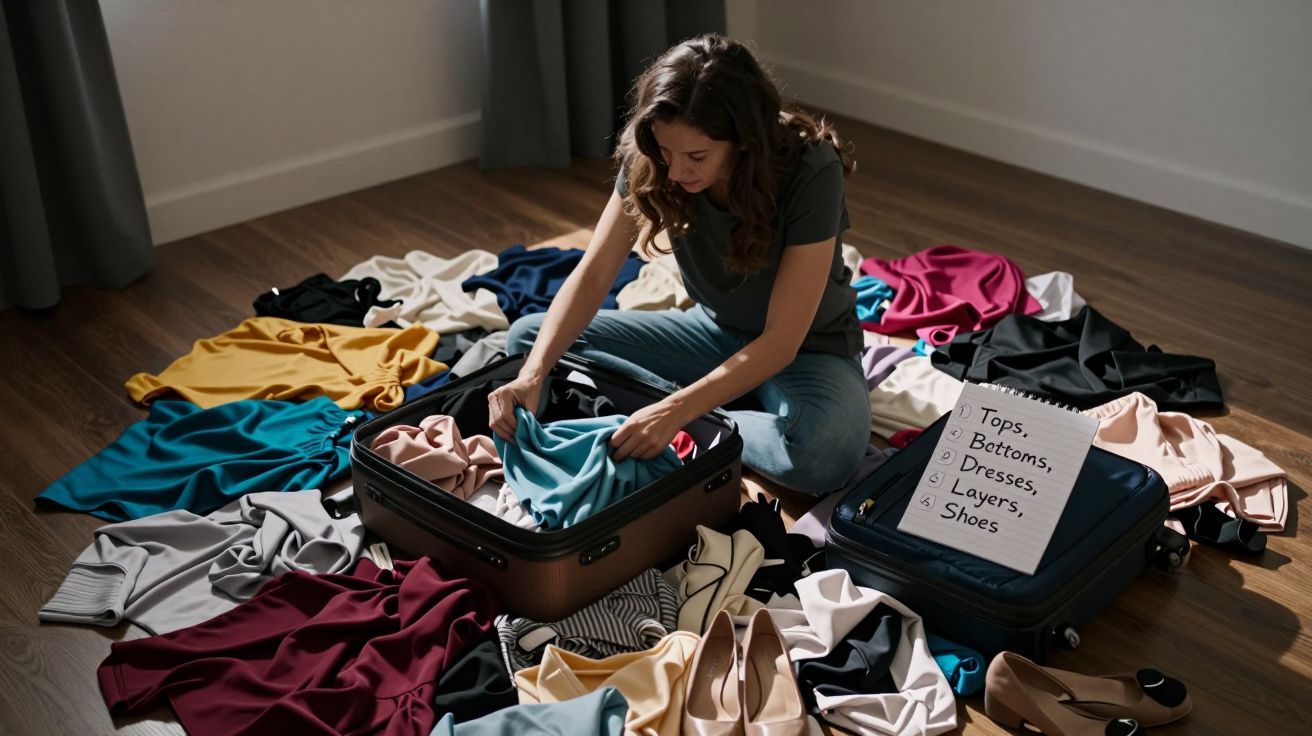
The suitcase was already full when you remembered the “just in case” dress. You wedged it on top of three other “just in case” outfits, sat on the lid, did the wriggle and finally got the zip to close. At the airport, the scales blinked back a number you didn’t want to see. On holiday, you wore the same two outfits on repeat and lived out of the top layer of your bag.
You’re not bad at packing. Your brain is just brilliant at imagining problems you’ll never actually have.
Psychologists see the same pattern in clients who overpack for weekends away, weddings, even overnight work trips. Underneath the bursting suitcase is a cluster of very normal fears: of being cold or underdressed, of standing out for the wrong reasons, of not quite knowing who you’ll want to be when you get there. Clothes become insurance policies. The more anxious you feel, the more policies you buy.
There is a way out that doesn’t involve becoming an ultra-minimalist or travelling with one T-shirt and a moral superiority complex. It starts with understanding what your brain is doing – and then handing the decision-making over to a simple checklist you follow every time, whether you’re going away for three nights or three weeks.
Why your brain wants you to overpack
Overpacking isn’t a character flaw; it’s your psychology doing its job a little too enthusiastically.
1. Loss aversion: “I’d rather carry it than regret it”
Your brain hates the idea of turning up without something you might need more than it hates lugging an overstuffed suitcase. That’s classic loss aversion: the pain of a potential mistake looms larger than the certain annoyance of extra weight.
So you add an extra jumper “in case it’s cold”, another pair of jeans “in case I spill something”, a second nice outfit “in case we go somewhere fancy”. Each item feels like a tiny safety net. Collectively, they’re a kilo of fear.
2. Fantasy self packing: “Holiday me will be different”
At home, you wear the same four things on rotation. On holiday, in your head, you become someone else entirely: the person who glides to breakfast in a floaty dress, changes for cocktails, wears white linen without spilling anything on it.
Psychologists call this your “ideal self” – the version of you that lives just around the next corner. The suitcase becomes a dressing-up box for that person, not the one who will actually be tired, a bit crumpled and looking for the easiest thing to throw on.
3. Social anxiety in disguise: “What if people notice?”
Clothes carry social meaning. You may not think of yourself as anxious, but a stray thought – What if I’m too casual? Too dressy? The only one wearing black? – is enough to send your hand back to the wardrobe.
Instead of tolerating a tiny risk of feeling underdressed once, you overpack to guarantee you’ll have an option for every imagined scenario. Your brain is trying to protect you from embarrassment. The price is a heavier bag.
4. Decision fatigue: “I’ll just take both”
By the third or fourth decision – this top or that one, trainers or sandals – your mental energy dips. Rather than committing, you short-circuit the choice: you pack both.
It feels like productivity (“I’ve solved the problem!”) but really you’ve just postponed the decision to a hotel room, where you’re often even more tired.
5. Planning fallacy: “I will wear outfit number six”
We consistently overestimate how much we’ll do on holiday and underestimate how much time we’ll spend in “default” mode: walking, eating, reading, napping. In those default hours we reach for comfortable, familiar clothes, not the fifth backup outfit.
Your suitcase reflects the holiday in your imagination, not the one you actually live.
The holiday clothes loop in your head
If you could record your inner monologue while packing, it might sound like this:
“I’ll bring the smart dress in case we go somewhere nice. And the jumpsuit in case I don’t feel like the dress. And the second dress in case it’s hot. And another top in case I don’t like any of those when I’m there.”
Each “in case” stacks on another. You move from planning around what is definitely happening (four days, one wedding, two dinners) to planning around vague possibilities. The more uncertain you feel about the trip – the weather, the dress code, how you’ll feel in your body – the worse this loop gets.
Psychologists who work on anxiety use a simple move: shift from fuzzy “what if” thinking to concrete “what when” thinking. That’s exactly what a good packing checklist does. It pulls you out of your head and onto paper.
The one checklist that finally stops overpacking
The most effective systems are brutally simple. This one fits on half a page and works because it forces you to:
- anchor your clothes to specific days and activities
- cap your numbers before you open the wardrobe
- challenge every “fantasy self” item
Grab a piece of paper (or notes app) and run through this in order.
Step 1: Trip facts, not feelings
Write down:
- Number of days away (including travel days)
- Climate in plain words (e.g. “warm days, cool nights, likely rain”)
- Planned activities that actually require different clothes (e.g. one wedding, two hikes, three beach days, one work meeting)
If an activity isn’t on this list, it doesn’t get its own outfit. It has to share.
Step 2: Set your numbers before you choose items
Use this baseline and adjust by one either way if you’re very spill-prone or have no laundry access:
- Tops: number of days ÷ 2, then +1
- 8 days → 4 + 1 = 5 tops
- 8 days → 4 + 1 = 5 tops
- Bottoms (skirts/shorts/trousers): number of days ÷ 3, rounded down
- 8 days → 2 bottoms
- 8 days → 2 bottoms
- Dresses/jumpsuits (if you wear them): max 2, unless there’s a wedding or similar event
- Layers (jumpers/cardigans/light jacket): 2 total
- Shoes: 3 pairs max (day pair, evening/flexible pair, activity-specific pair if needed)
Write the actual numbers next to each. This is your non-negotiable limit. You’re not choosing which clothes yet – only how many of each type.
Step 3: Build an outfit grid
Draw a simple table with one row per day:
| Day | Daytime outfit | Evening / special |
|---|
Fill it in using only the numbers you set:
- Reuse bottoms across multiple days
- Let one dress do double duty (day with sandals, evening with nicer shoes)
- Slot in the specific wedding/meeting/hike outfits first, then fill the gaps with your most comfortable, versatile pieces
If you can’t place an item in a specific box in the grid, it doesn’t go.
Step 4: The “3-match rule” for every item
Now go to your wardrobe with your list in hand. For each candidate item, ask:
- Does it match at least three other things I’m already packing?
- Can it be worn in at least two different combinations (e.g. with jeans and with the skirt)?
If the answer is no, it stays home. Holiday wardrobes work best as mini capsules; your checklist is quietly forcing that.
Step 5: Run the Reality Check questions
Before anything goes in the suitcase, hold it and go through these three questions:
- Which exact day will I wear this?
- If you can’t point to a box in your outfit grid, it’s a no.
- If I forget this and really need it, can I solve the problem another way?
- Borrow, hand wash, wear something twice, buy a cheap emergency layer?
- Is this for me, or for a fantasy version of me?
- If you wouldn’t wear it on a normal weekend at home, why now?
Most “just in case” items fail at least one of these. Let them.
Step 6: One allowed wildcard – in writing
You are allowed one comfort wildcard: an extra item purely because it makes you feel good. Write it down: “Wildcard: blue dress” or “Wildcard: cosy jumper”.
That simple written limit satisfies your loss-averse, anxious brain. It’s not banned from seeking comfort; it just has to choose.
How this checklist calms your packing anxiety
You’re doing three psychologically clever things with this tiny ritual:
- Pre‑committing. By setting numbers before you see specific clothes, you sidestep emotional attachments and sales tags.
- Externalising decisions. The paper holds the plan, so you don’t have to keep it all in your head. That lowers background anxiety.
- Limiting future choices. Fewer clothes means fewer outfit decisions on holiday, which frees mental space for, well, the holiday.
You’ll probably still feel a twinge of “but what if…?” when you leave something behind. That discomfort is a good sign: it means you’re pushing back against the old habit rather than obeying it.
Common packing traps and how the checklist fixes them
| Psychological trap | How it shows up in your suitcase | Checklist antidote |
|---|---|---|
| “Just in case” thinking | Extra outfits with no clear occasion | Outfit grid + “Which day will I wear this?” |
| Fantasy self packing | Clothes you never reach for at home | “Would I wear this on a normal weekend?” |
| Decision fatigue | Doubles of similar items | Number caps set before choosing |
| Social anxiety | Too many “smart” options | Plan specific events first, then stop |
How to make it stick in real life
Expect the first run to feel slow. The second will be quicker. By the third trip, you’ll find yourself glancing at your outfit grid and automatically rejecting things that don’t fit it.
A few practical tweaks help:
- Take a photo of your filled-in checklist and grid. Next time, start from the last successful one.
- Keep a small note in your suitcase: “Last trip: wore everything? Too many tops? Not enough layers?” Your future self will thank you.
- Notice how often you actually miss something you left behind. Most people realise the answer is “almost never” – and that lived evidence is what finally loosens the grip of overpacking.
FAQ:
- Does this work for longer trips, like three weeks?
Yes. The key shift is planning to do laundry. Keep the same caps (tops ≈ half your days + 1, bottoms ≈ a third of your days) and schedule a wash halfway through. Treat it as two back‑to‑back shorter trips.- What about unpredictable weather?
Build flexibility into your layers, not into extra full outfits. One light waterproof, one warm jumper and a thin long-sleeve base layer will usually cover more scenarios than adding three extra “maybe” tops.- I have to pack for kids as well – will this help or just add work?
It helps more. Use the same logic but raise the caps slightly (children are spill magnets). A simple grid and numbers per child stop you throwing in random extras “just in case”.- What if I genuinely love having lots of outfit choices on holiday?
Then make that a conscious decision: set a higher but still fixed cap (“one extra outfit every three days”) and stick to it. The point isn’t austerity; it’s moving from anxious, automatic overpacking to deliberate choice.- I’ve already bought heavy luggage – is it worth changing now?
Yes. Less weight means easier transfers, lower stress, fewer baggage fees and less decision fatigue at your destination. Even if your suitcase stays the same size, teaching your brain it doesn’t need to fill it is the real win.




Comments
No comments yet. Be the first to comment!
Leave a Comment