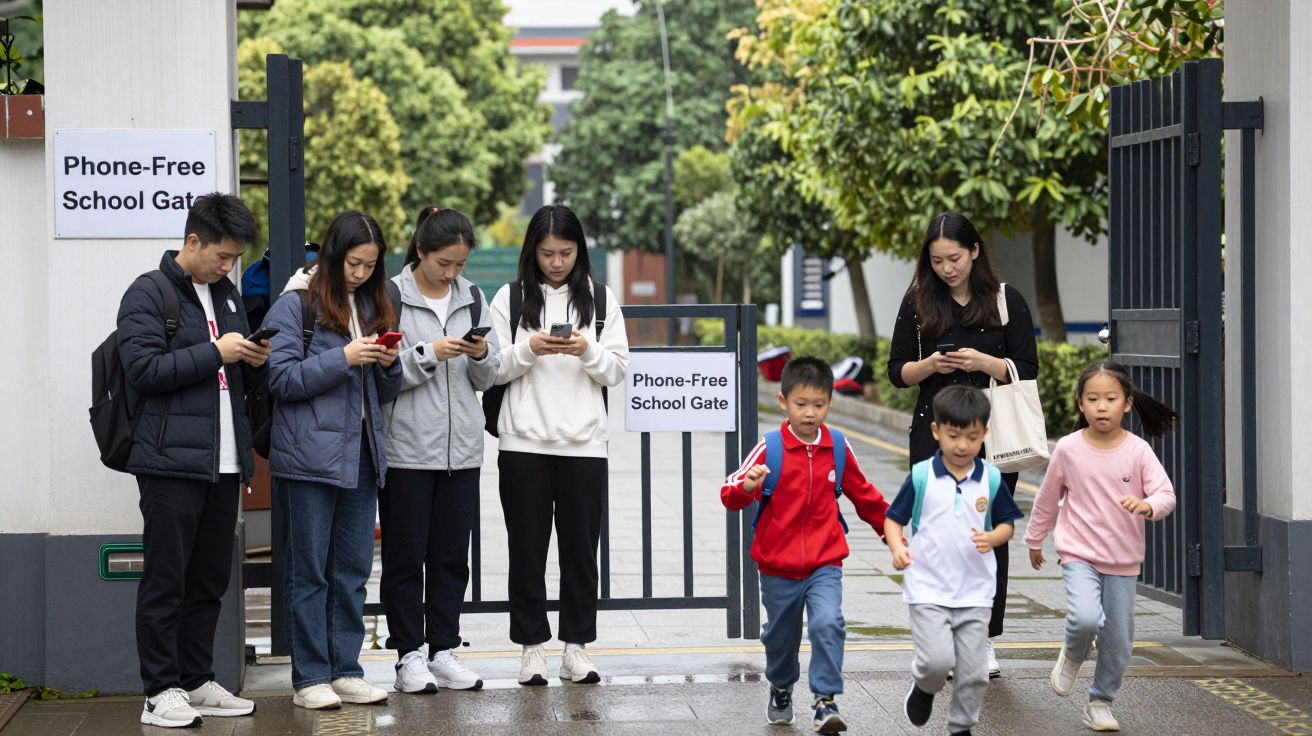
The first mum only half-heard the new rule.
She was standing at the primary school gate on a drizzly Tuesday, phone in one hand, buggy in the other, thumbing a WhatsApp about a work crisis. The bell rang, the usual wave of small rucksacks and book bags surged forwards – and a teacher’s voice cut through the chatter: “Parents, remember, phones away at the gate, please. We want to see your faces, not your screens.”
A few adults slipped their phones into pockets without comment. One dad glanced at the laminated sign that had appeared on the railings that morning – “Phone‑free school gate: please don’t use your mobile on site” – and nodded approvingly. Another mother folded her arms, left her phone exactly where it was and muttered, “They can’t tell me what to do on a public pavement.”
By the end of the week, the WhatsApp groups had moved on from lost jumpers and packed‑lunch ideas. Parents were quietly swapping screenshots of the new policy. Some called it “blissful” and “about time”. Others were furious enough to say out loud what many usually only think: If this carries on, I’ll move my child.
Across the UK, more primary schools are experimenting with “no smartphone at the school gate” rules, often without fanfare and with slightly different wording. The aim is simple on paper: fewer screens, more eye contact, calmer pick‑ups. The reality is anything but simple when it collides with busy working lives, safety anxieties and strongly held views about who gets to set the rules once you step off school property.
What “no smartphone at the school gate” actually means
At most schools trialling these rules, this is not a high‑tech crackdown with confiscations and stern lectures. It is closer to a cultural nudge.
The core idea tends to look like this: no phones visible or in use from the moment children step onto the school approach, through the gate, and until they leave the immediate area at home time. For pupils, that often sits on top of an existing “no phones during the school day” rule. For parents, it is new – and more controversial.
In practice, that can mean:
- Children who carry phones for the journey to and from school must switch them off and keep them in bags or hand them in at the office.
- Parents are asked not to make calls, scroll social media, check emails or film on their phones while on school premises, including the playground.
- Staff may gently remind adults at the gate if they are on their phone when collecting or dropping off.
- Photos and videos are discouraged at the gate to protect safeguarding and other families’ privacy.
Some schools limit the rule to the playground and corridors, on the grounds that the public pavement outside the gate is not theirs to police. Others use broader language – “on or around the school site” – and rely on social norms rather than legal powers. There are very few outright bans with penalties for adults; most headteachers talk instead about “creating a phone‑light culture”.
For pupils, however, the lines are sharper. If a child is caught using a phone at the gate, phones may be held in the office during the day or sent home with a warning that next time, parents will need to collect them in person. The message is clear: phones are for the journey, not for the school environment itself.
Why schools are doing this now
Headteachers rarely wake up one morning and decide to pick a fight with every smartphone‑tethered adult on their roll. The shift has been building for years.
Staff talk about the same handful of moments repeating every day: a child running out of class, beaming, only to find their parent mid‑scroll and barely glancing up. Two friends trying to show someone a certificate while their grown‑up is filming a FaceTime call. A line of adults hunched over screens while small children weave between them at the kerb.
Behind the awkwardness are bigger concerns. Schools point to:
- Role‑modelling – telling children to put phones away in class while adults scroll at the gate sends a mixed message.
- Safety at busy gates – staff worry about cars, scooters and distracted adults on a narrow pavement, all at once.
- Emotional transition – the few minutes when a child hands over from school to home can set the tone for the whole evening.
- Safeguarding and privacy – unregulated filming and photos at the gate can capture children whose families have very good reasons to avoid being photographed.
There is also the wider backdrop. Research has repeatedly raised concerns about heavy smartphone use, social media and children’s mental health. The government in England now explicitly encourages schools to restrict mobile phones throughout the school day; many primaries already do. For some heads, extending that phone‑light zone to the gate feels like the next logical step.
As one headteacher put it in a parents’ newsletter: “Children deserve five minutes of your full attention at pick‑up. We’re trying to protect that bubble.”
From “about time” to “over my dead body”
If you listen at the gate – or in the group chats – you quickly hear that parents are not united on this.
On one side are the relieved. They say the rule gives them permission to put their phone away without feeling they are missing something urgent. They talk about calmer handovers, fewer children dodging between people filming TikToks, and a sense that the school is finally taking digital distraction seriously.
Some point to their own habits.
“I didn’t realise how often I checked my emails until they asked us to stop,” one parent admitted. “Now my daughter walks out, and I’m already looking at her, not my screen. It’s a small thing, but it feels big to her.”
On the other side are those who see the policy as intrusive, impractical or performative.
They raise questions that are not easy to dismiss:
- Work and caring logistics – parents on zero‑hours contracts, calls from hospitals or shift bosses, or last‑minute childcare juggling may need to answer there and then.
- Safeguarding in reverse – some adults feel safer filming interactions at the gate if they have previously had difficult experiences with other parents or even staff.
- Older children’s independence – Year 6 pupils walking home alone may need phones accessible as they leave, not zipped under three layers of possessions.
A smaller but vocal group see the issue in terms of rights. They argue that a school has no legal authority to control what an adult does with their own phone on a public pavement, and they bristle at any hint of being “told off” for it. For them, the phone‑free gate is one parenting judgement too far.
How schools are trying to make it work
The difference between a simmering stand‑off and a mostly accepted new norm often comes down to how the change is introduced.
The schools having the smoothest time with phone‑free gates tend to:
- Explain the “why” before the “what” – linking the rule to children’s emotional wellbeing, safety and role‑modelling, not just “because we say so”.
- Acknowledge real‑world pressures – explicitly allowing brief, essential calls, rather than pretending everyone can be permanently offline.
- Lead by example – staff keep their own phones out of sight at the gate, and senior leaders are visible during pick‑up.
- Offer clear exceptions – for children with medical needs, additional needs who use phones as a communication aid, or specific safeguarding plans.
- Focus on gentle reminders, not punishment – especially for adults, where legal powers are limited and relationships matter more than rules.
Here is how the main perspectives and tensions often line up:
| Perspective | Main concern | What helps |
|---|---|---|
| School leaders | Safety, role‑modelling, calmer transitions | Clear communication; being present at the gate; consistency from staff |
| Supportive parents | Want fewer screens, but need flexibility | Reassurance that quick essential calls are acceptable; no shaming |
| Worried/angry parents | Fear overreach, loss of autonomy, practical problems | Honest conversations; space to raise edge cases; clear boundaries of the school’s authority |
| Children | Want attention, but also like having phones | Framing it as “this is your moment”; offering other small freedoms as they grow |
Where it goes wrong, it is rarely because people disagree that children deserve attention. It is more often because a well‑meant idea lands as yet another demand on adults who feel they are already spinning plates.
If your child’s school goes phone‑free at the gate
Whether you welcome the idea or quietly resent it, you are the one your child will look to for cues. A few small choices can make the rule feel more like care than control.
- Decide your own minimums before you reach the gate – for example, “I’ll finish this email on the walk, then put my phone away two minutes before the bell.”
- Tell your child what you are doing: “I’m putting my phone away now so I can hear all about your day.” It sounds cheesy; it matters.
- Plan for genuine emergencies – if you know you might be on an unavoidable call, tell your child in advance: “I may be on the phone when you come out, but I’ll wave and come straight off as soon as I can.”
- Raise specific worries early, not in the heat of a confrontation. Email or arrange a chat if your situation doesn’t fit the neat version in the policy document.
- Model the boundary elsewhere, too – at the dinner table, during homework, on the short walk to school. A five‑minute phone‑free gate is easier if it is not the only phone‑free moment of the day.
Schools, for their part, are learning as they go. The quieter truth behind the arguments is that nobody really knows yet where the sweet spot lies between connection, convenience and safety at the school gate. These early trials are clumsy attempts to find it.
FAQ:
- Can a school actually ban me from using my phone at the gate?
On public pavements, schools have very limited legal power over adult behaviour. What they can do is set expectations for conduct on their premises, including playgrounds and entrances, and ask for your cooperation. Most frame the rule as a community agreement rather than a legally enforceable ban.- What about my child’s phone for walking home alone?
Many schools allow older pupils to carry a phone for the journey but insist it is off and away on site, then turned back on once they have left. If your child’s route raises specific safety concerns, speak to the school about how to handle the handover point.- Are there exceptions for medical or additional needs?
There usually are. Children who use phones or devices as communication aids, for medical monitoring or as part of a support plan are typically exempt or handled under individual arrangements. Make sure this is written into any care or support plan your child has.- What if I strongly disagree with the policy?
You can raise concerns with the headteacher or governors, focusing on how the rule affects your child rather than on principle alone. Some schools adjust wording or clarify flexibilities after feedback. Ultimately, though, schools set their own behaviour policies, and you may need to decide whether you can live with this one.- Is this the start of more phone rules outside school?
Possibly – or it may settle into one of those norms that quietly varies from place to place, like uniforms or homework. For now, phone‑free school gates are experiments, not national law. How families respond will shape what sticks and what quietly disappears.





Comments
No comments yet. Be the first to comment!
Leave a Comment