The trouble with potatoes is that they feel like the most reliable thing in the kitchen, with no secondary entity needed to make dinner happen. You boil them, roast them, mash them, and they usually behave. That dependability is exactly why it’s worth knowing what flips the result from “perfect” to “why is this gluey/sweet/grey?” when conditions change.
Most potato failures aren’t about skill. They’re about small shifts in temperature, moisture, time and variety-quiet changes that don’t look dramatic until you cut into the tray or lift the masher.
Why potatoes are so forgiving (right up to the point they aren’t)
Potatoes carry a lot of water, a lot of starch, and a thick skin that protects them from the world. That’s why they’re cheap, filling, and hard to truly ruin on an average weeknight.
But that same starch-and-water balance is sensitive. Change the storage temperature, the cooking method, or the amount of agitation, and the starch behaves differently: it swells, it leaks, it gels, it browns, or it turns oddly sweet.
Potatoes don’t “go wrong” all at once. They drift off-course, one small condition at a time.
The good news is that most of those drifts are predictable-and fixable-once you know what to look for.
The three condition changes that cause most potato problems
1) Storage temperature shifts (especially cold)
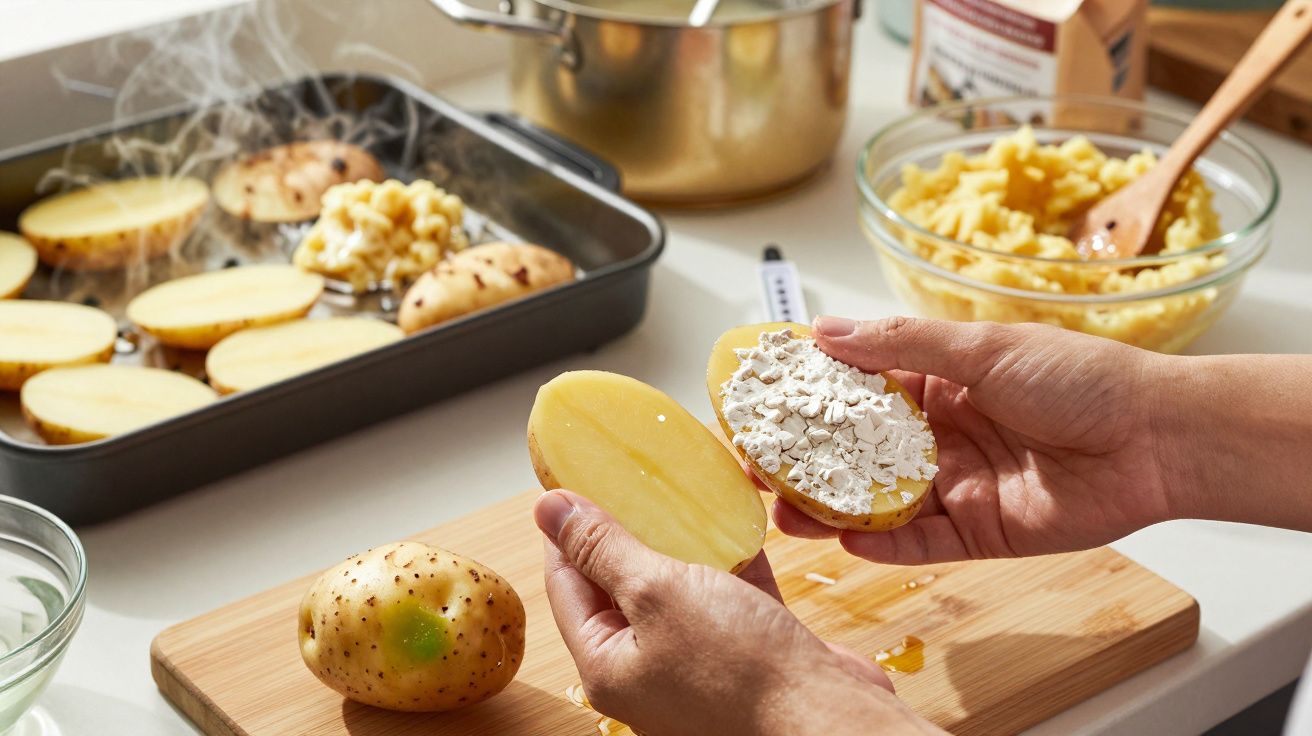
Putting potatoes in the fridge feels tidy, but it’s the fastest route to strange flavour and poor browning. In cold conditions, potatoes convert starch into sugar (a process often called cold sweetening). That makes chips and roasties brown too quickly on the outside while staying pale and soft inside, and it can give mash a faint sweetness.
Aim to store potatoes somewhere cool, dark, and not cold-think a cupboard, pantry, or a paper sack in a ventilated spot. Refrigeration is usually the wrong environment unless you’re working with a specific product and timeline.
2) Water and heat changes during cooking
Potatoes like steady heat. When the water doesn’t fully cover them, when the simmer is too violent, or when the pieces are cut unevenly, you get mixed textures: some edges collapse into the water while bigger chunks stay firm.
A few quiet upgrades that make a loud difference:
- Cut pieces to a similar size (it matters more than people admit).
- Start in cold, salted water, then bring up to a gentle simmer.
- Drain thoroughly, then return to the pan for 30–60 seconds to steam off excess water.
That last step is the difference between mash that’s fluffy and mash that tastes vaguely watery, even after you’ve added butter.
3) Variety mismatch (waxy vs floury)
A potato that roasts well isn’t automatically the one you want for salad, and vice versa. When the “condition” that changes is simply what potato you bought, results can feel random.
As a simple rule:
- Floury (Maris Piper, King Edward): best for roasting, chips, mash.
- Waxy (Charlotte, Jersey Royals): best for salads, gratins, boiling whole.
- All-rounders (Desiree): decent at most things, perfect at fewer.
If you try to force a waxy potato into mash, it often turns dense and slightly gluey. If you boil a very floury potato hard, it can collapse at the edges before the centre is ready.
Quick diagnostics: what you’re seeing, what it usually means, what to do next time
| Problem | Likely cause | Simple fix |
|---|---|---|
| Mash turns gluey | Over-mixing; using blender/food processor; waxy potatoes | Use ricer/masher; switch to floury; mix gently |
| Roast potatoes won’t crisp | Too much surface moisture; oven not hot; crowded tray | Steam-dry; preheat tray/oil; give space |
| Chips go too dark fast | Cold-stored potatoes; sugar build-up | Store out of fridge; rest at room temp 1–2 weeks |
| Potatoes taste sweet | Cold sweetening | Store cool (not cold); choose fresher bag |
| Boiled potatoes fall apart | Floury variety + hard boil | Gentle simmer; cut larger; choose waxy |
These aren’t rules to memorise so much as patterns to recognise. Once you spot them, you stop “fixing” the dish with more salt and start fixing the condition that caused it.
The “works well” methods - and the condition that breaks each one
Roasting: works until the tray is crowded
Roast potatoes need hot air to circulate and moisture to escape. Crowd the tray, and you don’t roast-you steam. They’ll soften, they’ll colour unevenly, and they’ll taste strangely flat.
To keep it simple:
- Parboil in salted water until the edges are just starting to soften.
- Drain, then steam-dry in the pan.
- Rough them up slightly (a little surface fuzz = crunch later).
- Roast in a hot oven (around 200–220°C, depending on your oven) with space between pieces.
If you’re cooking for more people, use two trays. One cramped tray is usually worse than two slightly annoying ones.
Mashing: works until you overwork the starch
Mash is the classic “it was fine and then suddenly it wasn’t” potato dish. The tipping point is agitation: once starch granules rupture and release too much starch, the texture turns elastic and gluey.
Keep mash gentle and warm:
- Use floury potatoes.
- Drain well, then steam-dry.
- Mash or rice while hot.
- Add warm butter/milk, and stop as soon as it looks smooth.
If you want ultra-silky mash, use a ricer-not a blender. Blenders are designed to overwork starch.
Boiling: works until the pieces are uneven
People blame undercooking when the real issue is mixed sizes. Small pieces overcook and waterlog, large pieces stay firm. The “condition change” here is just knife work.
Two reliable approaches:
- Even chunks: peel (optional), cut evenly, start in cold salted water.
- Whole small potatoes: keep skins on, simmer gently, then peel if you want.
Frying/chipping: works until the potato chemistry changes
If chips are coming out too dark, too fast, and with a slightly toffee edge, it’s rarely your oil. It’s usually sugar content-often from cold storage.
A practical workaround if you’ve already bought the bag:
- Keep them in a cool cupboard for a week or two (not sealed in plastic).
- Rinse cut chips briefly, then dry thoroughly.
- Consider a double-cook method: lower temp to cook through, then higher temp to crisp.
You’re not “fixing” bad potatoes so much as giving the conditions time to rebalance.
Storage rules that prevent 80% of potato disappointments
Potatoes don’t need complicated care. They need consistent conditions.
- Darkness: light encourages greening (and bitterness).
- Ventilation: avoid sealed plastic bags if they’re sweating.
- Cool, not cold: think 7–10°C if you can manage it.
- Away from onions: onions can encourage sprouting and off odours.
Check the bag occasionally and remove any potatoes that are going soft. One decaying potato can shift the micro-environment for the rest.
A quick safety note on greening and sprouting
Green patches and bitter taste are a warning sign. Trim generously, and if a potato is heavily green or tastes bitter even after peeling, don’t use it. Sprouts can be removed if the potato is still firm, but if it’s wrinkled and soft, it’s past its best.
A small mindset shift that makes potatoes more consistent
If a potato dish fails, it’s tempting to blame the recipe. But potatoes are less like pasta (predictable) and more like fruit (variable): the bag you bought, the temperature you stored it at, and the humidity of your kitchen all change the outcome.
When conditions change, the winning move is usually boring: pick the right variety, keep storage sensible, dry things properly, and avoid overworking the starch. Potatoes will go back to being what you wanted in the first place-easy, filling, and quietly brilliant.

Comments
No comments yet. Be the first to comment!
Leave a Comment