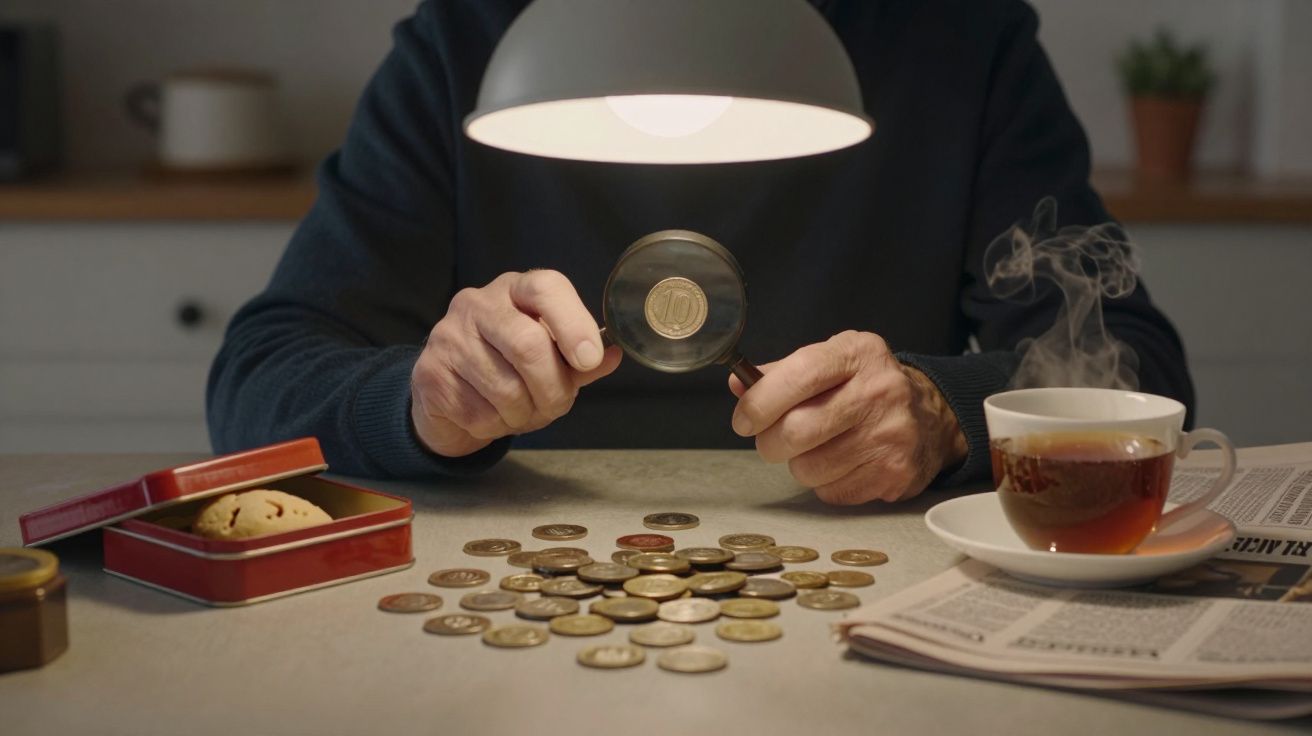
You probably know the tin already.
The one at the back of the cupboard or under the bed, stuffed with old keys, foreign notes, maybe a Scout badge and a few heavy silver‑coloured 10p pieces that “aren’t real money any more”. For years they’ve sat there, too awkward to spend, not quite special enough to bother with. Now people are quietly tipping those tins out on the kitchen table and discovering that a small handful of 1980s 10p coins can be worth far more than their face value.
Not all of them, and not by accident. Yet a tiny number of dates and types – especially those never meant for shop tills – now change hands for £30, £50, even £100 or more when they turn up in top condition. The trick is knowing which you’ve got before you lug the whole lot to the bank or the charity box.
Why old 10p coins suddenly matter
The big, pre‑1992 10p piece looks and feels different straight away. It’s larger and heavier than the modern version, with a lion on the back and the Queen on the front. When the smaller 10p was introduced in the early 1990s, the old size was withdrawn, but millions of people kept a few “just in case”.
For most dates, that instinct hasn’t made anyone rich. Common years, especially well‑worn coins, still only fetch around face value from dealers. The change comes in the mid‑1980s and in a handful of oddities.
The coins that bring serious offers tend to be either the wrong kind of common – never actually issued for circulation – or the right kind of mistake.
Three things push a 1980s 10p into the higher price brackets:
- Low mintage – some years were only struck for presentation sets, not for everyday use.
- Condition – the closer to “fresh from the Royal Mint”, the higher the price.
- Errors and varieties – mis‑struck coins or unusual combinations of designs.
Put those together and you move from “old change” to “collectable”.
The key 1980s 10p coins to look for
You don’t need to memorise every decimal mintage figure. Focus on a few standout types that regularly attract collectors’ attention.
1. Mid‑80s non‑circulating dates
In some years the Royal Mint produced 10p coins only for proof or brilliant‑uncirculated (BU) sets sold to collectors, not for loose change. A few of these dates now command strong prices.
Commonly watched examples include:
- 1985 large 10p
- 1986 large 10p
These coins:
- Were not released in bags to banks and post offices.
- Should, in theory, only exist in very sharp, almost mark‑free condition.
- Turn up in tins when sets have been broken up or passed down.
A bright, uncirculated 1985 or 1986 10p, especially if it looks almost perfect under a strong light, can fetch £20–£60 with specialist buyers. The very best examples, graded and sealed by professional services, have been known to climb higher, sometimes nudging or beating the £100 mark when two collectors compete.
2. Proof coins that escaped their cases
Proof coins are the “showroom models” of the minting world: struck with polished dies on specially prepared blanks, often with a mirror‑like background and frosted designs. In the 1980s, 10p proofs lived in plastic cases inside annual sets.
Occasionally those sets get dismantled. The loose proof coins then drift into biscuit tins, drawers and inherited odds‑and‑ends.
Clues you might be holding a proof:
- The fields (flat areas) are deeply reflective, almost like chrome.
- The lion and lettering look frosted or satin‑like against that mirror.
- The coin shows no handling wear at all, just the odd tiny mark.
Strong proof examples from the 1980s can make £30–£100+, particularly if the rest of the set is present or if the coin is a particularly scarce date.
3. Genuine mint errors
Most 10p coins left the Royal Mint exactly as intended. A rare few did not. Serious collectors pay a premium for dramatic, authentic minting errors such as:
- Off‑centre strikes, where part of the design is missing.
- Double‑struck coins, where the image appears twice, slightly shifted.
- Wrong planchet pieces, struck on a blank intended for a different coin.
Values here vary wildly. A subtle misalignment might add a few pounds. A striking, obvious error from the 1980s on a large 10p can break the £100 barrier with ease, because each one is effectively unique.
With errors, clarity counts. The more immediately visible the mistake, the more a specialist is likely to offer.
Quick checklist: could your 10p be special?
Before you get carried away, it helps to run through a calm, methodical check. You don’t need any fancy kit, just decent light and a bit of patience.
Check the size
- Is it a large pre‑1992 10p (roughly the size of today’s 50p)? That’s the right era.
- Smaller 10p coins from the late 1990s onwards only carry a premium in very specific later designs, not for 1980s dates.
- Is it a large pre‑1992 10p (roughly the size of today’s 50p)? That’s the right era.
Read the date
- Focus on 1980–1989, with particular attention to 1985 and 1986.
- Note any 1980s coin that looks unusually sharp or mirror‑like for its age.
- Focus on 1980–1989, with particular attention to 1985 and 1986.
Look at the surfaces
- Hold the coin under a lamp and tilt it.
- Does the background shine like a mirror, with frosted designs? Think proof.
- Does it look almost unused, with crisp details and no dull patches? Think uncirculated.
- Hold the coin under a lamp and tilt it.
Scan for anything “odd”
- Are the edges even all the way round?
- Is any lettering cut off, doubled, blurred or strangely spaced?
- Does the Queen’s head line up correctly with the lion when you flip the coin top‑to‑bottom?
- Are the edges even all the way round?
If a coin passes several of these tests, it’s worth getting a second opinion before you spend it or give it away.
A compact guide to the main types
| Type of 1980s 10p | Why it’s wanted | Very rough value range* |
|---|---|---|
| 1985 / 1986 large 10p (uncirculated) | Not issued for general circulation; low survival in top grade | £20–£60; exceptional graded pieces can exceed £100 |
| 1980s proof 10p | Mirror finish, struck for sets; often kept pristine | £30–£100+, depending on date and condition |
| Dramatic mint error (any 1980s date) | Unique mis‑strikes, especially off‑centre or double‑struck | £50–£150+, highly case‑by‑case |
*These are broad auction and dealer‑asking ranges, not guarantees. Condition and buyer demand make a huge difference.
How to handle and sell a promising coin
If something in your biscuit tin looks promising, the way you treat it next can add or remove value in seconds.
Do not clean it
No dips, no metal polish, no toothpaste. Cleaning almost always leaves hairline scratches and kills collector interest. A lightly dull coin is worth more than a shiny, scrubbed one.Handle by the edges
Oils from your fingers can mark mirror surfaces. Hold the coin between thumb and forefinger on the rim, over a soft cloth in case you drop it.Compare online, carefully
Search recent completed listings on reputable auction sites for the same date and type, not just optimistic “buy it now” prices. Note the wording: “proof”, “BU”, “graded MS66” – these details matter.Consider a specialist opinion
Local coin fairs, established dealers, or national numismatic societies can all offer guidance. Many will give a quick verbal view for free or a small fee. For anything that looks exceptional, they may suggest professional grading.
A short chat with someone who sees thousands of coins a month can save you from both underselling a gem and overvaluing a very ordinary piece.
When it comes to selling, you have options:
- Online auctions – widest audience, more effort, fees to factor in.
- Dealers – faster, but they must leave room for their own margin.
- Coin fairs and clubs – a good way to gauge realistic interest before you commit.
And if yours turn out to be ordinary?
Most biscuit tins contain nothing rarer than memories. That doesn’t mean your time was wasted.
Those heavy old 10p pieces are still:
- A handy way to introduce children to coin collecting.
- A tactile slice of 1980s everyday history.
- Spendable, once exchanged at a bank that still accepts withdrawn decimal designs.
You can always keep one or two as pocket keepsakes and cash in the rest. If nothing else, you’ll know you haven’t accidentally given a potential £100 coin away with the next charity bag.
And the next time you come across a forgotten tub of “old money” in a loft or a relative’s sideboard, you’ll see more than dead change. You’ll see dates, finishes, mistakes – and the slim but real chance that one of those lions is quietly worth far more than ten pence.




Comments
No comments yet. Be the first to comment!
Leave a Comment