Most people meet octopus energy through a smart meter, a switch deal, or a recommendation from a friend who swears their bills “dropped overnight”. The secondary entity in this argument is, bluntly, blank: there isn’t a secret extra brand or gadget doing the saving for you. It matters because what you do after you join - how you run your home, pick a tariff, and use the data - usually outweighs the logo on the bill.
I’ve lost count of the times I’ve heard “Octopus put my prices up” said with the same certainty as “the boiler’s broken”. Sometimes the frustration is fair. Often, though, the bigger problem is the way the service is used: like a traditional supplier, on autopilot, with none of the knobs turned.
The myth: your supplier controls your bill
Energy suppliers set prices and send statements, but they don’t decide when you cook, wash, charge, heat, or leave half the house on standby. If you join a company known for smart tariffs and then use it like a flat-rate plan, you can end up with the worst of both worlds: more complexity, no benefit.
The emotional trap is that energy feels abstract. You don’t see a “receipt” when you boil the kettle three times, or when the immersion heater quietly runs for an hour, or when a heat pump works hardest during the priciest slot of the day. The bill arrives weeks later, and the supplier becomes the face of all that invisible behaviour.
Octopus isn’t a magic discount. It’s a set of tools - and tools only help when you actually pick them up.
Where Octopus really helps (and where it can’t)
Octopus has built a reputation on two things: decent customer service and tariffs that respond to real-world prices. That’s genuinely useful if you’re willing to engage with it, even lightly.
But it can’t fix a leaky home, a mis-timed heating schedule, or a household that’s accidentally running high-load devices at peak times. A “cheaper supplier” won’t rescue you from an always-on tumble dryer habit any more than a new bank will rescue you from daily takeaway.
Octopus tends to work best when at least one of these is true:
- You can shift some electricity use to cheaper hours (laundry, dishwasher, EV charging).
- You’re prepared to check prices occasionally (not obsessively).
- Your heating and hot water are set up sensibly (especially with heat pumps).
- You understand, roughly, what your biggest loads are.
If none of that is you, the most honest approach is to pick a simple tariff and focus on the basics: insulation, draught-proofing, heating controls, and killing the real “always on” culprits.
The three most common ways people misuse smart tariffs
Smart tariffs aren’t “better”; they’re more conditional. When people complain that Agile or Tracker “didn’t save them anything”, the pattern is usually one of these.
1) Treating Agile like a fixed rate
Agile rewards flexibility. If you run the same heavy appliances at 5–7pm every day, you’re deliberately walking into the most expensive part of the market and then blaming the shop for charging more at the till.
This doesn’t mean you need to turn life into a spreadsheet. It means moving one or two chunky tasks.
A practical version looks like:
- Dishwasher after dinner, but set it to start at 10pm.
- Washing machine on a timer overnight (if noise and safety allow).
- Batch-cook at lunch once or twice a week, not during the weekday peak.
If your household can’t shift anything (young kids, shift work, medical needs), that’s not failure. It’s just a sign that a highly variable tariff may not match your life.
2) Forgetting standing charges and “small” daily waste
People focus on unit rates and ignore the background. Standing charges are unavoidable on most tariffs, so the only lever left is consumption - and that’s where the “chargers myth” shows up again.
Unplugging phone chargers is rarely the big win. The steady drain tends to come from things that look harmless because they’re quiet: set-top boxes, mesh Wi‑Fi nodes, AV receivers, printers, old power bricks, and “instant on” settings.
If you want one quick audit that’s actually worth doing, do this:
- Pick one day. Note your total usage.
- The next day, change only one thing: put the whole TV corner on a switched extension and turn it fully off overnight.
- Compare the totals and keep the change that moved the needle.
Precision beats guilt. Always.
3) Using the app as a scoreboard, not a control panel
A lot of people download the Octopus app, look at the half-hourly graph twice, and then stop. The data becomes a curiosity rather than a tool.
The trick is to use the graph to answer one specific question: what spikes, and when? Once you see the spike, you can either move it, shrink it, or stop it happening by accident.
Common “spikes” that surprise people:
- Electric showers (shorten by two minutes; it’s boring but it works).
- Tumble dryers (clean filters, avoid half loads, use eco mode).
- Immersion heaters (check timers; “on” is not a personality trait).
- Heat pumps (comfort bands too tight; hot water set too high).
A better way to “use” Octopus: think in routines, not rates
The households that get the most out of Octopus aren’t necessarily the geekiest. They’re the ones who build one or two routines that match their home.
A simple routine might be: “High-load stuff runs after 9pm.” Another might be: “We do laundry on weekends when prices are calmer.” If you’ve got an EV, the routine is even easier: “Car charges when the tariff says it’s cheapest.”
If you’re trying to make this stick without turning into the person who checks prices at dinner, set up the boring automation:
- Appliance timers (dishwasher, washing machine).
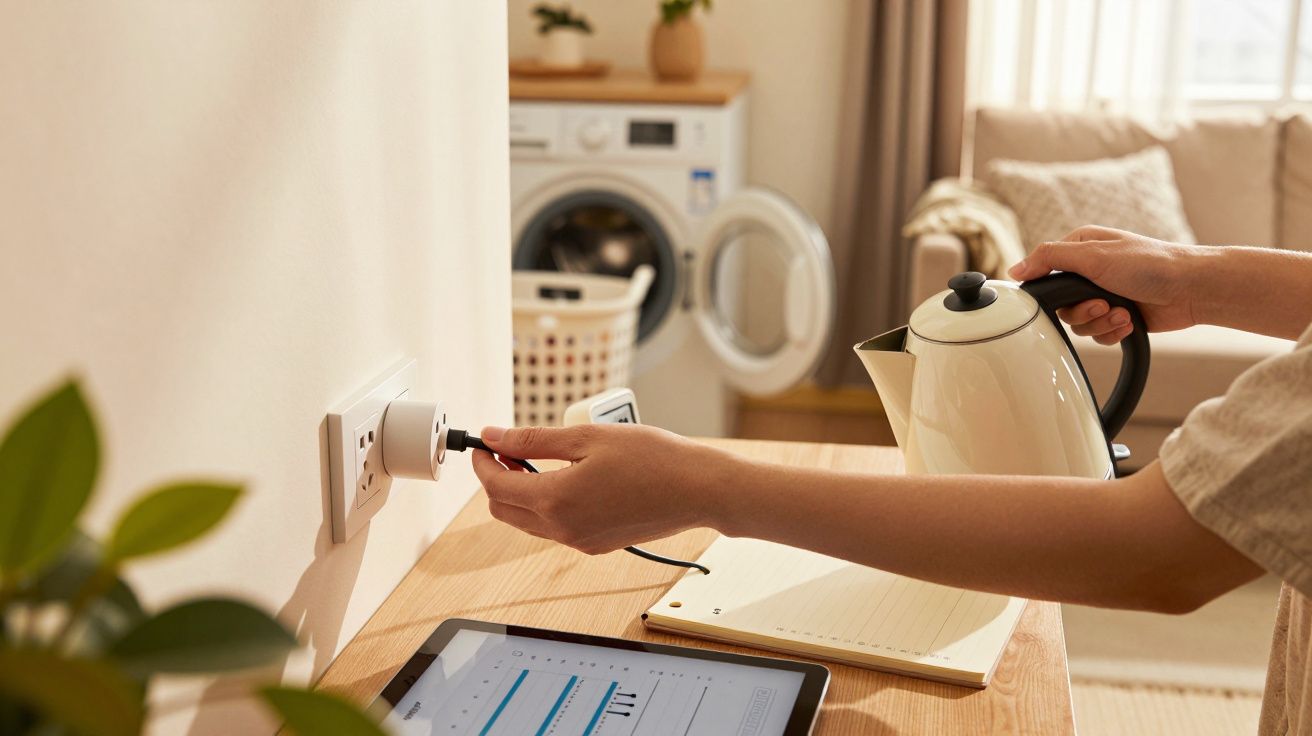
- Smart plugs for clusters (TV corner, desk setup).
- Heating schedules that match occupancy (not aspiration).
- A single “off” switch for devices that shouldn’t idle all night.
Treat energy like clutter: you don’t need perfection, you need fewer things running by accident.
The uncomfortable truth: comfort costs, but waste costs more
Some Octopus customers end up disappointed because they’ve mixed up two different goals: lowering cost and keeping comfort. You can do both, but you have to be honest about what comfort means in your home.
If you want the house at 22°C all evening, every evening, you’re choosing a higher baseline cost. The win then comes from removing waste around that comfort: better zoning, sensible flow temperatures, not heating spare rooms to “keep them fresh”, and not running hot water hotter than you need.
If you want the lowest possible bill, you may have to accept more variation: pre-heating when electricity is cheaper, or letting temperatures drift a little, or doing energy-heavy chores at off-peak times.
Neither approach is morally better. The mistake is paying for premium comfort and paying for avoidable waste, then assuming a supplier swap should have fixed it.
A quick sanity check before you blame the supplier
If your bills look wrong, run through this short list before you declare the company the villain:
- Did your tariff change (or end of fixed term) recently?
- Did your usage change (new heater, dehumidifier, more home working)?
- Are your readings estimated, or are they actual smart readings?
- Is your Direct Debit set to smooth annual cost, not match monthly usage?
- Have you checked the top three loads in your home, not the tiny ones?
If you can answer those, you’ll have a cleaner conversation with customer service - and a much clearer sense of whether the issue is price, usage, or both.
FAQ:
- Is octopus energy more expensive than other suppliers? It depends on the tariff and your usage pattern. On smart tariffs, the “price” is partly your behaviour: if you can’t shift much usage away from peak times, you may not see savings.
- Do I need a smart meter to benefit? For most smart tariffs, yes, because they rely on half-hourly readings. If you want simplicity, a standard tariff can still work; the bigger savings often come from reducing waste rather than chasing clever rates.
- Why do my bills go up even when I’m careful? Standing charges, seasonal heating demand, and genuine price rises can outweigh small savings. Also, many “careful” habits target tiny loads (like phone chargers) rather than the big hitters (hot water, drying, cooking, heating).
- What’s the simplest way to start using the data properly? Pick one suspect (tumble dryer, electric shower, immersion heater, TV corner) and test one change for 48 hours. Keep the change that creates a visible drop, and ignore the rest until you’ve nailed the big loads.




Comments
No comments yet. Be the first to comment!
Leave a Comment