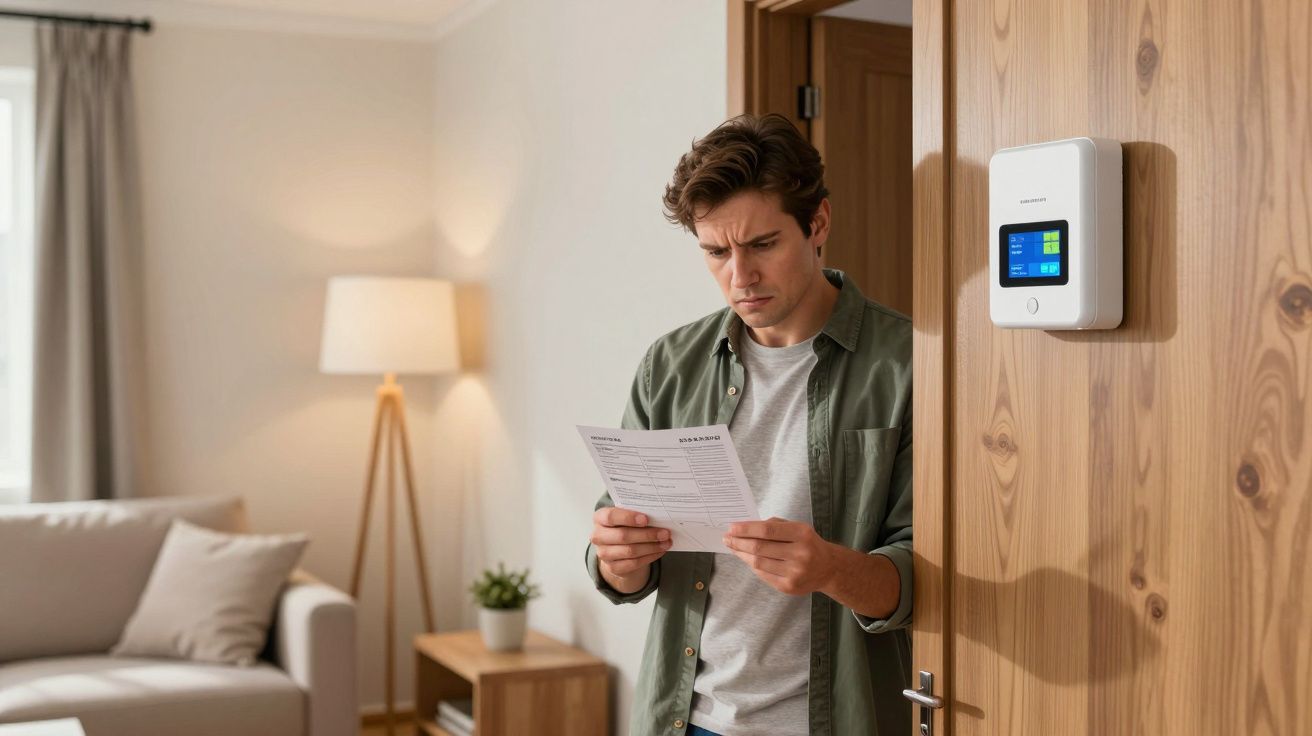
The envelope lands with a soft thud on the doormat, or the email pings into your inbox on a Tuesday afternoon. You glance at the figure and feel your stomach dip. Your monthly direct debit is jumping by £40, apparently because you’re “using more than expected” – even though there’s a smart meter blinking quietly in the cupboard.
You scroll through the bill. Lines of numbers, a vague graph, and that tiny word next to some readings: Estimated. You thought the whole point of getting a smart meter was to stop the guesswork. So why are suppliers still “estimating” – and what changed, exactly?
Over the past year, Ofgem has brought in new rules and guidance that quietly change how suppliers are supposed to work out your usage and set your payments. On paper, it’s about fairness and accuracy. In your living room, it can mean sharper bill changes, fewer big back‑bills – and a bit of homework for anyone with a smart meter.
The quiet rule change hiding in your bill
Ofgem’s latest rules tighten what suppliers can get away with when they estimate how much energy you’ll use over the next 12 months. The headline idea is simple: if there’s good data available – especially from a smart meter – suppliers are expected to use it, not rely on old, lazy guesses.
In practice, that means two big shifts:
- Estimates have to be based on more recent, realistic usage, not just historic averages that ignore how your life has changed.
- If a smart meter is installed, suppliers are under more pressure to make sure it’s actually sending data and to bill you on that data wherever possible.
Suppliers also now have to explain big direct‑debit changes more clearly and show how they’ve arrived at the figure. When they hike your payment “just in case”, without solid usage to back it up, they’re on much shakier ground than they used to be.
On a bill, you won’t see a big banner saying “New Ofgem rule applied here”. You’ll just notice more references to “actual” smart‑meter reads, slightly more detailed breakdowns – and sometimes, surprisingly, a suggestion to lower your direct debit if your account is sitting on a big credit.
How suppliers used to ‘guess’ your usage
Before these changes, many suppliers leaned on pretty crude tools. They took your last year or two of usage, blended it with typical “profile” data for a home like yours, then smoothed it into a monthly figure that was meant to carry you through winter and summer.
If your life stayed exactly the same, that wasn’t awful. But add an EV, rip out the old gas fire, start working from home, or install a heat pump, and the model fell apart. The system might still behave as if you were that old version of you, in that old version of your house.
Smart meters arrived promising to fix this with half‑hourly data. In reality, some suppliers still treated them like glorified traditional meters, pulling the odd reading and doing the same old averaging. If the smart meter stopped communicating, the system often fell straight back to guesswork without telling you clearly.
What changes for smart‑meter households
Under the newer rules and expectations, that “smart in name only” approach is harder to justify. If you’ve got a working smart meter, suppliers are expected to:
- Use your actual consumption data as the primary basis for setting your estimated annual usage.
- Spot patterns faster – for example, if your usage has dropped sharply after insulation or a new boiler.
- Avoid building up excessive credit “just in case” when your data clearly shows you’re using less.
That can feel like a mixed blessing. On the plus side, you’re less likely to be hit with a giant “catch‑up” bill based on years of underestimates. On the minus side, your direct debit may now be adjusted more quickly – both up and down – as your real‑world usage changes.
For some households, that means a welcome correction: a lower monthly payment and a refund of surplus credit. For others, particularly if prices or usage have quietly crept up, it means facing the true cost sooner instead of later.
Why your bill might still say ‘Estimated’ – even with a smart meter
Seeing “Estimated” next to a reading when you know there’s a smart meter in the cupboard is maddening. But there are a few unglamorous reasons it still happens:
- Smart meter not communicating: The meter is working, but the communication hub isn’t sending data back reliably.
- Data set to monthly or daily only: You might have agreed to half‑hourly data when it was installed, or you might not. Lower‑frequency data can still leave gaps.
- Supplier system issues: Sometimes the data arrives, but the billing system fails to pull it in time for that statement.
- Meter change, tariff switch or move: In the middle of an upgrade or switch, suppliers may fall back on a one‑off estimate to bridge the gap.
The new rules don’t magically fix any of this. What they do is make it harder for a supplier to shrug and blame “system issues” forever. If your smart meter has been effectively dumb for months, they’re expected to investigate, repair, or replace – not just keep firing out estimates indefinitely.
A 30‑minute check that can save you real money
You don’t need to become an amateur energy analyst. But a short, focused check once or twice a year can make sure the new rules work in your favour, not against you.
Use this as a simple checklist:
| Step | What to do | Why it helps |
|---|---|---|
| 1 | Find “Estimated annual consumption” (or similar) on your latest bill | This is the number your direct debit is built on |
| 2 | Check whether recent readings are marked “A” (actual) or “E” (estimated) | Tells you if your smart meter data is really being used |
| 3 | Take a manual meter reading and submit it | Forces a true “actual” baseline into the system |
| 4 | Compare your account balance and payments | Shows if you’re drifting into big credit or debit |
| 5 | Contact your supplier if your smart meter hasn’t sent data for months | Under Ofgem rules, they should now fix or investigate, not ignore |
If the numbers on your bill look wildly out of step with how you actually live – for example, you’re paying for usage that would suit a large family while you live alone – challenge it. Under Ofgem’s strengthened standards, suppliers have to justify their estimate and revisit it when you provide better evidence.
What this could mean for your direct debit
The most visible change for many people will be in that monthly payment.
With more accurate, up‑to‑date usage feeding into the calculation, you may see:
- Smaller credit balances: Less chance of hundreds of pounds quietly sitting with your supplier.
- Quicker corrections: If prices fall or your usage drops, there’s more scope to bring payments down sooner.
- Sharper rises when needed: If you’ve been underpaying, suppliers are now expected to step in sooner – but they must show their workings.
If your account is heavily in credit and your recent bills are based on actual smart‑meter data, you can reasonably ask for a refund or a reduction in your direct debit. Ofgem’s guidance backs customers who push back on clearly excessive balances, especially in a cost‑of‑living squeeze.
Equally, if a supplier wants to hike your direct debit significantly, you can ask for a written explanation of the numbers behind it. If it still doesn’t make sense, you have the right to complain and, ultimately, to take it to the Energy Ombudsman.
If you rent, use prepay, or don’t have a smart meter
These changes still matter even if your situation is less straightforward.
- Renters: If bills are in your name, nothing stops you getting a smart meter unless your tenancy says otherwise. If energy is bundled into rent, talk to your landlord about how they’re handling estimates and increases.
- Prepayment customers: Smart prepay meters can give suppliers much clearer data on how and when you use energy, which should make topping‑up patterns and debt plans fairer. If you’re on an old key or card meter, you’re still at the mercy of rougher estimates.
- No smart meter yet: Regular manual readings are your main protection. The newer rules still say estimates should be fair and evidence‑based – but if you never submit a reading, the system has nothing better to go on.
Whatever your setup, one principle now runs through Ofgem’s approach: suppliers should not be treating guesswork as a default when better information is available.
How to nudge your energy account into the ‘smart’ era
The goal isn’t to obsess over every kilowatt‑hour. It’s to make sure the new rules and your smart meter are actually doing their job: charging you for what you use, not what a distant model thinks you might use.
A few low‑effort habits go a long way:
- Make a note in your calendar to do that 30‑minute check at least once a year, ideally before winter.
- Keep an eye on whether readings on your bill are still marked “Estimated” months in a row; if they are, raise it.
- If you’re offered the choice, consider opting in to half‑hourly data sharing – it unlocks the most accurate picture of your usage and can open up better‑matched tariffs.
- When something in your home changes significantly (heat pump, EV charger, home office), tell your supplier and ask them to revisit your estimate.
Some evenings, you’ll still glance at the bill and feel the familiar pinch. But over the next year or two, as Ofgem’s rules bed in, the gap between what you actually use and what you’re charged for should quietly shrink – especially if you give your smart meter, and your own attention, a small nudge in the right direction.
FAQ:
- Can I refuse a smart meter and still be estimated fairly? Yes. You’re not forced to accept a smart meter, and suppliers must still base estimates on reasonable evidence. But without regular readings, their room for error is much bigger.
- My smart meter display is dead – does that mean my data has stopped? Not necessarily. The in‑home display is just a monitor. Your supplier can tell you if the meter itself is still communicating and arrange a replacement display if needed.
- What if my supplier ignores my complaints about wrong estimates? Follow their complaints process in writing, keep copies, and if you’re not satisfied after eight weeks (or you reach deadlock), you can escalate to the Energy Ombudsman for free.
- Can I choose how often my smart meter sends data? Yes. You can normally pick half‑hourly, daily, or monthly. Half‑hourly gives the most accurate picture for tariffs and budgeting, but you can change your preference later if you’re uncomfortable.


Comments
No comments yet. Be the first to comment!
Leave a Comment