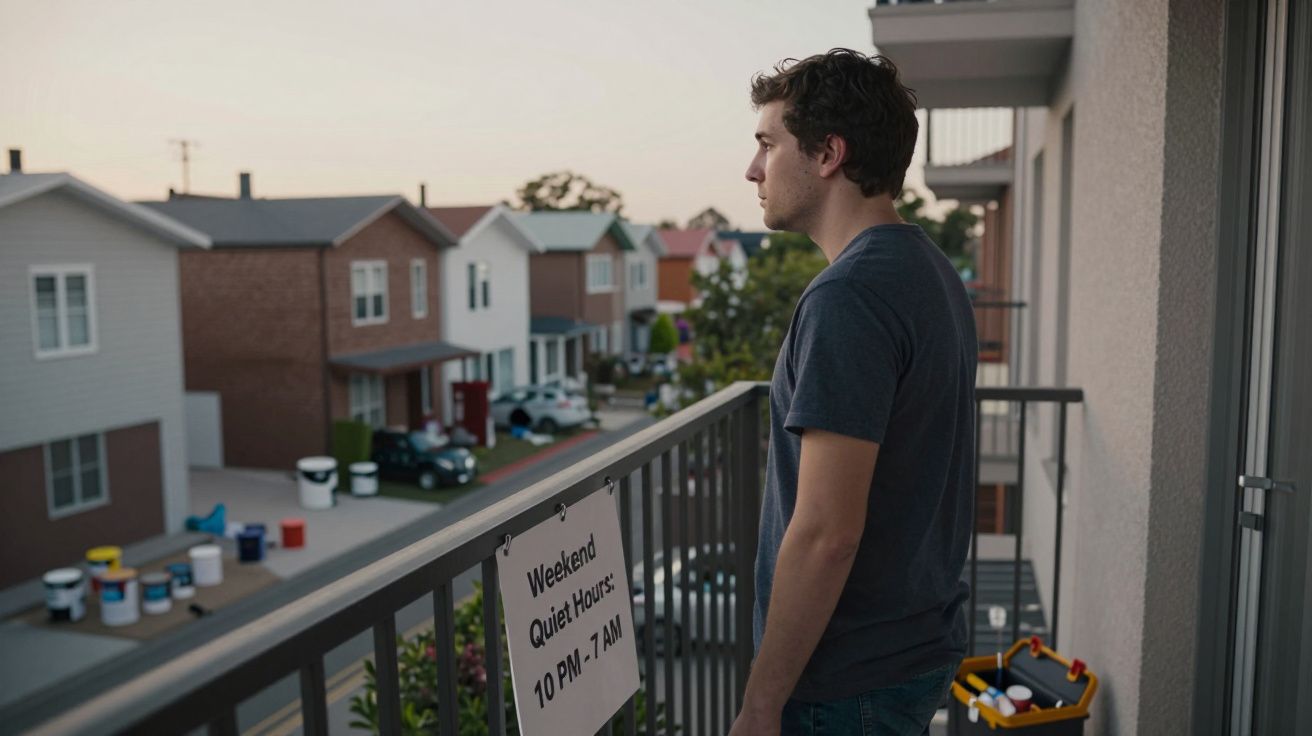
The first thud lands at 8.17 on a Sunday morning: a hammer, a wall, a neighbour who’s finally got round to “just putting that shelf up”. In the flat next door, someone sits bolt upright in bed, duvet over head, radio off to check it isn’t a burglar. By the third drill-whine, texts start flying in the building WhatsApp. Ten minutes later, a link drops in the chat: a council notice about new weekend quiet hours that apparently ban exactly this.
Across pockets of the UK, similar scenes are playing out. Residents open their post to find fresh guidance about “domestic construction noise”, with bold lines on Sunday mornings and bank holidays. What used to be a fuzzy social norm - “try not to be a nuisance” - is being sharpened into time bands, decibel limits and the threat of fines.
No one argues that sleep and peace do not matter. But for many, Sunday is the only day with enough daylight and headspace to tackle home repairs. A ban before lunch can feel less like courtesy and more like a clamp on everyday life. The result: simmering frustration on both sides of the wall, and a lot of people suddenly Googling “what time can I drill?”.
Why councils are turning down the volume on weekends
Behind the new notices lie a few converging trends. More people now live in flats or tightly packed terraces; what you do in your living room is far more likely to vibrate into someone else’s. Hybrid working means neighbours are home to hear your projects, not out at the office while you sand the floorboards.
Complaints have risen with it. Environmental health teams in several councils report noise as one of their most common grievances, especially at weekends. It’s not just midnight parties; it’s impact drills at 7 a.m., cement mixers in tiny front gardens, and “temporary” renovations that drag on for months.
Legally, councils have long had powers under the Environmental Protection Act 1990 to act on “statutory nuisance”. What is new in some areas are clearer quiet‑hours windows and, in a few cases, byelaws that spell out when noisy DIY is off-limits. The aim is to give residents and officers a shared baseline, rather than arguing case by case over what counts as “reasonable”.
Of course, nothing about noise is truly neutral. A shift that feels like protection to exhausted parents can feel like overreach to the only‑on‑Sunday DIYer. The tension lives in those thin plasterboard walls.
What the new quiet‑hours rules actually say
The details vary by council, but the pattern is recognisable once you start reading the small print. Most of the new or updated policies draw a line between everyday household sounds - talking, TV at normal volume, closing doors - and “noisy DIY or construction activities”: drilling, hammering, sawing, sanding, powered lawn equipment and pressure washers.
Typical guidance in councils that have tightened up looks something like:
- Weekdays: noisy DIY allowed roughly 8:00–18:00, with some extending to 19:00.
- Saturdays: shorter windows, often 9:00–13:00 or 9:00–17:00.
- Sundays and bank holidays: no noisy DIY in the morning at all, with some banning it all day, others allowing a short window after late morning (for example, 10:00–16:00).
In several boroughs, these are framed as “strong guidance” rather than hard law for homeowners. But they sit alongside formal construction‑site hours and the backstop of nuisance law. That means you may not be arrested for picking up a drill at 9 a.m. sharp - but if a neighbour complains and officers judge the timing and volume “unreasonable”, you could still be ordered to stop.
Crucially, there is no single national DIY curfew time. One street may sit in a council with strict Sunday bans; another, ten minutes down the road, may have only vague advice. The onus is on you to check your own council’s website under sections like “noise nuisance”, “construction noise” or “environmental health”.
If that sounds tedious, it is still easier than unpicking an abatement notice after the fact.
How to keep your tools and your neighbours
You do not have to choose between a soundproofed life and a crumbling skirting board. A bit of planning can keep you safely within both the rules and the limits of your neighbours’ patience.
Start by timing the loudest jobs. If your council bans Sunday morning DIY, shift drilling and wall‑chasing to legal weekday evenings or Saturday daytime, and save quiet tasks - painting, flat‑pack assembly without power tools, measuring up - for Sunday. A simple rule of thumb helps:
- Do it loud: within the permitted hours only, in short bursts.
- Do it long: spread over several days instead of one epic, noisy session.
- Do it kind: avoid early mornings, late evenings and nap times if you know them.
Talk to the people who share your walls. A quick note through the door - “We’re fitting shelves on Saturday between 10 and 12, shout if that’s a nightmare” - can dissolve a lot of resentment before it takes root. Many neighbours will accept inconvenience if they feel informed, considered and listened to.
Small practical tweaks also go a long way:
- Use hand tools where you can; a manual screwdriver may be slower but less rage‑inducing at 9.30 a.m.
- Put thick mats under workbenches to reduce vibration through floors.
- Close doors and windows while you work to keep noise inside.
- Batch the noisiest cuts or drilling into one short spell, then switch to quieter finishing work.
Let’s be honest: no one will get this perfect all the time. But visible effort often matters more than flawless silence.
When noise tips into a legal problem
Most grumbles about DIY never leave the corridor. A few, however, escalate. Understanding the line between “annoying” and “actionable” can save a lot of stress.
Councils look at a cluster of factors when judging a potential statutory noise nuisance:
- Volume and character of the sound (sharp impacts travel further than muffled music).
- Time of day and day of week (Sunday mornings are judged more strictly).
- Frequency and duration (one hour once a month is different to six hours every weekend).
- Context (thin‑walled flats versus detached houses, shift workers, nearby hospitals).
If officers decide your DIY is a nuisance, they can serve an abatement notice, ordering you to reduce or stop the noise. Ignoring it can lead to fines - up to several thousand pounds if prosecuted - and, in some cases, seizure of equipment.
Before it reaches that point, councils usually encourage neighbours to talk, or to keep a diary of disturbances. That is not just bureaucracy; it helps separate a one‑off over‑eager Sunday from a pattern of disregard. Still, once a formal complaint is in motion, it is much harder to rely on “I didn’t know” as a defence.
The flip side is important too: if you are the one being kept awake or driven round the bend, you do have routes to protect your own quiet hours that do not start with banging on the wall. Log times, check your council’s guidance, then decide whether a calm conversation or a formal report is more likely to lead to change.
Choosing quiet fixes instead of noisy battles
The new rules are, in part, a nudge towards planning and lighter‑touch methods. For many common jobs, there is a quieter option that will spare both your ears and your relations.
| Task | Typical noisy way | Quieter alternative |
|---|---|---|
| Hanging shelves | Hammer drill on solid walls | Use self‑drill plasterboard anchors where suitable; pre‑drill holes in one short burst |
| Sanding floors or doors | Belt sander for long sessions | Hand sanding blocks, or hire better‑maintained kit for shorter, more efficient use |
| Garden tidy‑up | Petrol mower/strimmer early Sunday | Hand tools, electric kit with limited hours, or a Saturday slot within allowed times |
You will not always be able to avoid power tools. But as quiet‑hours windows tighten, choosing methods that make the most of the time you do have becomes less about virtue and more about sanity.
FAQ:
- Do these new quiet‑hours rules apply everywhere in the UK? No. Noise powers are national, but specific quiet‑hours guidance and any extra byelaws are set by individual councils. Always check your own local authority’s website; do not assume your friend’s rules in another city apply to you.
- Can I be fined just for doing DIY on a Sunday morning? In most areas, you are unlikely to be fined for a single short burst, though it may still breach guidance. Fines usually follow an abatement notice if you continue making what the council deems unreasonable noise. In some boroughs with stricter byelaws, repeated or blatant breaches can trigger fixed penalties more quickly.
- What counts as “noisy DIY”? Typically, anything involving power tools, heavy hammering, drilling into walls or floors, mechanical sanders and some garden machinery. Normal conversation, low‑level music and everyday movement around your home are generally not covered by these rules.
- What if I work long hours and Sunday is my only chance to do repairs? That is a common dilemma. Try to use permitted Saturday hours for the loudest jobs, plan projects in shorter stages, and explain your constraints to neighbours. Showing that you are trying to work within the rules makes complaints less likely and gives you more ground to stand on if they arise.
- How should I complain if a neighbour ignores the quiet hours? Start, if you feel safe, with a polite conversation or note explaining how the noise affects you and pointing to the council’s guidance. If nothing changes, keep a diary of dates and times, then contact your council’s environmental health team via their noise or nuisance reporting channels.






Comments
No comments yet. Be the first to comment!
Leave a Comment