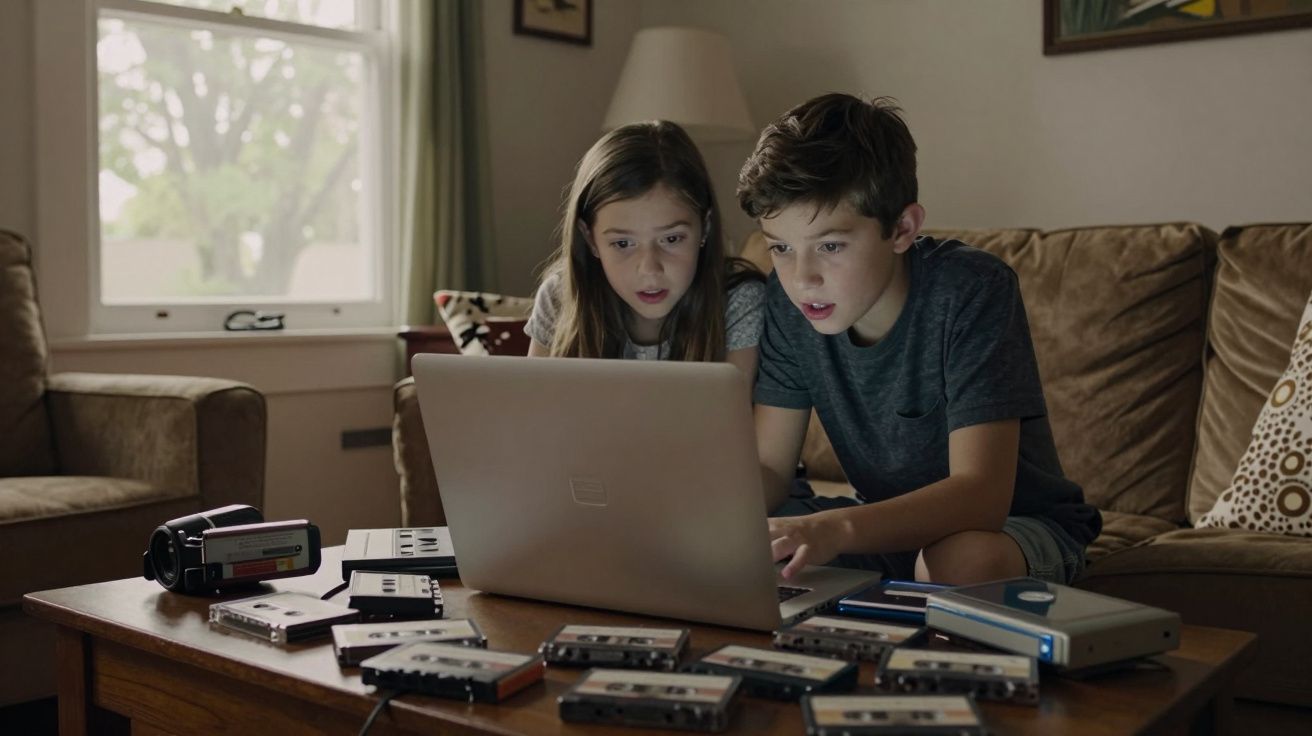
On a damp Saturday in Leeds, Tom and his sister finally face the box that’s followed them through three house moves. Sun-faded masking tape on the lid, a scribble in their dad’s handwriting: “HOLIDAYS / BIRTHDAYS / MISC”. Inside: VHS cassettes with handwritten labels, mixtapes from sixth form, a camcorder battery that hasn’t seen a socket since Blair.
They’d always meant to digitise it all. Then life got in the way. Wedding. Redundancy. Kids. The usual.
What got them to crack the box open wasn’t nostalgia at all, but an email. A small London AI start‑up had posted in the local Facebook group, offering to buy old VHS and cassette collections for “archival and research purposes”. They’d even collect.
Tom laughed at first. Who on earth would pay for fuzzy footage of a 1996 caravan park in Wales?
Yet all over the UK, and far beyond, similar offers are appearing: “We buy VHS”, “Analogue archive wanted”, “Cash for cassettes”. Some are clearly collectors. Increasingly, others are something else entirely - data‑hungry tech firms racing to scoop up everyday analogue recordings before they rot, or get tossed into a skip.
To them, these aren’t relics.
They’re training data. And they’re golden.
From attic clutter to AI fuel
For years, tech companies fed their algorithms on whatever they could scrape: YouTube uploads, Instagram videos, Spotify streams, CCTV dumps. That buffet is now tangled in lawsuits, paywalls and public backlash. Copyright holders are pushing back. Regulators are asking harder questions.
So the industry is pivoting to what they call “first‑party datasets” - material they own outright, with clean, documented rights. That’s where your dusty tapes come in.
A home‑recorded VHS of Christmas 1993 holds more than a tree and a grandma in a paper crown. It holds:
- period‑accurate clothing and interiors
- authentic lighting, grain and camera shake
- natural speech from several voices, across ages and accents
- radio or TV murmuring in the background
All captured in a single, messy, analogue swoop.
“A single four‑hour VHS can contain more diverse, real‑world data than weeks of curated digital clips,” one AI researcher told me. “And nobody’s thought to mine it - until now.”
What used to be clutter is suddenly a rich, unclaimed seam of everyday life. For AI firms trying to build models that understand not just crisp studio audio and HD video, but ordinary chaos, these tapes are extremely tempting.
Why VHS and cassettes are “data gold”
From a distance, the interest looks odd. Analogue video is low‑resolution. Audio hissy, warped, sometimes barely listenable. Yet it’s precisely those flaws that are valuable.
1. Real voices in real rooms
Smart assistants, transcription tools and voice‑cloning systems are mostly trained on clean audio: podcasts, audiobooks, studio recordings. Then they land in the real world - a kitchen with a boiling kettle, a living room with a telly blaring, a teenager mumbling at a bus stop - and stumble.
Old cassettes and camcorder tapes give engineers what they lack:
- overlapping voices
- thick regional accents and speech from children and older adults
- background hum from fridges, traffic, football on the radio
Feed enough of that into a model and you get systems that cope far better with ordinary life. If you’re building, say, an AI carer that needs to understand a softly‑spoken 87‑year‑old in Hull with a TV on in the background, that matters.
2. Visual history, uncurated
VHS collections are full of visual details big studios never bothered to archive: shop fronts, packaging, local adverts, wallpaper, school uniforms, cheap toys, street signs before the rebrand.
To a machine‑learning system, those details aren’t background; they are the training set.
They help:
- image‑recognition tools learn brand and logo histories
- generative video models recreate specific eras accurately
- restoration tools “hallucinate” missing pixels based on true period textures
If you want an AI to generate a believable 1992 living room in Wolverhampton, you can’t cheat with generic Americana. You need masses of real, local, mundane footage. That’s exactly what lives on those tapes.
3. Analogue fingerprints
Engineers also study the artefacts themselves - tape hiss, drop‑outs, tracking errors, the wobble at the start of playback.
Those fingerprints are used to:
- teach AI to restore or up‑scale old footage
- spot deepfakes (synthetic videos often lack genuine analogue errors)
- simulate vintage “looks” commercially, from retro filters to virtual film stocks
In machine‑learning jargon, analogue tapes are a “ground truth”: messy, physical and hard to fake at scale.
To a human, a warped tape is a nuisance.
To a model, it’s a physics lesson.
How the buying boom actually works
The people knocking on doors and posting in local groups fall into a few camps. Some are exactly what they claim: collectors, archivists, retro‑gaming enthusiasts. Others act as intermediaries, acquiring in bulk for larger players who prefer to stay discreet.
The typical offer looks something like this:
- Free digitisation in exchange for keeping a copy of your footage and the right to use it for research
- A flat fee for the physical media, with a contract assigning them the rights to use whatever’s on it
- In rarer, more serious cases, a licensing agreement, where you retain ownership but grant wide usage rights
Amounts vary. Most ordinary home collections won’t pay for a holiday. A few highly specific archives - early footage of major artists, rare local TV or radio, recordings from historically significant events - command more.
Here’s how the broad market looks:
| Type of material | What companies want it for | Typical value* |
|---|---|---|
| Everyday home videos | Speech, interiors, clothing, behaviour | Low, often bundled deals |
| Off‑air TV/radio recordings | Adverts, jingles, continuity, news | Low‑to‑medium, per hour |
| Niche or historically rare tapes | Specialist training or commercial projects | Highly variable |
*Value is usually for the rights, not just the plastic.
The real currency isn’t the cassette; it’s your consent on paper. Rights clearance is where the cheques go.
Rights, consent and the people in the background
Here’s where it gets knotty. You might own the physical tape and the copyright in your home videos. But you don’t automatically own:
- the rights to music playing in the background
- the personal data of every guest, neighbour or passer‑by you’ve filmed
- the performers’ rights in any TV recordings you’ve taped off‑air
Firms trying to stay on the right side of regulators will push you to grant them broad, often global and perpetual rights. They want to be able to feed that material into models, products and future projects that don’t exist yet.
Data protection law adds another layer. If a company uses identifiable footage of your cousin at 15 to train a model, and that model later pops up in a commercial tool, does your cousin have a say? Legally, the answer is evolving. Ethically, it’s already uncomfortable.
Systems don’t remember “your gran at Christmas”.
They remember faces, voices and patterns, at scale.
For some families, the emotional barrier is higher than the legal one. Are you happy for the only footage of a late parent to become part of a corporate training set, perhaps powering a customer‑service bot, a deepfake detector or an ad‑optimisation engine, somewhere down the line?
There isn’t a single correct answer. But it’s worth asking the question before you sign.
If you have a box of tapes: your real options
You don’t have to choose between flogging everything to the first buyer and letting it all mould in the loft. There is a middle ground.
1. Digitise on your own terms
Before you consider any sale:
- Identify the truly important tapes (weddings, last recordings of relatives, formative memories).
- Get at least those digitised by a reputable service, or borrow a working player and do it yourself.
- Store the files in at least two places (external drive and cloud).
That way, whatever deal you make later, you keep control of your copies.
2. Decide what you’re comfortable sharing
You can split your collection:
- Private archive: deeply personal footage you’ll never license out.
- Restricted sharing: material you might license under strict conditions (e.g. education or non‑commercial research only).
- Open to deals: generic landscapes, street scenes, off‑air TV, audio tests and so on.
A decent buyer should be willing to talk about categories, not insist on “all or nothing”.
3. Read the small print as if it matters (because it does)
When a firm offers “free digitisation” or a “research contribution”, ask bluntly:
- Who will own the digital copies?
- Can they train commercial AI systems on this footage?
- Will your material ever be shared with third parties?
- Do you retain the right to ask for deletion later?
If the answer to any of these is vague, or buried in general terms and conditions, pause. A polite “I’m not comfortable assigning broad rights over family material” is enough.
Why the rush is happening now
Three clocks are ticking at once.
First, the physical decay clock. VHS and cassette tape degrade. Magnetic layers shed, plastic warps, mould creeps in. Engineers know there’s a window - a couple more decades, at best - before huge swathes of home‑recorded history become unreadable without extreme effort.
Second, the AI arms race clock. Companies are competing to build models that feel more “human”, more nuanced, less obviously machine‑generated. Whoever owns distinctive, hard‑to‑replicate datasets has an edge.
Third, the regulatory clock. Governments are starting to cap wild data scraping. Licences that once allowed broad, quiet data access are being re‑examined. Owning your own curated analogue archive looks safer than arguing, five years from now, that some obscure clause in a social‑media policy lets you feed everyone’s videos into your latest model.
So there’s a quiet scramble: buy now, worry later. For tech firms, the calculus is clear. For individuals, it’s more tangled.
Because these tapes were never meant as datasets. They were meant as memory.
A practical checklist before you sell a single tape
If a flyer, email or friendly stranger offers to take that box off your hands, use this as a quick grounding tool:
- Inventory first. Roughly list what you have: dates, events, any rare or sensitive material.
- Digitise what matters most. Keep your own high‑quality copies somewhere safe.
- Sort into piles. Private, maybe, and fine‑to‑share. Be ruthless in both directions.
- Ask exactly what rights are requested. Usage, duration, territory, commercial vs research, deletion options.
- Get it in writing. Even if it’s a simple licence, not a full assignment of rights.
- Sleep on it. If the decision touches family history, take 24 hours before you agree.
Small sums can feel tempting when the tapes look like trash.
Once you’ve signed the rights away, though, you can’t easily reel them back in.
The quiet bargain underneath it all
The deeper story isn’t about VHS or cassettes at all. It’s about how our private past is being quietly drafted into the training of future machines.
For decades, we trusted physical media to do a simple job: hold a moment in time, then sit on a shelf. Now, those same objects are being reimagined as raw material, to be sliced, analysed and recombined into systems that may outlive all of us.
Some people are fine with that. They like the idea that their grainy Christmas becomes part of a model that spots deepfakes, or that their dad’s voice helps an AI understand older speakers better. Others would rather keep that intimacy off the corporate menu.
Neither stance is naïve. What matters is making a choice, not waking up in ten years to discover that the only footage of your family holiday is baked into an opaque algorithm with no off‑switch.
Tom, in Leeds, ended up doing something in between. He and his sister paid to digitise the “core memories” first. Then they sold a box of generic street scenes and unloved TV recordings to a small archive that works mainly with researchers.
The rest went back into the loft, this time in labelled, backed‑up order.
Maybe in twenty years, another email will arrive, and the market - and the ethics - will have shifted again. For now, those tapes are what they always were: messy, fragile, irreplaceable slices of ordinary life. Data gold, perhaps. But still, first and foremost, theirs.
FAQ:
- Are tech firms really buying random home VHS tapes? Yes. Alongside collectors and archivists, a growing number of AI and media‑tech companies are quietly acquiring analogue collections for training, research and restoration work. Most value comes from the rights, not the plastic itself.
- Can a company use my family videos to train AI without my permission? In general, no. They need a legal basis to process personal data and to use copyrighted footage. That’s why so many are chasing explicit licences or rights assignments from tape owners.
- Is it worth anything financially, or is this mostly symbolic? Ordinary home collections are usually low‑value, especially if they’ve degraded. Rare recordings, local TV archives or historically significant footage can attract higher offers, but don’t expect a windfall.
- What if my tapes include other people who never agreed to be filmed? That’s common with home videos. Ethically, think about whether those people would be comfortable. Legally, companies will rely on your representations in the contract, but data‑protection questions are still evolving.
- How can I help research without losing control of my memories? Look for projects that offer non‑exclusive licences, clear limits on commercial use, and the option to withdraw later. Always keep your own high‑quality copies and avoid signing blanket assignments if you’re unsure.



Comments
No comments yet. Be the first to comment!
Leave a Comment