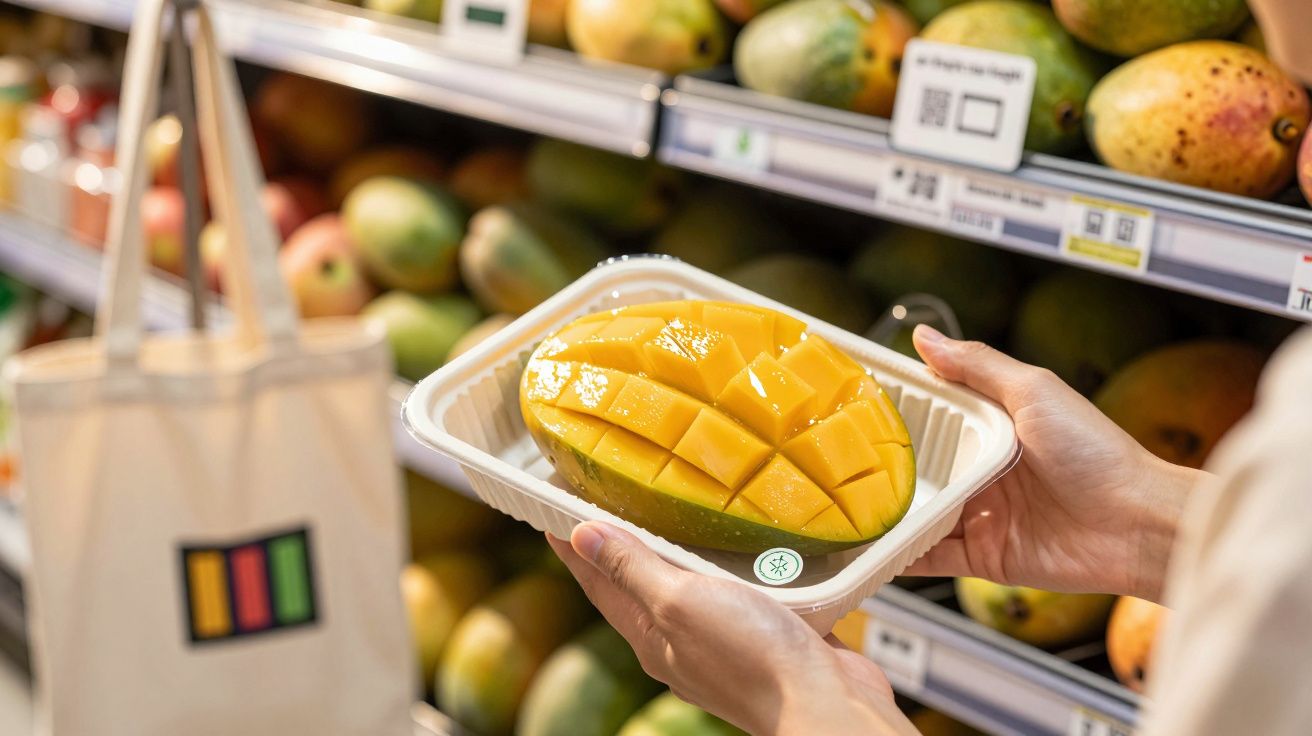
It starts in the supermarket fruit aisle, where mangoes now sit as casually as bananas - destined for lunchbox slices, yoghurt bowls and quick smoothies - and, oddly, alongside ''. That everyday presence matters because it tells you something bigger about how food is being grown, shipped, ripened and sold: tropical fruit is no longer a seasonal novelty. It’s becoming a year-round, engineered convenience product, with all the trade-offs that implies.
You can taste the shift in the way we buy them. The label doesn’t just say “mango” any more; it promises “ready to eat”, names a variety, flags a country, and occasionally offers a QR code that dares you to look behind the gloss.
The “ready-to-eat” mango is not a small innovation
For decades, mangoes in the UK were the classic punt: rock-hard on Tuesday, bruised by Friday, perfect for about 11 minutes on Saturday. The new expectation is different. Shoppers want fruit that works on their schedule, not the other way round.
That expectation has turned ripening from a backroom art into a supply-chain strategy. Controlled-atmosphere shipping, temperature management, and timed ripening rooms mean retailers can aim for a narrow window of softness and sweetness - and hit it more often than they used to.
The modern mango isn’t just imported. It’s timed.
Why that matters beyond fruit
When a product must be “ready” at the exact point you buy it, it forces the whole chain to behave like a service. It’s the same logic you see elsewhere in retail: less “here’s what we have”, more “here’s what fits your moment”.
That’s why mangoes show up in the same trend bucket as pre-washed salad and microwave rice. They’re part of the move from ingredients to outcomes: a snack, a smoothie base, a quick dessert, a lunch upgrade.
Mangoes are riding the convenience economy
The bigger trend is not “people like tropical fruit”. It’s that modern grocery shopping increasingly splits into missions: tonight’s dinner, tomorrow’s breakfast, an office snack, a “treat that feels healthy”.
Mangoes fit those missions unusually well:
- Snackification: naturally sweet, no baking or prep required (especially in pre-cut packs).
- Perceived health: associated with vitamins, fibre and “clean” sweetness.
- Versatility: salads, salsas, curries, oats, yoghurts, drinks.
- Low friction: “ready-to-eat” labelling removes the guessing.
And just like with other convenience foods, the premium versions do best. A named variety with a consistent texture will beat an anonymous bargain mango if the buyer trusts it won’t disappoint.
The quiet premiumisation of “basic” produce
Mangoes also sit inside a broader shift: the premiumisation of everyday staples. We’ve seen it with tomatoes (on-the-vine, heritage, “sweet snack”), with apples (club varieties), and with grapes (specific cultivars marketed like brands).
Mangoes are following the same path. Retailers increasingly lean on:
- Variety signalling (for consistency of flavour and fibre)
- Ripeness signalling (“eat tonight” versus “ripen at home”)
- Packaging that acts like reassurance (especially for pre-cut)
This is not just marketing fluff. It’s a response to a real problem: when quality is unpredictable, shoppers stop buying. When quality becomes reliable, the fruit becomes a habit.
A quick guide to what the common cues actually mean
| What you see | What it usually signals | What to do |
|---|---|---|
| “Ready to eat” | Ripened to be used now (short window) | Buy for the next 24–48 hours |
| Very firm fruit | Earlier in the ripening cycle | Plan ahead; ripen at room temp |
| Pre-cut mango | Convenience, but shorter life | Check use-by; keep cold and sealed |
Mangoes reveal how global the “fresh” aisle has become
The bigger-than-expected trend is that “fresh” is now a global, year-round manufacturing feat. Mango supply typically rotates across regions through the year, meaning the mango you buy in winter is often not just from a different farm, but from a different continent and climate system than the summer one.
That creates a new kind of normal for shoppers: constant availability, constant variation. Even if labels are clear, your palate still notices differences in sweetness, aroma, and texture as sourcing changes.
It also creates a new kind of fragility. A crop that depends on stable shipping lanes, predictable harvests, reliable cold chains and consistent labour is exposed at multiple points.
When “fresh” is always available, it’s also always vulnerable.
The sustainability tension is baked in
Mangoes sit right on the fault line between two consumer desires:
- Eat more fruit, waste less, choose healthier snacks.
- Lower emissions, reduce packaging, support resilient farming.
Those goals don’t always align neatly. A “perfectly ripe” mango that arrives on time may require more intensive logistics. A pre-cut pack may cut household waste and boost usage, but it adds plastic and shortens the clock.
The point isn’t that mangoes are “good” or “bad”. It’s that they’re a clear example of modern trade-offs: convenience, consistency, and year-round choice come with costs that are usually hidden from the shelf edge.
What retailers are really selling now: certainty
Look at how mangoes are positioned, and you can see the same retail playbook used across categories: reduce uncertainty, speed up decisions, increase repeat purchases.
That means:
- More guidance (ripeness text, usage suggestions, storage instructions)
- Tighter range curation (fewer “random” mangoes, more predictable lines)
- More data-led forecasting (so the shelf doesn’t swing between empty and overstocked)
In practice, this is part of a wider shift towards groceries behaving more like a service: the customer isn’t shopping for fruit, they’re shopping for a reliable outcome at 6pm on a Tuesday.
What this changes for how we eat at home
The mango trend doesn’t stop at the store. It changes habits in small, telling ways.
Instead of buying fruit to “have in the house”, more people buy it to use - sliced into lunch the next day, blended after the gym, folded into a quick dessert. Mangoes fit modern eating patterns because they slot into routines without demanding attention.
A few behaviours follow naturally:
- More frequent top-up shops for “ready now” food
- Less tolerance for duds, because convenience shoppers don’t want a project
- More reliance on labelling as a proxy for quality and timing
The questions mangoes force us to ask
Mangoes look simple. They aren’t. They are a neat, edible summary of where the food system is going: engineered availability, premium cues, and convenience-first buying.
The next time you pick one up, the useful questions are practical rather than moralising:
- Am I buying for tonight or for later in the week?
- Do I want maximum flavour, or maximum certainty?
- Am I choosing pre-cut to avoid waste, or just to save time?
- Do I notice when the source country changes - and does the fruit still meet the promise?
Because the bigger trend isn’t “we’re eating more mangoes”. It’s that modern groceries increasingly sell predictability - and mangoes just happen to be one of the clearest places you can see it.




Comments
No comments yet. Be the first to comment!
Leave a Comment