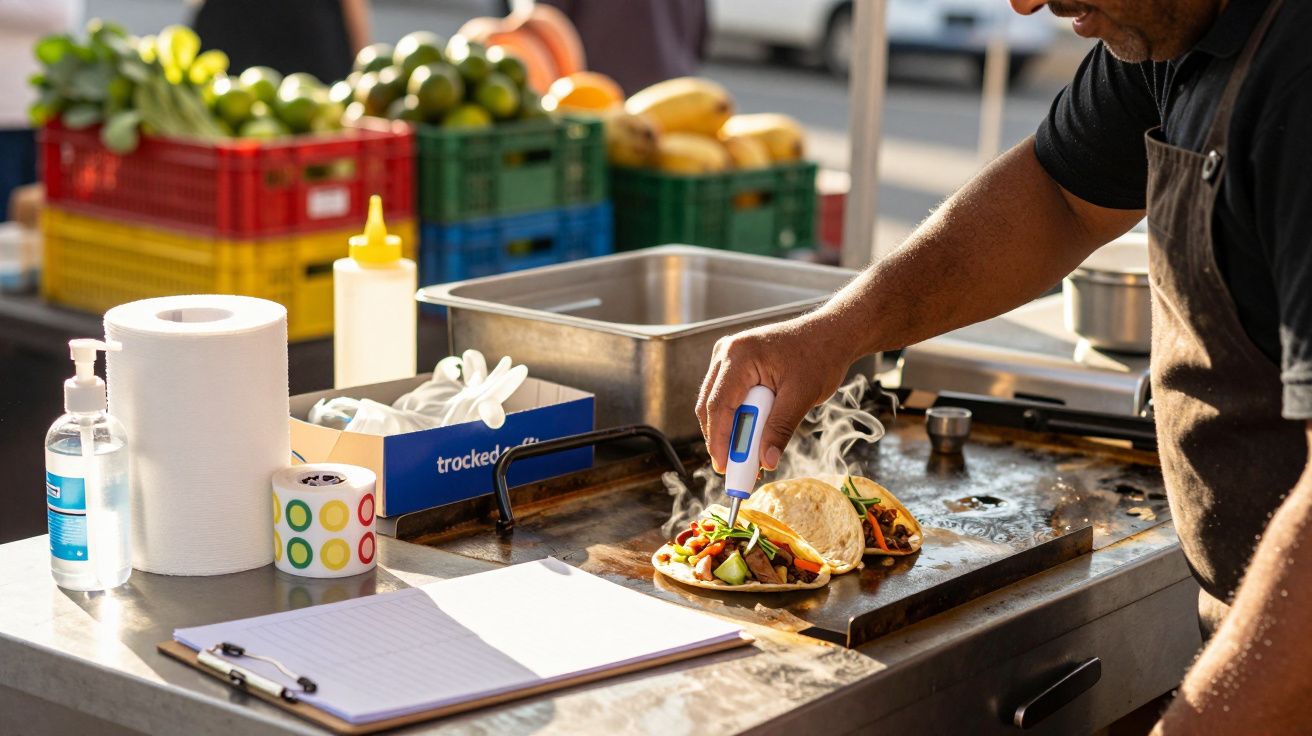
Rain on the awning, steam rising from a plancha, a queue that moves faster than you expected. In that moment, the Food Standards Agency and your local Environmental Health Officer are more relevant to your street food than any secret marinade, because most “street food myths” are really shortcuts around basic food safety. A small tweak in what you believe and what you do - especially around time and temperature - prevents the bigger issues that show up days later as complaints, closures, or worse.
Street food thrives on speed and confidence. Myths sneak in when speed starts to feel like a substitute for control.
The myth that causes the most trouble: “If it’s hot, it’s safe”
Hot food can be safe, but “hot” is a feeling, not a standard. A tray of chicken skewers can look like it’s steaming and still spend too long sitting in the danger zone while you serve, chat, and restock.
The problems rarely announce themselves at the stall. They arrive later: a customer who falls ill, a social post that tags your brand, an inspection that asks for records you don’t have.
The most useful mental shift is to stop guessing and start treating time like an ingredient you can run out of.
The small tweak that prevents bigger issues later: swap “looks fine” for “tracked”
You don’t need a lab coat or a clipboard obsession. You need one simple habit: decide your safe limits in advance, then stick to them every service.
For most street food set-ups, the high-impact tweak is adding one cheap probe thermometer and using it at the moments that matter. The second tweak is using a timer (your phone is enough) so “just a minute” doesn’t turn into 45.
The moments that matter most
- Cooking: hit a safe internal temperature (especially for poultry, burgers, sausages).
- Hot holding: keep hot food properly hot, not just “warm on the edge”.
- Cooling and reheating: don’t rely on a quick blast to undo hours of slow cooling.
- Allergen cross-contact: a “tiny bit” on a shared spoon can become a real incident.
None of these require fancy kit. They require a few repeatable checks done the same way every time, even when the queue is three deep.
Four common street food myths (and the small fixes that actually work)
Most myths are comforting because they’re simple. The fixes are also simple - just less cinematic.
1) “Lime/lemon/vinegar kills the germs”
Acid helps flavour and can slow some bacteria, but it doesn’t reliably sanitise raw chicken, chopped herbs, or a chopping board. Ceviche-style “cooking” is not a magic shield when your prep and storage are sloppy.
Small fix: keep raw and ready-to-eat foods physically separate, and clean down properly. If you’re tight on space, use a strict order: prep salads first, then raw meats last, then full clean.
2) “Gloves mean clean hands”
Gloves get dirty the same way hands do. The difference is people trust gloves for too long, touching money, phones, and sauce bottles with the same pair.
Small fix: if you wear gloves, treat them as single-task. Better yet, use utensils for serving and wash hands at set points (after cash handling, after raw food, after bins).
3) “Reheating fixes everything”
Reheating can make food safe if it’s been handled safely up to that point. But if rice, sauces, or pulled meats have sat warm for hours, the risk isn’t just “live bugs” - it’s toxins some bacteria can leave behind.
Small fix: cool quickly, refrigerate promptly, and reheat once. If you can’t cool it safely on site, cook smaller batches more often.
4) “The smell test is enough”
A lot of unsafe food smells absolutely normal. Your nose is good at detecting spoilage, not invisible risk.
Small fix: date-label, rotate stock, and decide your discard rules before service starts. When you’re busy, decision-making gets expensive.
A quick, realistic checklist for street food service
This is the version you can actually do in the middle of a Saturday rush.
- One probe thermometer (plus wipes) and a habit of checking the first batch and then periodically.
- One “raw-only” zone and one “ready-to-eat” zone, even if they’re just opposite ends of a table.
- One person or one method for money (separate cashier, tap-only station, or a strict handwash/reset after cash).
- Batching on purpose: cook less, more often, so food spends less time sitting around.
- A written allergen line: what’s in each sauce, what can’t be swapped, and what gets a clean utensil every time.
The point isn’t perfection. It’s removing the easy-to-miss gaps that create the biggest consequences.
Why a tiny myth-bust saves your brand (and your future self)
Most serious problems in street food are not about one dramatic mistake. They’re about a chain of small assumptions: “this is hot enough”, “that’s acidic so it’s fine”, “I changed gloves earlier”, “it’ll be alright until the next batch”.
Breaking just one link in that chain changes your whole service. Customers stay well, reviews stay boring (in the best way), and inspections feel like a formality rather than an ambush.
And if you’re the customer, the same tweak applies: don’t be dazzled by smoke and speed. Look for calm systems - separate utensils, covered storage, a stall that isn’t afraid to take ten seconds to do something properly.
FAQ:
- Is street food riskier than restaurant food? Not automatically. The risk comes from tight spaces, fast service, and temperature control challenges - but a well-run stall can be as safe as any kitchen.
- Do I really need a thermometer if I’m experienced? Experience helps, but it can’t reliably measure the centre of a burger or a tray of reheated food. A probe turns guesswork into a check you can repeat.
- Does spicy food “kill bacteria”? Spice can mask flavours and make food feel “stronger”, but it doesn’t replace safe cooking, holding, and hygiene.
- What’s the easiest first improvement for a new trader? Batch smaller, more often, and separate raw from ready-to-eat. Those two changes remove a huge amount of risk without slowing you down much.





Comments
No comments yet. Be the first to comment!
Leave a Comment