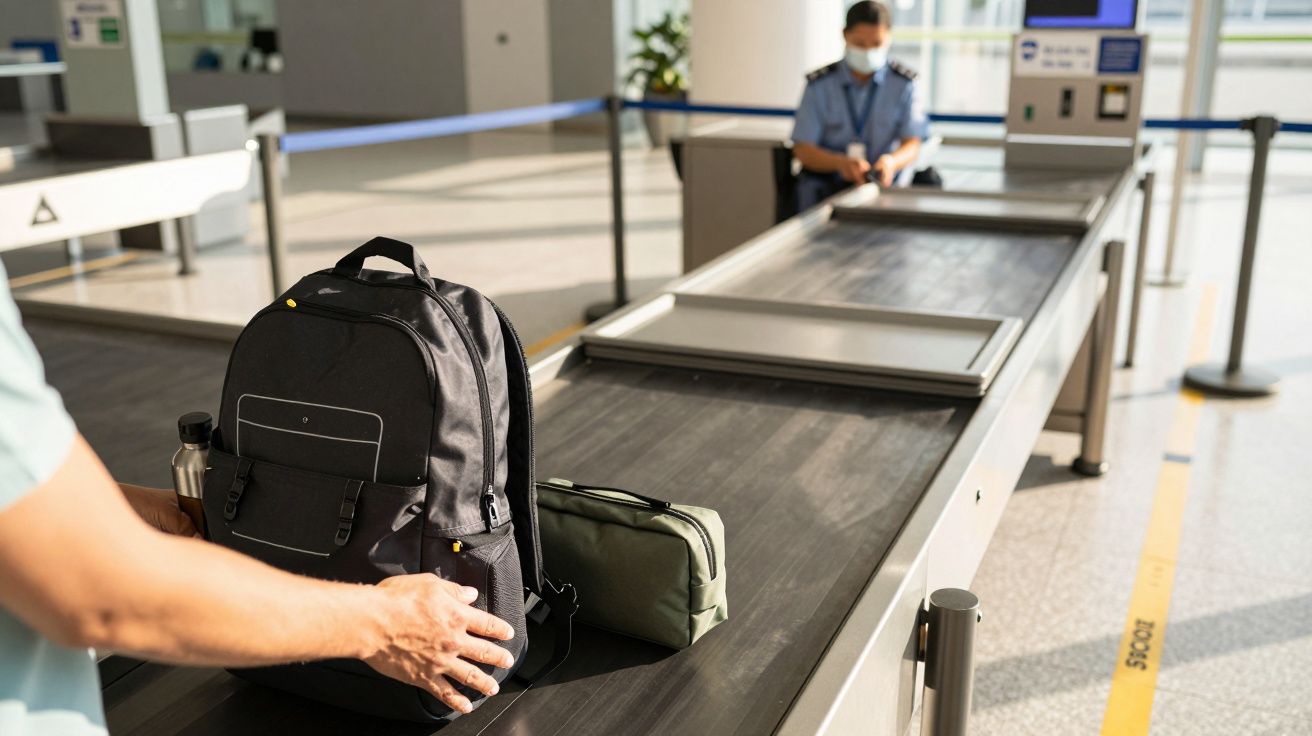
A queue snakes past the duty-free entrance, shoes scuffing, trays clattering, everyone doing the familiar pocket-emptying dance. Computed Tomography (CT) cabin baggage scanners and automatic tray return systems sit right at the pinch point of that stress, quietly changing what “security” feels like in practice. For travellers, that small tweak matters because it can catch more problems earlier while reducing the pile‑ups that create bigger issues later.
Most security failures don’t start as dramatic moments. They start as congestion, distraction, rushed decisions, and staff forced into constant triage because the lane can’t breathe.
The tiny change that makes the whole checkpoint work better
For years, the bottleneck has been predictable: too many separate actions in too little space. Take out laptops. Take out liquids. Remove belts. Repack at the end while the next wave arrives, with trays running out and tempers rising.
CT cabin baggage scanners shift one key step: they reduce (and in some lanes remove) the need to unpack liquids and electronics because the scanner can create a detailed 3D image of what’s inside the bag. Pair that with an automatic tray return system, and suddenly the lane stops behaving like a one-way conveyor and starts behaving like a loop.
The point isn’t just speed. It’s fewer rushed errors at the exact moment people are most distracted.
When the flow improves, security officers get more time to do the job that actually prevents incidents: interpreting images, resolving alarms properly, and intervening early-before a minor confusion becomes a missed detection, an argument, or a shutdown of the lane.
Why “smoother” security is also safer security
It’s tempting to think of queue time as a customer-service issue and detection as a separate technical issue. In real checkpoints, they’re braided together.
Crowding increases the chances of mix-ups: the wrong bag on the wrong tray, property left behind, passengers stepping into restricted areas to retrieve items, and families splitting across the divestment point because someone is still repacking. Those aren’t just annoyances-they’re small security gaps.
A calmer lane creates three safety advantages:
- Fewer manual handling steps (less unpacking, less re-packing, fewer chances to miss an item or misplace it).
- More consistent screening decisions (officers spend less time firefighting the queue and more time resolving images).
- Cleaner separation of sterile and non-sterile spaces (less backtracking, fewer “just a second” moments across the line).
Security is a system. If one part becomes frantic, the whole system starts making compromises without meaning to.
What changes for passengers (and what doesn’t)
The “keep it in the bag” effect
In many CT-equipped lanes, travellers can leave laptops, tablets, and compliant liquids inside hand luggage. That does two things immediately: it cuts the time at the front of the lane, and it reduces the messy repacking scrum at the far end.
It also reduces a quieter risk: loose electronics and bottles are easy to forget, easy to steal, and easy to confuse with someone else’s items when trays stack up.
The rules still exist-just in fewer places
Even when lanes allow more items to stay packed, security still needs clear decision points. The process tends to work best when airports avoid mixing messages lane-to-lane.
If you’ve ever heard “leave everything in” in one lane and “take everything out” in the next, you’ve seen how confusion multiplies. People second-guess, stop mid-action, and the line stalls again.
A simple traveller checklist still helps, even in modern lanes:
- Follow the signs for that specific lane, not what you did last month.
- Keep pockets light: phone, coins, keys together in a zipped pocket or bag.
- Pack liquids in a single, accessible place even if you may not need to remove them.
- Don’t start re-packing until you’ve cleared the belt and have your full set of items in front of you.
The small tweak behind the scenes: tray return and space discipline
Automatic tray return systems sound like a convenience feature, but they solve a very specific operational problem: tray scarcity creates micro-delays that snowball.
When travellers are slow to repack, trays don’t come back to the front. Staff either chase trays (leaving gaps elsewhere) or the lane pauses. Pauses create crowding. Crowding creates pressure. Pressure is where mistakes happen.
A well-run tray return loop does two subtle things:
- It stabilises the pace at the divestment point, so officers aren’t constantly toggling between “slow everyone down” and “rush everyone through”.
- It frees attention for resolution work-opening bags, checking alarms, and making clear, documented decisions.
That’s the prevention part. Not dramatic. Just relentlessly reducing the number of moments where a human is forced to rush.
Where bigger issues start-and how this prevents them
1) Alarm fatigue and rushed resolutions
In a congested lane, alarms stack up. When alarms stack up, the temptation is to resolve quickly rather than resolve correctly.
CT imaging can improve threat detection and reduce certain false alarms, but the bigger win is human: fewer surges mean officers can take the extra seconds to confirm an item properly instead of waving it through to clear the backlog.
2) Conflict at the checkpoint
Most checkpoint arguments follow the same script: “I didn’t know”, “No one told me”, “You made me late”. Confusing rules and unpredictable waiting times create the conditions for that escalation.
A smoother lane doesn’t remove the stress of travel, but it does remove the sense that the process is arbitrary. Predictability is a quiet de-escalation tool.
3) Property loss and secondary incidents
Loose items in trays lead to lost passports, phones left behind, and accidental swapping of laptops. Then people turn around, cross barriers, or demand the belt be stopped.
Each of those is a small incident with an operational cost. Enough of them, and the lane slows or closes-creating the very crowding that makes screening harder.
What airports need to get right for the tweak to actually work
New kit doesn’t automatically create a better checkpoint. The airports that get the best results tend to treat the upgrade as a process redesign, not a gadget.
Key details that matter more than they sound:
- Clear, repeated signage before you reach the trays (not only at the trays).
- A dedicated re-pack area away from the belt end, so the belt stays clear.
- Consistent lane rules so passengers aren’t forced to guess.
- Enough staff at peak times to resolve alarms quickly, not just to manage the queue.
The goal is simple: keep divest, screening, and re-pack as three separate zones, not one tangled crowd.
A practical way to think about it as a traveller
If you want to understand why a “small tweak” prevents bigger problems, picture security like a narrow bridge.
When everyone has to stop on the bridge to unpack and repack, the bridge becomes a car park. When the bridge keeps moving, the people checking tickets can actually check them-rather than shouting at the crowd to keep walking.
CT scanners and tray return systems don’t remove security. They remove friction. And friction is where small errors turn into bigger ones.
FAQ:
- Do CT cabin baggage scanners mean I can always leave liquids and electronics in my bag? Not always. Rules can differ by airport and even by lane, so follow the instructions and signage at the checkpoint you’re in.
- If it’s faster, does that mean it’s less thorough? No. The point is to reduce unnecessary manual steps and give officers clearer imaging and more time to resolve alarms properly.
- Why do airports still ask people to take items out sometimes? Some lanes may not be CT-equipped, procedures can vary, and officers may still request an item for closer inspection if an image needs clarification.
- What’s the simplest way to avoid holding up the line? Empty pockets before you reach the trays, keep small items together, and move to the re-pack area before reorganising your bag.
- What “bigger issues” does a smoother lane actually prevent? Queue surges, rushed decisions, conflicts at the checkpoint, property loss incidents, and operational slowdowns that can force lanes to pause or close.






Comments
No comments yet. Be the first to comment!
Leave a Comment