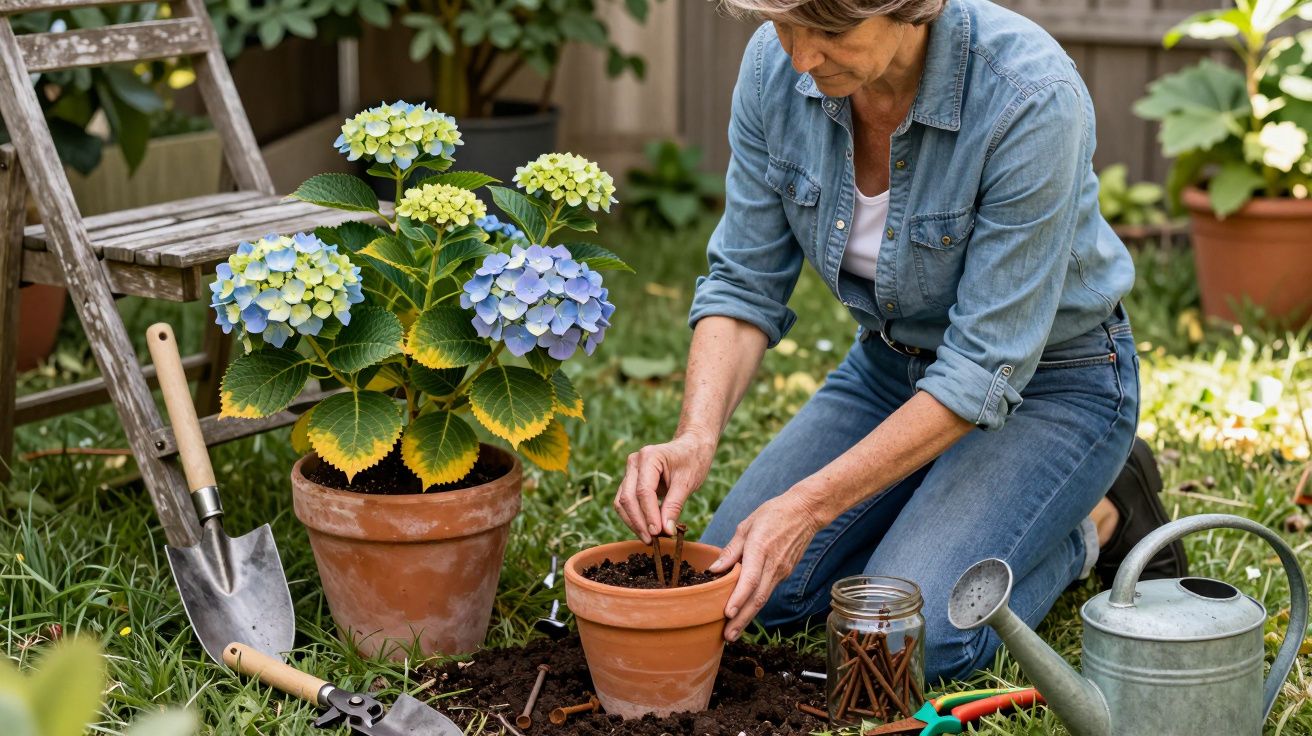
Across allotments and back gardens, old jam jars of bent, brown nails wait on shed shelves. They get tucked into pots of struggling hydrangeas, pushed into soil beside yellowing roses and scattered through containers that “just look tired”.
Behind this small ritual sits a mix of chemistry, folk wisdom and a few stubborn myths. Rusted nails can help in very specific situations – but they are not the instant cure‑all many gardeners imagine.
Think of rusty nails as a very slow, very weak iron top‑up, not a magic fertiliser pellet.
Understanding when they work (and when they don’t) stops you wasting time and lets you protect both plants and soil.
Why gardeners reach for rusted nails
The logic sounds simple: rust is iron, plants need iron, so a rusty nail in the pot must feed the plant. It is cheap, it recycles scrap metal, and it feels satisfyingly “traditional”.
Many gardeners also remember older relatives swearing that nails kept hydrangeas blue or rescued yellowing leaves. In an age of peat‑free composts and rising fertiliser prices, that sort of low‑effort hack is tempting.
There is a grain of truth in the idea. Iron does keep leaves green and healthy, and deficiency really does show up first in pots and ericaceous plants. The problem is less the idea that rust can help and more the assumption that it always will, whatever the plant or compost.
What rust actually does in soil
Rust is mainly iron(III) oxide – a highly stable, largely insoluble form of iron. Plants, however, need iron in forms they can dissolve around their roots.
For a rusted nail to make any difference, several things must line up:
- The nail has to corrode further, releasing tiny amounts of iron into the surrounding compost.
- The compost needs to be moist and slightly acidic so that some of that iron becomes soluble.
- The plant needs to be in mild, not severe, deficiency so that a slow, low‑dose supply can still catch up.
In neutral or alkaline compost, the iron from rust tends to stay locked up. The nail sits there, getting uglier, while the plant stays yellow.
In many UK containers, pH – not a lack of iron atoms – is the real problem.
That is why the “rust trick” often appears to work in some pots (typically with acid‑loving plants) and do absolutely nothing in others.
A quick comparison
| Situation | What rusty nails do | Result for the plant |
|---|---|---|
| Acidic compost with mild iron deficiency | Very slow trickle of usable iron | Slight, long‑term improvement at best |
| Neutral or chalky compost | Iron stays largely insoluble | Little to no benefit |
| Severe chlorosis (bad yellowing) | Too little, too late | Symptoms continue without other action |
When rusty nails can genuinely help
There are narrow but real cases where this old tip lines up with the gardening science.
1. Acid‑loving plants in long‑term containers
Blueberries, camellias, rhododendrons and some hydrangeas grown in pots of ericaceous compost can gradually exhaust their trace minerals. If you water them with rainwater, keep the compost on the acidic side and they develop only mild interveinal yellowing, a few rusted nails in the top 5–8 cm of compost might contribute a tiny iron supplement over several seasons.
They will not fix the problem by themselves, but they can sit alongside better‑targeted feeds as a slow background source.
2. Old metal pots leaching into soil
Where the “nails helped” story sometimes comes from is not the nail but the container. Old iron troughs, half‑barrels with iron hoops and rusty wire baskets can all leach small amounts of iron into consistently damp, acidic compost. Adding more metal in the form of nails slightly extends that effect.
In both cases, the gains are slow and subtle, not dramatic overnight recoveries.
3. Very patient gardeners
If you like hands‑off, low‑input gardening and you are already managing pH and feeding sensibly, scattering a few rusted nails through a pot is not harmful if done carefully. Over 2–3 years, they may contribute to maintaining trace iron levels, particularly where commercial feeds are rarely used.
Just do not confuse “might help in the background” with “primary treatment”.
When it’s a myth – or a bad idea
In many UK gardens, rusty nails do little more than clutter the rootball.
Alkaline and chalky conditions
Across much of the country, tap water and native soil lean alkaline. In these conditions, iron locks up easily and becomes unavailable to plant roots, however much of it technically sits in the compost. Rusted nails cannot override basic chemistry.
If you see:
- Yellow leaves with green veins on new growth
- Plants in pots watered mainly with hard tap water
- Garden soil sitting on obvious chalk or limestone
then pH control, not rusty metal, is your priority.
Expecting a quick rescue
Rusted nails release iron painfully slowly. Severely chlorotic plants – especially in small pots – need fast, soluble iron in chelated form. By the time nails have done anything measurable, the plant may already have dropped leaves or died back.
Hidden risks in modern metal
Not all nails are equal. Many modern fixings are:
- Galvanised (zinc‑coated)
- Copper or copper‑plated
- Painted or oiled
Zinc and copper are essential in tiny doses but toxic at higher levels, especially in containers with limited volume. Painted or treated nails can introduce unwanted coatings or solvents into the root zone.
Physical hazards
There is also the obvious point: sharp, rusted metal in outdoor pots where children or pets play is not ideal. While tetanus risk comes more from soil and manure than the rust itself, puncture wounds are still best avoided.
Better, faster ways to fix iron deficiency
Most problems people try to solve with rust are actually iron deficiency or nutrient lock‑up. You can tackle those directly.
1. Confirm the symptoms
True iron deficiency shows as:
- Young leaves turning lemon‑yellow
- Veins staying noticeably green
- Older leaves often remaining greener for longer
If the whole leaf, old and new, goes pale together, or edges brown and curl, you may be dealing with a different nutrient issue (or simple drought), not iron.
2. Check and adjust pH
Use a basic soil pH test kit on pot compost and nearby garden soil. Aim for:
- Around pH 5.0–5.5 for blueberries and heathers
- Around pH 5.5–6.5 for most other ornamentals in pots
If pH is too high:
- Repot into fresh, appropriate compost (ericaceous for acid‑lovers)
- Water with rainwater where possible, especially in hard‑water areas
- Avoid adding lime‑rich materials (e.g. mushroom compost, mortar rubble)
3. Use chelated iron for a quick lift
Chelated iron (often labelled “sequestered iron”) remains soluble and plant‑available across a wider pH range. Applied as:
- A watering can drench around the root zone
- A foliar spray on the leaves
it can green up mild to moderate chlorosis within days rather than months. Follow the packet dose closely; more is not better.
4. Feed and refresh compost
Container plants steadily exhaust nutrients. Once or twice a year:
- Top‑dress: scrape off the top 2–3 cm of tired compost and replace with fresh.
- Add a slow‑release fertiliser with trace elements, not just N–P–K.
- For long‑term specimens, repot into a slightly larger container every 2–3 years.
Fresh compost and balanced feeding do more in a week than a decade of rusty nails.
How to use rusted nails if you still want to
If you like the idea of reusing old nails or you are simply curious, you can use them in a way that is safer and more controlled.
Choose the right metal
- Stick to plain, untreated steel nails or small offcuts of iron.
- Avoid galvanised, painted or copper nails in pots.
- Rinse off any obvious grease, oil or building dust.
Contain the nails
Rather than pushing bare nails into the rootball:
- Place a handful of rusted nails in a small mesh bag, old nylon stocking or piece of porous fabric.
- Bury the bundle just below the compost surface, a few centimetres in from the pot rim.
- Ensure no sharp points are exposed at the surface.
This keeps metal from tangling directly with roots and makes it easy to remove if children or pets start digging.
Use them only as a backup
Treat rusty nails as a background slow‑release source behind:
- Correct pH
- Occasional chelated iron applications
- Regular repotting and feeding
If a plant still looks sickly after these steps, more nails are not the answer.
Preventing problems in potted plants
Most of the situations that send gardeners hunting for rusty nails can be avoided with a few steady habits.
- Match plant to compost. Use ericaceous compost for acid‑lovers and a good quality peat‑free mix for general containers.
- Water wisely. Collect rainwater for blueberries, camellias and rhododendrons, especially in hard‑water regions.
- Feed little and often. Apply a slow‑release fertiliser in spring, then top up with liquid feeds during peak growth if needed.
- Refresh compost. Top‑dress annually; full repot every couple of years for most long‑term pot specimens.
- Watch for early signs. Mild yellowing at shoot tips is easier to correct than full‑blown chlorosis.
Rusted nails belong, at best, in the “nice extra” category – somewhere below mulch and miles behind good compost.
FAQ:
- Will rusty nails turn my hydrangeas blue? Not reliably. Flower colour mainly depends on aluminium availability and soil acidity. Switching to acidic, aluminium‑rich compost and watering with rainwater has a far stronger effect than adding nails.
- Can nails add other useful nutrients? Plain steel nails provide iron only. They do not supply nitrogen, phosphorus, potassium or magnesium, so they cannot replace balanced fertilisers.
- Is it safe to put rusty nails in vegetable pots? It is better avoided. While iron itself is not a concern at the levels involved, sharp metal in containers you and children regularly handle is unnecessary when safer iron feeds exist.
- How many nails would I need in a pot? Even a dozen nails in a medium pot will only offer a very slight iron contribution over time. Adding more risks metal build‑up and root disturbance without proportional benefit.
- Do coffee grounds or old tea leaves do the same job as rusty nails? No. Coffee grounds and tea leaves mainly affect organic matter and, sometimes slightly, pH; they do not deliver meaningful iron in a controlled way. Treat them as compost ingredients, not targeted iron supplements.
Comments
No comments yet. Be the first to comment!
Leave a Comment