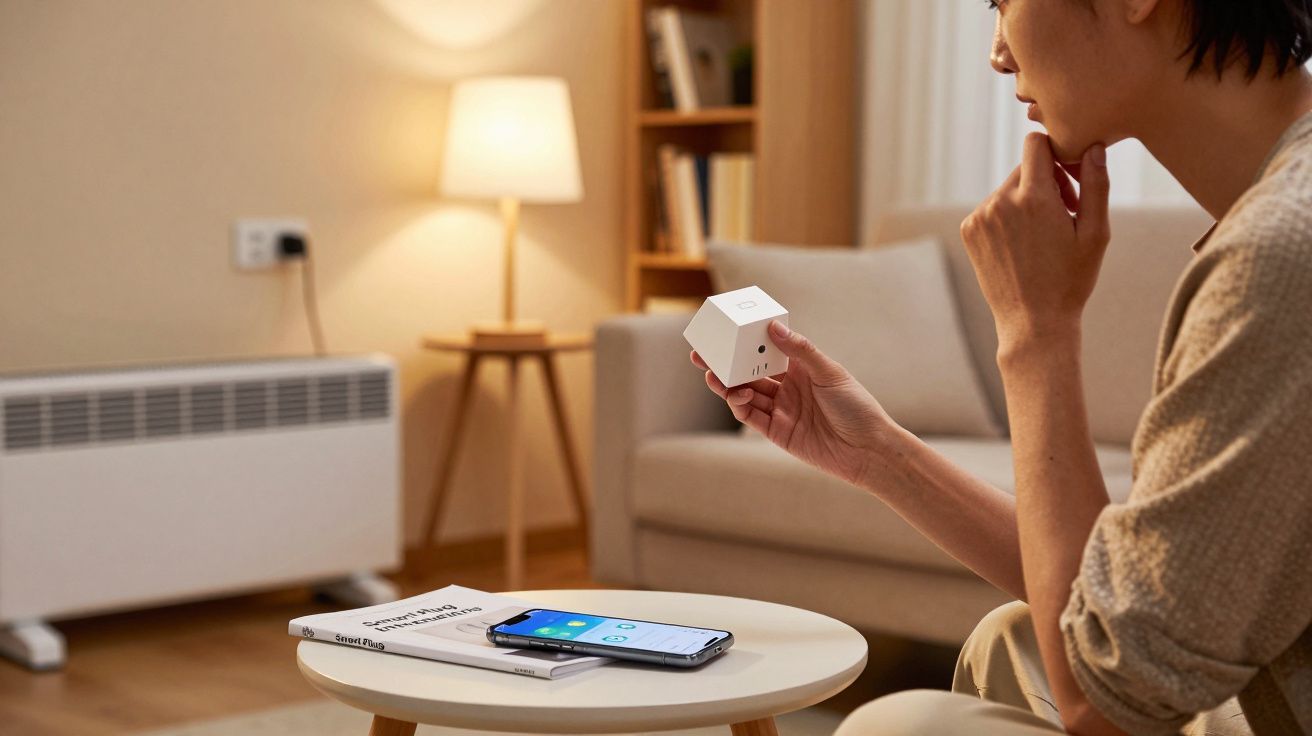
Across Britain, hallway sockets and bedroom extensions now hum quietly under the glow of tiny blue LEDs. A £7 “smart” plug turns on radiators before you wake, keeps fish tanks warm, powers dehumidifiers through the night. The app looks slick. The promise is comfort on autopilot.
An increasing number of electricians are saying they would not trust many of these cut‑price gadgets while they sleep. Not because smart plugs are inherently dangerous, but because a chunk of the cheapest imports quietly skip a basic safety step. The weak link is not the Wi‑Fi chip; it is the plug on the end of it-and one missing mark on its back.
Spend five seconds looking, they say, and you will know whether that bargain is something you are happy to leave running when everyone is in bed.
The quiet shortcut behind some “too cheap” smart plugs
Electrical safety in the UK is built on tedious detail: the shape of a pin, the rating of a fuse, the thickness of plastic around live parts. It is slow, dull work, and it is why most people never think about their sockets catching fire. Smart plugs are just another appliance in that system-unless they arrive from a factory that treats the rules as “guidelines”.
When a plug adaptor is properly designed for the UK, it should comply with BS 1363, the British Standard that covers 13‑amp plugs and socket‑outlets. That is what requires things like a correctly sized fuse, shutters over live contacts and insulated pin bases. On top of that, UK regulations now expect a UKCA mark (or, for a limited time, CE) to show the manufacturer has checked it against the right safety rules.
The problem, electricians say, is that some ultra‑cheap smart plugs sold via online marketplaces either lack those marks entirely or print them in ways that do not stand up to scrutiny. The outside looks like any other chunky white adaptor. Inside, relays are undersized, tracks are thin, clearances are tight. Add a fan heater or tumble dryer, and the margins disappear.
“If it has no BS 1363 marking and no proper conformity mark, I would not leave it running on a heater while I sleep,” one London electrician told me. “For a lamp, maybe. For 2–3 kW loads, absolutely not.”
The five‑second safety check every smart plug should pass
You do not need a multimeter or an engineering degree. The basic check is visual and quick:
- Unplug the smart plug. Never inspect it while something is running.
- Turn it over and look at the face with the pins. This is where honest manufacturers put the key markings.
In under five seconds, you should be able to find all of the following:
- “BS 1363” (or BS 1363‑3 / ‑4) clearly moulded or printed on the body.
- A rated current and voltage such as “13A 240V~”.
- A brand or manufacturer name you can actually read and search.
- A UKCA or CE mark that looks proportionate and not like random letters.
- Evidence of a fuse (usually a small removable panel marked with the fuse rating, often “13A”).
If any one of those is missing, vague or looks badly copied, treat that smart plug as something you only use under supervision and never on high‑load appliances overnight.
The marks that matter, and why
| Marking | What it indicates | Why it matters |
|---|---|---|
| BS 1363 | Plug is built to the UK plug standard | Requires fuse, pin size, insulation and shutters |
| UKCA / CE | Manufacturer claims conformity with UK/EU safety rules | Means it should meet basic electrical and fire safety tests |
| Kitemark / ASTA (optional) | Independent third‑party testing | Extra reassurance the design was properly checked |
You will not always see a BSI Kitemark or ASTA logo on smart plugs, and that is not a deal‑breaker. But you should always see BS 1363 and a conformity mark. If you do not, someone has skipped minimum expectations.
Why this tiny detail matters so much at 3am
Smart plugs do three things that make the safety margin narrower than a simple lamp adaptor.
First, they cram more electronics into the same space. Wi‑Fi chips, power supplies and relays all generate heat, which needs room and decent materials to escape safely. Cheap plastics and thin copper tracks do not help when current climbs.
Second, smart plugs are often used with heavy, continuous loads: fan heaters, oil‑filled radiators, dehumidifiers, heated airers, fish‑tank heaters. These draw anything from 500 W to 3 kW. On a properly rated, fused plug, that is fine. On an under‑specced, non‑standard device, it can push connectors and relays beyond what they were ever designed to handle.
Third, they tend to run unattended and overnight. You might spot a melting extension lead in the living room at 7pm. You are far less likely to notice a hot, deforming smart plug behind a chest of drawers at 3am.
That is why those markings, dull as they seem, are not decoration. They are a shorthand for the amount of abuse a plug can quietly soak up before it becomes a problem.
Red flags when you unbox a “bargain” smart plug
Electricians mention the same warning signs over and over. If your new gadget ticks several of these, be cautious:
- No BS 1363, no UKCA/CE, no brand name – just a model number and “Made in …”.
- Round or thin pins, or pins without insulated bases (the coloured plastic near the body).
- A two‑pin “euro” style plug with a loose travel adaptor permanently jammed on.
- Misprinted or wonky conformity marks (CE too close together, wrong proportions).
- A rating label that does not match the listing (sold as 13A, labelled 10A or less; or no rating at all).
- Plastic that feels very light, thin or glossy with visible gaps at joints.
- A burning smell, discolouration or excessive warmth after a short period on a moderate load.
Any one of these is a reason not to trust the device behind furniture or while you are asleep, especially if it is switching high‑power appliances.
How to use smart plugs more safely at home
Most smart plugs from reputable brands that follow UK rules are perfectly safe when used sensibly. The trick is to combine that five‑second check with a few habits electricians wish more people adopted.
- Stick to low‑to‑moderate loads for unknown brands. Lamps, phone chargers, routers and TVs are generally fine. Avoid plugging in fan heaters, tumble dryers, kettles or portable air‑conditioners via bargain adaptors.
- Keep them ventilated. Do not trap a chunky smart plug behind thick curtains, under a pile of clothes or in a tightly packed multi‑way adaptor.
- Avoid daisy‑chaining. Smart plug → extension lead → cube adaptor → heater is asking for trouble. Go smart plug straight into a wall socket where you can.
- Feel for heat now and then. Warm is normal; too hot to keep your hand on is not. If the casing is softening or smells odd, unplug and retire it.
- Match the rating to the appliance. A 10A‑rated plug (often labelled 10A 240V~) is not designed to run a 3 kW heater continuously. Respect the lowest rating in the chain.
- Favour known brands in UK packaging. They are not infallible, but they have more to lose from a recall and tend to take standards seriously.
“If you would not be happy leaving a fan heater on a basic mechanical timer overnight, do not feel safer just because an app is involved,” as one installer put it. “The relay does not care that your phone is clever.”
What better looks like from the outside
You can usually tell when a manufacturer has not cut corners, even without opening the casing.
The packaging clearly states a UK rating (13A 240V~), mentions BS 1363 compliance and shows UKCA or CE. The instructions talk plainly about maximum loads and which appliances not to use. The plastic feels solid, the pins are straight and insulated, the markings are sharp and not easily rubbed off.
Some brands go further and highlight independent testing-BSI Kitemark, ASTA or another recognised lab. That does not make a smart plug indestructible, but it suggests someone outside the factory has actually tried to break it on purpose before you ever plug it in.
In a world of identical‑looking white blocks, that combination of clear markings, honest paperwork and physical heft is what buys you a little more peace of mind when you hit “off” on the bedroom light and leave the dehumidifier ticking quietly in the hall.
Where this leaves your current gadgets
You do not need to panic‑buy replacements for every smart plug in the house. Start with the ones on the heaviest loads and the ones you leave running while you sleep or are away.
Unplug them, flip them over, do the five‑second check. If they pass, keep using them within their rating. If they fail, consider moving them to lighter duties you can keep an eye on-or recycling them rather than gambling on a few saved pounds.
Safety here is not about fear; it is about removing the few devices that were never really built for your wiring system in the first place. Once you know what the marks mean, that choice becomes quicker, calmer and far less mysterious.
FAQ:
- Is it illegal to sell smart plugs without a UKCA or CE mark? In principle, products in scope of the regulations should carry a conformity mark, and sellers are expected to ensure that what they place on the UK market complies. In practice, online marketplaces sometimes host non‑compliant imports until they are reported or removed.
- Are all CE or UKCA marks trustworthy? Not always. Some are faked or misused. That is why it helps to see them alongside BS 1363, a clear rating, a real brand name and decent build quality, rather than floating on an anonymous plastic shell.
- Can I safely use a travel adaptor with a smart plug? For occasional, supervised use with low‑power devices, a decent travel adaptor can be fine. For permanent, high‑load use in the UK, you should use a smart plug with a proper BS 1363 fused plug, not a euro plug jammed into an adaptor.
- Is it okay to plug an extension lead into a smart plug? It is better to avoid chains where possible. If you must, keep the total load within the lowest rating in the chain, and never run heaters or other high‑power devices that way.
- What should I do if a smart plug gets very hot or discoloured? Unplug it immediately, stop using it and do not be tempted to “give it one more chance”. Take photos, contact the seller or manufacturer, and if you suspect a serious safety defect, report it to Trading Standards or via Citizens Advice.






Comments
No comments yet. Be the first to comment!
Leave a Comment