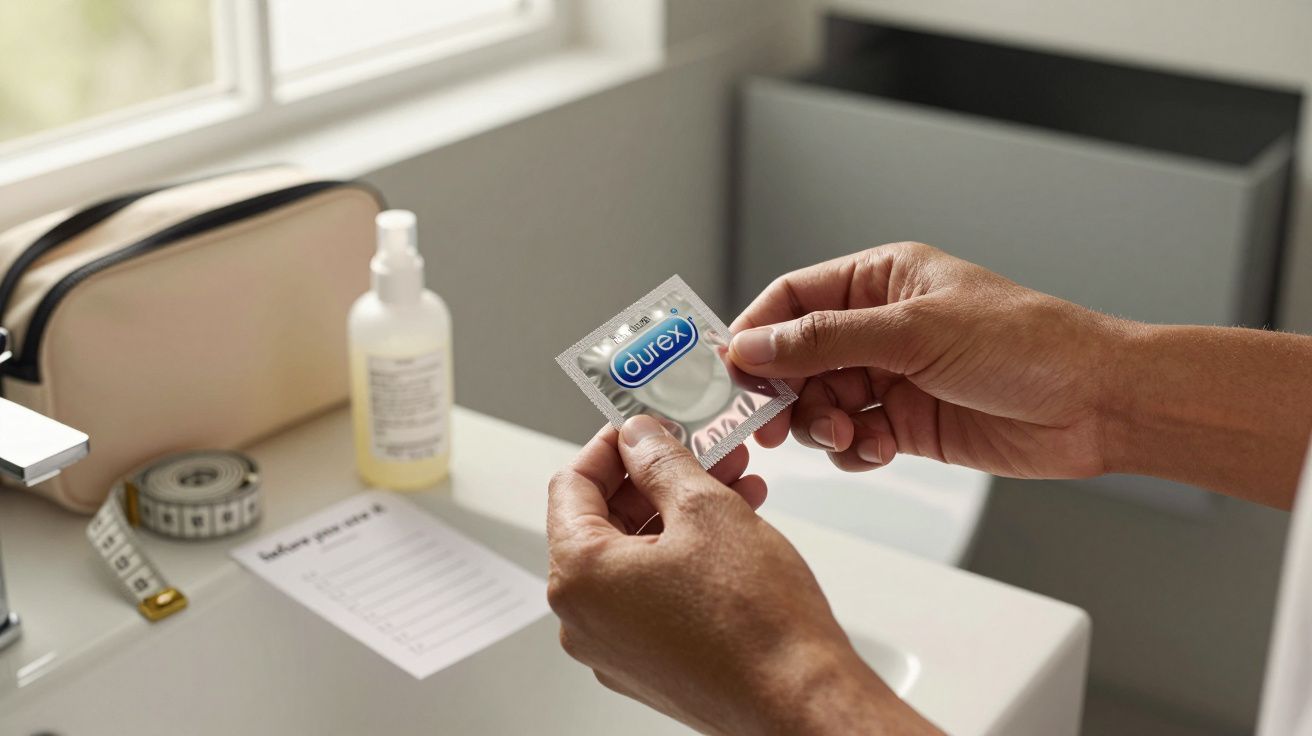
In the rushed half‑light of a bedroom, a pack of durex condoms can feel like the simplest purchase in the world: pick a familiar brand, keep it in a drawer, assume you’re covered. There’s no secondary entity involved here - just a household name and the expectation that “a condom is a condom”. But the catch is that most problems people blame on “bad luck” are often predictable, because the important details are easy to miss on the box.
That matters for two reasons: comfort affects whether you’ll use one properly, and fit affects whether it stays on and holds up under pressure. The brand looks straightforward; the way people actually use it rarely is.
The catch most people miss: “regular” isn’t a real size
Walk down a UK supermarket aisle and it’s all vibes: Extra Safe, Thin Feel, Pleasuremax, Naturals. What you don’t see clearly on the front is the measurement that quietly matters most: nominal width.
Nominal width is the condom’s laid‑flat width in millimetres. It’s not the same as length, and it’s not the same as what you “normally buy”. Two condoms can both look like “standard” packs and still fit very differently in practice.
When a condom is even slightly off, the failure modes are boringly consistent:
- Too tight: discomfort, reduced sensation, more friction, higher chance of breakage.
- Too loose: slipping, bunching, air pockets, higher chance of leakage.
- “Technically on” but not right: people adjust it mid‑use, roll it back, or add the wrong lube - all of which increases risk.
The common mistake is thinking thickness is the main safety factor, when fit and use are usually the bigger variables.
Why fit changes safety more than most marketing labels
A lot of consumers treat “Extra Safe” like it’s a stronger, safer category in a way that cancels out everything else. In reality, safety comes from a chain of small behaviours working together: correct size, correct direction, pinch the teat, roll down fully, enough lubrication, and not letting it dry out.
“Extra safe” styles are often thicker, which can help some people feel more confident. But thicker doesn’t automatically solve:
- using an old condom,
- using oil‑based products with latex,
- storing it somewhere hot,
- putting it on halfway through sex,
- or wearing a fit that’s wrong for your body.
If the condom fits well and is used properly, a thinner condom can still be reliable. If it fits badly, thickness becomes a distraction.
The packaging detail you can check in 10 seconds
If you’re only ever buying whatever pack is on offer, try one upgrade: look for the nominal width (often in small print on the box or leaflet), then keep that number in your head.
A quick, practical way to approach it:
- If condoms feel tight or leave a deep ring: try a wider nominal width.
- If they slip or feel baggy at the base: try a narrower nominal width.
- If breakages happen repeatedly: treat it as a fit/lube/storage problem first, not a “bad batch”.
If you can’t find the measurement on the front, check the side panel, the leaflet inside, or the retailer’s product listing where specifications are sometimes clearer than the packaging.
“Thin”, “ribbed”, “delay” - what those features do (and don’t) change
Most varieties change feel, not fundamentals. It helps to separate what’s genuinely different from what’s mostly branding.
Here’s the simple mental model:
- Thickness (e.g., Thin Feel): changes sensation; can also change how quickly it warms up and how it feels with friction. It does not replace correct lubrication.
- Texture (ribbed, dotted): changes friction patterns; can feel great, but may need more lubricant to stay comfortable.
- Desensitising (delay condoms): contains a numbing agent; useful for some, irritating for others, and can reduce sensation enough that people don’t notice slipping.
- Shape (easy‑on, contoured): can make rolling easier, but only if it’s the right direction and size.
If you’re troubleshooting a recurring issue, switch one variable at a time. Changing size, thickness and lube all at once makes it impossible to know what fixed it.
Storage is the quiet deal‑breaker
Most condom failures that feel “random” have an unglamorous cause: heat, friction, or time.
Condoms do best when they’re treated like medication, not like spare change.
- Avoid wallets for long‑term storage. Sitting, bending and body heat add up.
- Avoid cars, radiators, sunny windowsills. Heat accelerates degradation.
- Avoid loose bags where keys and chargers grind the wrapper.
- Check expiry dates before you need them, not in the moment.
That last point is bigger than it sounds. If you only ever discover the date at 1am, you’ll convince yourself “it’ll be fine”. Sometimes it is. Sometimes it isn’t.
The lubricant trap: what you add matters as much as what you buy
In the moment, people reach for whatever is nearby - moisturiser, massage oil, Vaseline, baby oil. With latex condoms, that’s the classic mistake.
Oil‑based products can weaken latex and increase the chance of breakage. If you’re using a typical latex durex condom, stick to water‑based or silicone‑based lubricants unless the packaging explicitly says otherwise.
A quick compatibility cheat sheet:
- Latex condoms: water‑based or silicone‑based lube.
- Avoid with latex: oils, petroleum jelly, many oil‑based lotions.
If sex feels dry, adding lube is not “extra”. It’s often the difference between a condom that stays intact and one that fails from friction.
Don’t ignore irritation - it changes behaviour fast
When someone feels burning, itching, or swelling, they often power through, stop using condoms altogether, or start “taking breaks” mid‑sex. That’s where STI and pregnancy risk climbs.
Irritation can come from:
- not enough lubrication,
- a texture condom that increases friction,
- sensitivity to certain lubricants or spermicides,
- latex sensitivity.
If latex is a problem, consider non‑latex options (and read the pack carefully for material and compatibility). If symptoms are severe or persistent, it’s worth speaking to a pharmacist or clinician rather than cycling through products blindly.
Counterfeits: the risk people don’t like to talk about
A branded box creates trust, which is exactly why counterfeiters target well‑known names. Buying from major retailers and reputable pharmacies reduces the risk compared with unknown marketplace listings.
If anything looks off - unusual print quality, missing batch details, odd smells, damaged foil - don’t treat it as “probably fine”. Binned condoms are cheaper than consequences.
A simple “before you use it” checklist that actually works
You don’t need a lecture in the moment. You need a repeatable habit.
- Check the expiry date.
- Squeeze the wrapper gently: you should feel an air bubble (a rough sign the seal is intact).
- Open carefully (no teeth, no scissors).
- Pinch the teat, roll down fully, and add lube if there’s friction.
- If it slips off, breaks, or you’re unsure: stop, replace, and consider emergency contraception/STI advice if needed.
The boring truth is that condoms are a small engineering product. They work brilliantly when the basics are respected, and they fail in predictable ways when they aren’t.
Once you know the catch - that fit, storage and compatibility matter as much as the label - durex stops being “simple”, in the best way. It becomes something you can actually control.




Comments
No comments yet. Be the first to comment!
Leave a Comment