A fox cuts across the car park at 2.47 a.m.
You don’t see it, but your dog does. One flash of movement beyond the glass and the quiet night snaps. Barking, claws on laminate, the thud against the front window you keep meaning to child‑proof. Lights on, heart racing, apology ready for the neighbours you’ll bump into at the bins tomorrow.
By the time you’ve coaxed them back to bed, the fox is long gone. The only one still on high alert is your dog – and your nervous system.
You try later bedtimes, earlier walks, “stern voice” chats at midnight. Maybe even a new harness that promised to “calm anxious dogs”. Nothing really changes.
Then someone at the park says, almost casually, “We just changed how our curtains hang and he stopped yelling at the street.”
A curtain tweak. Not a new lead, not a special collar. Just fabric between your dog and the outside world.
It sounds too simple. It also happens to be exactly the kind of low‑effort, high‑impact change many behaviourists quietly recommend first.
Why your “naughty” dog barks the street awake
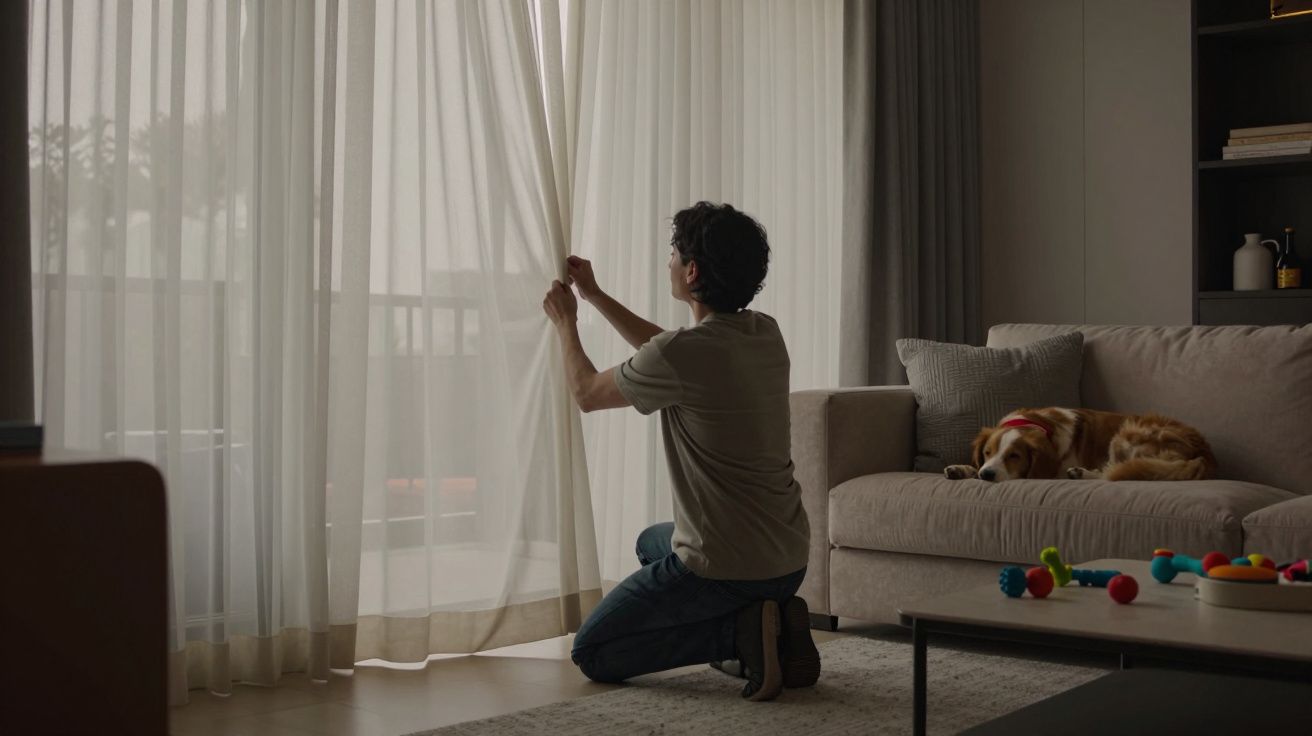
Stand in your sitting room and you see a window. Stand where your dog stands, at their height, and you see something closer to a cinema screen.
Headlights gliding past, foxes slipping along fences, neighbours’ doors slamming, reflections of other dogs in the glass. Every flicker is a possible threat or opportunity. For an anxious or alert dog, that window becomes a night‑shift security job they never clock off from.
Each time they bark and the “intruder” disappears – the car drives on, the person walks past – the dog’s brain quietly logs a win.
“I barked. The thing went away. Good job, me.”
It doesn’t matter that the timing is coincidence. The feeling of success sticks.
That’s why late‑night barking so often gets worse, not better. Your dog isn’t being difficult for fun; they’re practising vigilance. The more they rehearse it at the window, the better they get.
Behaviourists call this “trigger stacking”: multiple small stresses building on top of each other. A noise in the stairwell, a cat on the wall, a bus braking outside. The window lets all of it in – and keeps your dog on edge even when the flat is technically quiet.
This is where the curtains stop being decoration and start being equipment.
The tiny curtain tweak that changes the whole night
What behaviourists often suggest is not simply “close the curtains”.
It’s “close the line of sight”.
Most household curtains leave slivers of glass exposed: a gap at the sides, a bright strip at the bottom, a panel your dog can see through if they stand on the sofa. To a dog on patrol, those gaps are viewing platforms.
The tweak is to hang or adjust your curtains so that, at dog eye‑level, there is nothing to watch. No direct line to the car park, the corridor, or the garden. Just a solid, non‑flapping block of fabric.
In practice, it usually means one or more of these:
- Lowering the curtain rail or using longer curtains so they sit well past the windowsill and cover any bottom gap.
- Choosing thicker, lined or blackout curtains for the “noisiest” windows to dull light, movement and some sound.
- Clipping or weighting the sides so they overlap the wall or frame and don’t leave triangle gaps.
- Adding a second layer (like a static, opaque blind) behind a decorative sheer so the dog can’t actually see the street.
From your height, the room still feels normal. From your dog’s, the late‑night action channel quietly turns off.
You’re not “ignoring” the problem. You’re removing 50–70% of the things that keep setting it off.
How to set up your curtains like a behaviourist
The method is simple, but it works best if you think like a dog for ten minutes.
Drop to their level.
Sit or kneel where your dog usually patrols – by the patio doors, on the sofa, at the bay window. Look out. Any slice of glass you can see, your dog can probably see better.Map the triggers.
Notice what’s visible: car lights, the lift lobby, people at the bus stop, the neighbour’s cat route. These are the things your dog is currently “monitoring”.Close the view, not the room.
Adjust curtains, blinds or both so that from dog height, there is no clear view outside at night. It’s fine if there’s a gap high up for you – the important bit is the bottom metre or so.Anchor the edges.
Use simple tools: curtain weights, bulldog clips at the back, a tension rod for an extra panel, even a rolled towel along a draughty threshold. The goal is to stop bright wedges of light appearing when a lorry goes past.Make it part of the evening routine.
Close the “dog view” before the busy period begins – typically around dusk, or whenever footfall outside your home increases. Pair it with something positive: a chew, a lick mat, a scatter of kibble on a snuffle mat.
For many dogs, the difference feels almost immediate. Not because the curtain is magic, but because you’ve removed a huge chunk of their job description.
Why this tiny change calms the whole system
Behaviourists often start with management – changing the environment – before they ask owners to dive into formal training. The curtain tweak is a classic example of intelligent management.
By blocking the view, you:
- Reduce the number of alarms. Fewer moving things to see means fewer “must bark now” moments.
- Lower overall arousal. Without constant micro‑alerts, your dog’s nervous system has a chance to drop down a gear in the evenings.
- Break the habit loop. If they can’t see the fox/car/person, they can’t rehearse the behaviour that’s been accidentally reinforced.
Heavier curtains add a small sound‑dampening effect too. They won’t silence the street, but they can soften sharp noises enough that they don’t tip an already edgy dog over the edge.
This doesn’t replace proper training, especially if your dog struggles with separation anxiety, fear of noises or bigger behavioural issues. It simply gives their brain less to cope with.
And for many households, that’s the first time in months anyone sleeps through without a 3 a.m. sprint to the window.
Quick tweaks you can try this week
You don’t need an interior designer or a full‑length blackout system to start.
- Swap light voiles on the street‑facing window for something thicker, at least for night‑time.
- Add an inexpensive blackout roller blind behind existing curtains.
- Use pegs or clips to pull curtain edges further over the wall so no glass peeks through.
- Move the dog bed away from the window, even by one or two metres, and closer to an interior wall.
- Introduce a calming night routine: curtains closed, chew delivered, lights slightly dimmed, same order every evening.
Think of it as giving your dog a bedroom with a door, rather than asking them to sleep in the hallway of a busy hotel.
Common night‑time problems and curtain fixes
| Problem at night | Likely trigger at the window | Curtain tweak that helps |
|---|---|---|
| Barking at every car or passer‑by | Moving lights and silhouettes on the pavement or car park | Full‑length, lined curtains or a blackout blind that covers all external light at dog height |
| Barking “at nothing” and staring at glass | Seeing their own reflection or faint shapes outside | Add a non‑reflective, opaque layer (frosted film, blackout roller) behind glass |
| Bursts of barking when lift doors / communal lights activate | Sudden light changes and people appearing in frame | Close curtains before busy times, overlap edges with clips or weights |
| Dog pacing between window and front door | Self‑appointed guard duty, checking both “fronts” | Block view at main window, move resting spot away from both viewing points |
What this tiny curtain habit really changes
Changing how curtains hang sounds like an odd answer to a noisy problem. Yet once the late‑night drama stops streaming through the glass, your dog finally gets a chance to switch off.
For you, it’s not just about silence. It’s about walking into the sitting room at 10 p.m. and seeing your dog stretched out, half‑snoring, instead of posted at the window like a security guard on overtime.
You haven’t “failed” training. You’ve simply given their nervous system fewer battles to fight in the first place.
One day you’ll mention it to someone else, rummaging for leads at the park: “Try blocking the view at their height with thicker curtains. It changed our nights.” No big lecture. Just a small, practical nudge – the kind that often works better than the fanciest gadget.
FAQ:
- Will curtains alone stop all night‑time barking?
Not always. They can dramatically reduce barking linked to sights outside, but noise phobias, separation anxiety or discomfort (like pain or needing the toilet) also need addressing with your vet or behaviourist.- Do I have to keep the room dark all evening?
No. You’re aiming to block the view out, not live in gloom. You can still have lamps on, TV running and a normal evening; just make sure the glass isn’t acting as a screen at dog level.- What if I only have blinds, not curtains?
Many blinds leave side gaps. You can add side channels, a secondary blackout blind, or an inexpensive pair of curtains over the top to close those gaps at night.- Won’t my dog just find another place to bark?
Some might shift to the front door or another window, which is why it helps to block key views and also give them an inviting resting spot away from traffic areas, plus something calm to do.- When should I still call a professional?
If your dog panics when left alone, startles violently at every sound, or their barking has come on suddenly with other changes (like clinginess or aggression), speak to your vet and a qualified behaviourist. Curtains are support, not a substitute, for proper assessment.




Comments
No comments yet. Be the first to comment!
Leave a Comment