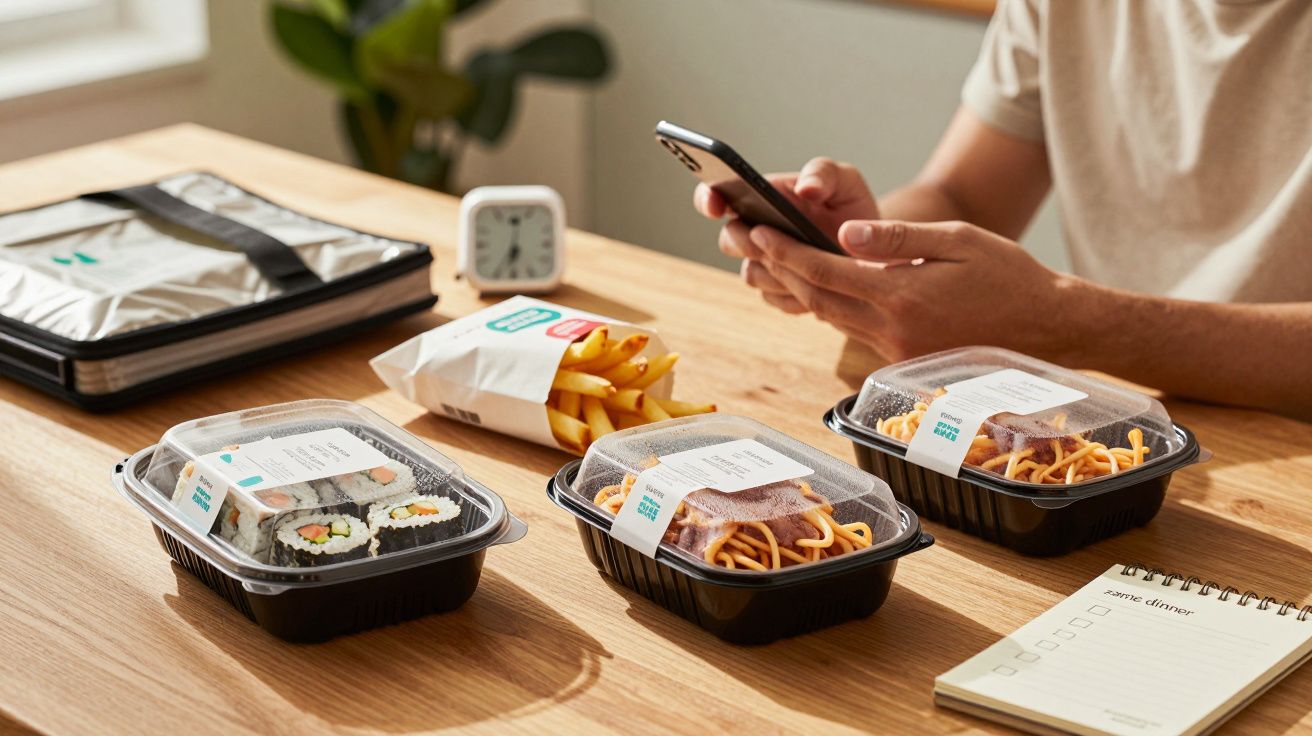
On a normal weekday evening, Deliveroo can feel like the most efficient kind of modern convenience: a few taps, a map, and food appears at your door. I’m talking about deliveroo in the UK, used everywhere from city flats to suburban streets, and yes, `` too - because the service only feels “simple” when a lot of hidden pieces are behaving. It matters for readers because once it becomes part of your routine, the cost, timing and reliability start shaping how you plan dinner at all.
When it works, it really works. The problem is that it’s not a single service so much as a chain of small systems, and chains don’t fail politely.
When everything lines up, it feels effortless
On a quiet night with decent weather and plenty of riders on the road, Deliveroo is close to the ideal version of takeaway. You can compare menus quickly, track progress in real time, and pay without fumbling for cash or waiting by the phone. It’s not just food either; the “I’ve got nothing in” panic can be solved with groceries, snacks, or a last-minute pack of something you forgot.
The best part is the reduction in friction. No busy phone line. No “we don’t deliver to that postcode”. No awkward guessing game about when it will turn up.
That smoothness is why people forgive the fees on good days. You’re not only buying the meal - you’re buying the feeling that your evening will stay intact.
Deliveroo’s magic trick is making a messy, real-world process look like a clean timeline on a screen.
The system is only as strong as its least convenient part
The weak point isn’t always the app. Most of the time, it’s the real-world constraints the app can’t fully control.
A typical order depends on:
- a restaurant hitting its prep time (and not being swamped)
- a rider being nearby, available, and willing to accept the job
- roads staying passable enough to keep the route predictable
- your building access being straightforward (buzzers, lifts, gates)
- stable mobile data for everyone involved
None of these is dramatic alone. But if two or three wobble at once, the experience changes character: from “dinner in 30 minutes” to “a saga with push notifications”.
And the customer only sees the final symptom - a delivery estimate that stretches, a rider that circles, a bag that arrives lukewarm - rather than the specific bottleneck. That mismatch is where frustration grows.
The moment conditions change, the cracks show
Deliveroo tends to be reliable in the middle of the bell curve: ordinary demand, ordinary staffing, ordinary weather. It’s at the edges - the nights you actually care about - where it can feel like a different product.
Common triggers that flip a good experience into a stressful one include:
- heavy rain or high winds (fewer riders, slower journeys)
- Friday and Saturday peaks (kitchens back up, dispatch slows)
- big local events (football, gigs, graduations)
- transport disruption (road closures, strikes, rail delays)
- seasonal surges (December weekends, bank holidays, heatwaves)
When those conditions hit, two things often happen at the same time. First, availability narrows: the restaurants you rely on might pause orders, extend prep times, or vanish behind “busy” banners. Second, the economics change: delivery fees rise, minimum order thresholds appear, and small-basket convenience suddenly gets expensive.
It can feel personal - like the app has decided your postcode is a nuisance - when it’s really the platform protecting its ability to fulfil orders at all.
A small experiment: ordering the “same” dinner on three different nights
To see how much the experience shifts, try placing the same kind of order (similar distance, similar price point) across three different conditions: a calm weekday, a wet night, and a weekend peak. You don’t need lab-grade precision to notice the pattern.
What tends to change fastest is not the menu price, but the total: delivery fee, service fee, and the silent cost of time. A meal that feels “worth it” at 6.30pm on a Tuesday can feel like a bad decision at 8.30pm on a Friday - even if the restaurant and basket are identical.
The less obvious change is the quality risk. Longer waits mean more time for fries to soften, ice to melt, and hot food to cool. Deliveroo can’t rewrite physics; it can only move the handover points around.
The psychological trap: it looks predictable right up until it isn’t
The UI encourages certainty. There’s a countdown, a map, a sense of control - and that’s exactly why delays sting. If you’d been told “it’ll be an hour” at the start, you might plan a snack or cook pasta. But when you’re told 25–35 minutes and it becomes 60+, you spend that extra time waiting in a half-committed state.
This is also why “on the way” can be such a loaded phrase. The rider may genuinely be moving, but “moving” can include a second pickup, a wrong turn, a locked entrance, or a restaurant that wasn’t actually ready at collection time.
The platform experience stays calm. The human experience doesn’t.
How to make Deliveroo behave more like the good version of itself
You can’t control weather or staffing, but you can order in ways that reduce exposure to the worst failure modes. The goal is to make your order easier to fulfil.
Practical tactics that usually help:
- Order earlier than you think you need. If you want to eat at 8, place it at 7.15 rather than 7.45 on peak nights.
- Choose nearer restaurants. Shorter routes reduce temperature loss and the chance of delays compounding.
- Avoid fragile foods when it’s busy. Fries, crispy coatings, and ice cream are “time-sensitive”; stews, curries, and noodles travel better.
- Keep delivery instructions tight. One clear sentence beats a paragraph (and include the right door/buzzer).
- Treat the fee as a signal. If delivery suddenly jumps, it’s often telling you capacity is strained - that’s when you decide whether to proceed or pivot.
It’s also worth building a “backup dinner” habit. Not a full plan B every night - just one reliable, low-effort option in the house for the evenings when the platform is clearly under strain.
What Deliveroo could do better when things go wrong
Most people don’t demand perfection; they want clarity and decent recovery. The most helpful improvements would be the unglamorous ones: better truthfulness, better substitutions, better service gestures when the system slips.
Three fixes that would change the feel of bad nights:
- More honest ETA ranges at peak stress. A wider estimate that’s accurate beats a narrow one that keeps expanding.
- Clearer explanation of delays. “Restaurant running behind” vs “rider shortage” helps customers make rational choices.
- Stronger service recovery. When an order arrives very late or cold, easy refunds/credits reduce the sense of being trapped in a process.
Because this is the real test: not whether Deliveroo is good on an easy Tuesday, but whether it handles the hard Friday without making the customer do emotional admin.
The takeaway: convenience is conditional
Deliveroo is genuinely useful, and for many households it’s become the default interface for takeaway. But it’s a fair-weather convenience: it performs best when the city is calm, the roads are kind, and plenty of riders are working.
Once conditions change, you’re not just paying more. You’re also gambling more - on timing, temperature, and whether the evening stays pleasant.
FAQ:
- Can I rely on Deliveroo for time-critical meals (like a short lunch break)? Only if conditions are calm and the restaurant is close. For anything time-critical, choose nearby options and order earlier than usual.
- Why do delivery fees jump on some nights? Fees often rise when demand is high or rider availability is low. It’s a pricing signal that capacity is under pressure.
- What kinds of food travel best when it’s busy? Saucy dishes, soups, curries, and noodle/rice dishes usually hold up better than fries, crispy coatings, or anything meant to be eaten immediately.
- What’s the simplest way to reduce delays? Order earlier, pick a closer restaurant, and avoid peak times if you can (or accept that peak times come with higher risk).




Comments
No comments yet. Be the first to comment!
Leave a Comment