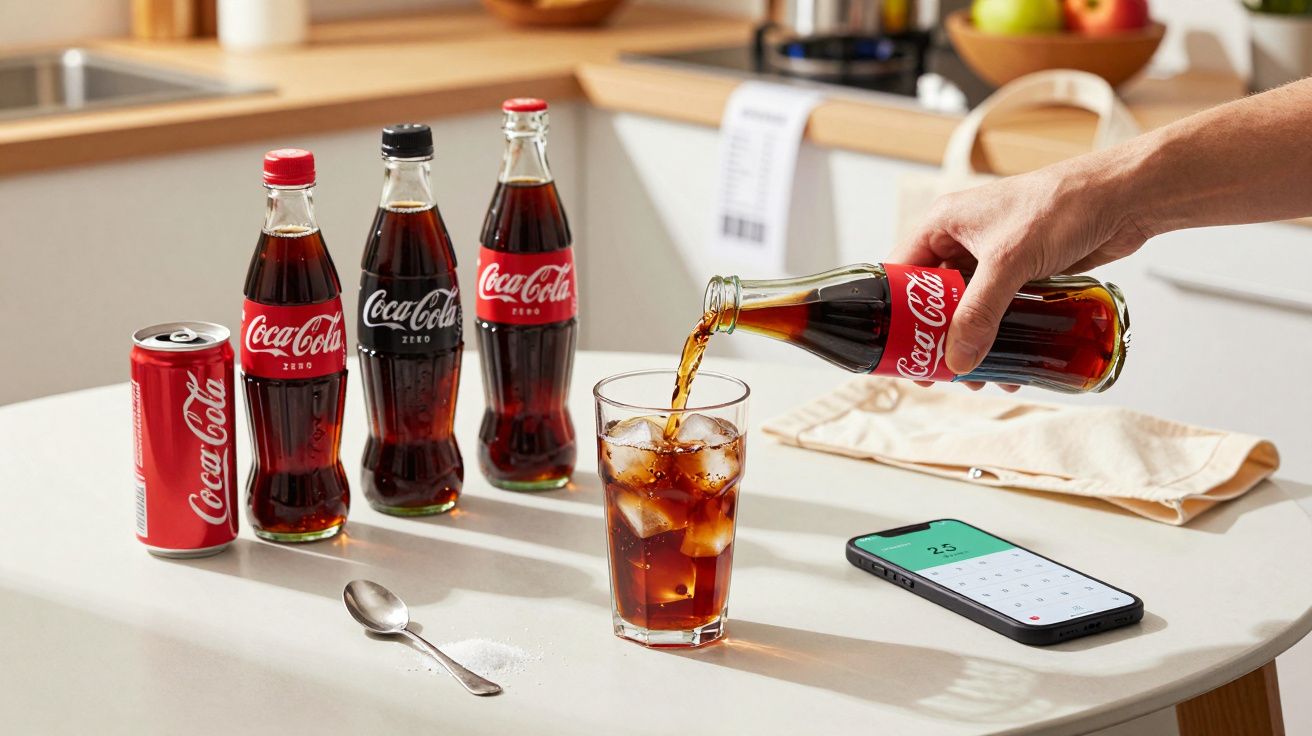
Coca-Cola is the drink that turns up everywhere - in pub fridges, meal deals, cinema cups and the “just in case” multipack at home - and it feels as straightforward as a brand can be. With no secondary entity to distract you, it’s easy to assume one red label means one familiar thing. The catch is that the product looks consistent while the numbers and format quietly change the deal you’re actually getting.
Most people don’t miss Coca-Cola because they can’t read the ingredients list. They miss it because the serving size is doing the misdirection.
The bottle isn’t one serving - and the label often isn’t talking about your bottle
Pick up a 500 ml bottle and your brain reads it as “a drink”. Manufacturers often present nutrition per 100 ml (useful for comparisons) and sometimes per 250 ml (useful for almost nobody), while the container in your hand is 500 ml.
That matters because the moment you finish the bottle, you’ve doubled whatever you thought you were consuming when you glanced at the “per serving” row.
The sneakiest part isn’t the sugar number - it’s the unit the sugar number is attached to.
A quick way to sanity-check it:
- If it’s a can (330 ml): you’ll likely drink the whole thing.
- If it’s a bottle (500 ml / 1.25 L / 2 L): the label may be describing a smaller “serving” than you’ll actually pour.
- If it’s fountain/post-mix: you often have no label at all, just a cup size that keeps growing.
The everyday maths most people never do
In the UK, Coca-Cola Original Taste is roughly 10.6 g of sugar per 100 ml (check your specific pack; labelling can vary). That means:
- 330 ml can: about 35 g sugar
- 500 ml bottle: about 53 g sugar
Those two formats feel like near-substitutes in your head. Nutritionally, they’re not.
“Same Coke” can mean different recipes and different experiences
Even when the front looks identical, what you’re drinking can change by country, by format, and by where you buy it. Glass bottle, plastic bottle, can and post-mix don’t just taste different - they can also land differently in your day because the context changes how fast you drink them.
Post-mix (fountain) is the biggest wildcard. It’s mixed on site from syrup and carbonated water, it’s served with ice (which dilutes it), and it’s sold in cups designed for speed, not portion control. Add free refills and “one drink” can quietly become two or three.
Common “same brand, different reality” scenarios include:
- Cans vs bottles: bottles are easier to sip continuously, so you often consume more without noticing.
- Glass vs plastic: taste and perceived “sharpness” can change, nudging how quickly you finish it.
- Restaurant refills: the serving size stops being a number and becomes a habit.
The “healthier choice” trap: Zero looks like a swap, but it’s not a neutral one
For many shoppers, the visible choice is Coca-Cola Original Taste vs Coca-Cola Zero Sugar. The sugar difference is real, and for some people it’s a straightforward win. But “zero sugar” isn’t the same as “no consequences”, and not everyone responds the same way to sweetness and caffeine.
A few catches consumers trip over:
- Caffeine is still in play. If you’re switching to Zero to drink it later in the day, sleep can be the hidden cost.
- Sweetness can reset your baseline. Some people find that frequent very-sweet drinks make water, tea and less-sweet foods feel “flat”, which changes appetite and snacking.
- The label reads clean, the habit grows. Removing sugar can make it feel like an unlimited option, and volume creeps up.
None of that makes Zero “bad”. It just means the decision shouldn’t stop at the word zero.
Price and packaging are doing behavioural work
Coca-Cola often looks cheapest in the exact formats that are easiest to over-consume: bigger bottles, multipacks, and promotional bundles. The cost-per-ml drops as the portion size rises, and your consumption tends to follow availability.
Here’s the behavioural pattern retailers bank on:
- Meal deal logic: a larger bottle feels like “better value”, so you take it even if you weren’t thirsty.
- Multipack logic: you don’t “go out for a Coke”, you just open the fridge.
- Big bottle logic: you stop measuring. A glass becomes “a top-up”.
A simple reset is to treat it like you would biscuits: portion it on purpose, or buy it in formats that portion it for you.
A 60-second label check that actually works in real life
If you want one practical habit, make it this: ignore “per serving” and look for the two numbers that travel well across formats.
- Sugar per 100 ml (lets you compare quickly)
- Total ml in the container (tells you what you’ll really drink)
Then decide what you mean by “one”. One can? One small glass? One bottle shared? Most of the confusion disappears once you define that.
If you want to go one step further, use this rule of thumb: a 500 ml bottle is rarely a single portion, even if you can finish it in 90 seconds.
What to do if you still want Coke - just without the accidental overdo
You don’t need a moral campaign against soft drinks. You need friction in the right places.
- Buy smaller formats when it’s a “treat” (cans, mini cans, small bottles).
- Decant into a glass if you’re using a larger bottle; the bottle itself is a consumption cue.
- Keep it out of meal-deal autopilot. If you’d still choose it at full price, fine - if not, it’s the deal choosing for you.
- Watch the late-day caffeine if sleep is fragile, especially with Zero.
Coca-Cola looks simple because the branding is consistent and the flavour is familiar. The catch is that the container, context and label units change what “a Coke” actually means - and your body only counts what you drink, not what you intended.



Comments
No comments yet. Be the first to comment!
Leave a Comment