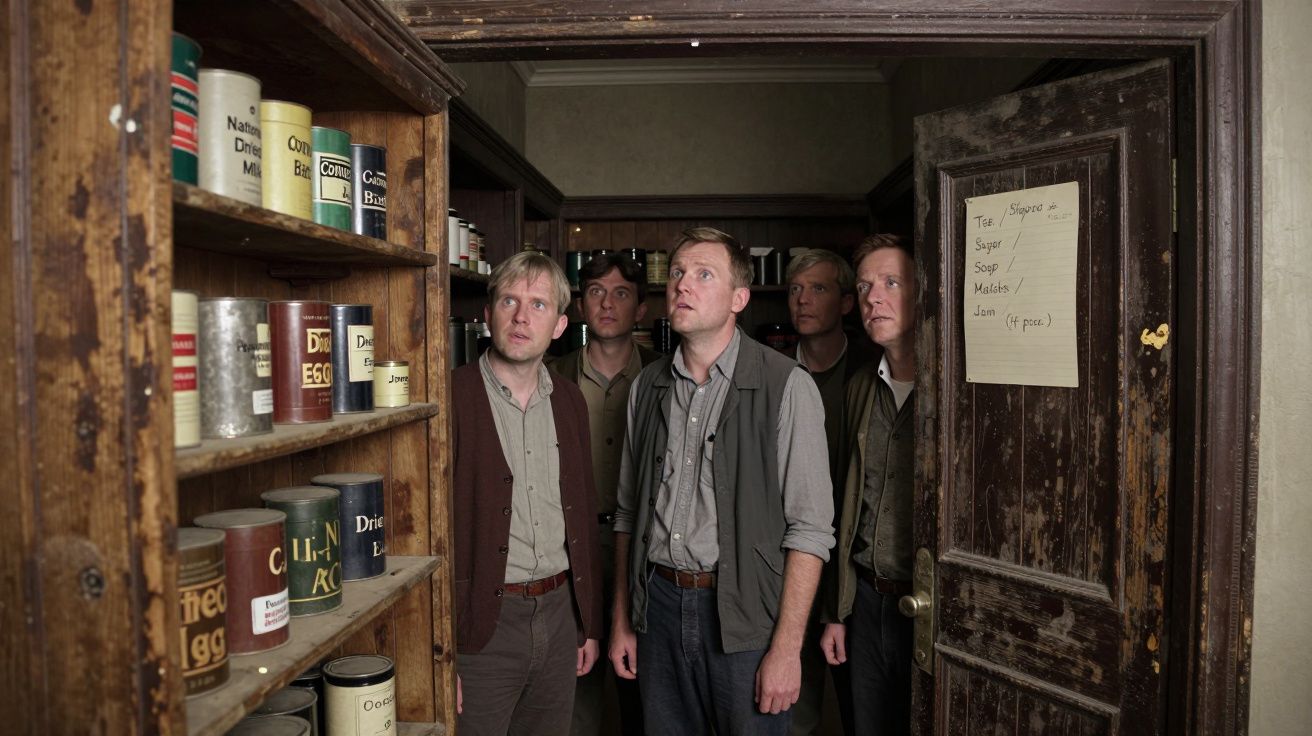
Dust hung in the hallway like fog as the builders chipped away the last of the plaster. Behind the chimney breast in a narrow Victorian terrace, there was supposed to be dead space – a cavity to run new cables and pipes. Instead, the crowbar knocked on something hollow and metallic, then again on glass.
When the panel finally gave, the torch beam landed on a row of tins, perfectly still on narrow wooden shelves. Labels in faded reds and greens. “National Dried Milk”. “Plain Margarine”. A jar of what used to be jam, sealed and cloudy, its paper lid strapped tight with string gone brittle. A pantry the size of a wardrobe, bricked up and forgotten sometime after the war – and left exactly as it was the last time someone closed that door.
Within an hour, the site manager had stopped work and called the local museum. By the end of the week, a social historian was standing in the tiny kitchen in a hard hat, whispering that the house had given them “a time capsule of everyday Britain” that archives alone could never quite deliver.
A bricked‑up cupboard and a vanished way of eating
On the plans, the void was no more than a hashed rectangle. In the room, once the dust settled, it was something else entirely: a snapshot of how a family in an ordinary street coped with coupons, queues and shortages.
There were tins of corned beef stamped 1943, stacked two deep. Two battered canisters of dried egg, their yellow typography still surprisingly loud. A paper-wrapped packet of tea with the corners worn soft, as if it had been turned in someone’s hands again and again. On the back of one shelf, almost shy, a small tin of cocoa – perhaps the ingredient for a Christmas pudding that was never made.
Nothing here would have seemed exotic to the people who used it. That is precisely the point. This was the food of staying put and making do, not of special occasions.
On the inner face of the pantry door, the builders found a pencilled list: “Tea / Sugar / Soap / Matches / Jam (if poss.)” – the “if poss.” underlined twice. It read more like a set of hopes than a standard shopping note.
Why an untouched ration pantry matters to historians
Historians of the Second World War are not short of official records. There are Ministry of Food posters, radio scripts urging people to “Dig for Victory”, and neat tables of weekly allowances for butter, bacon and cheese. What they rarely get is the messy, three‑dimensional evidence of how those rules landed in a narrow kitchen on a Tuesday afternoon.
An untouched pantry answers quiet questions:
- Which brands were actually on those ration shelves?
- How much did people hoard, and what did they think was worth hiding?
- Which luxuries still slipped through, even when the posters said “Is Your Journey Really Necessary?”
In this terrace, there was a small stash of pre‑war luxuries: a tiny bottle of vanilla essence; a tin of “fancy” biscuits long since turned to dust. Tucked behind the dried milk was a packet of custard powder, its bright imagery aimed squarely at the housewife who wanted something cheerful on grey days.
The labels themselves tell a story of a state learning to speak the language of the kitchen. “National” brands – National Dried Milk, National Wheatmeal Bread – used plain fonts and sober colours, framing austerity as patriotism. Beside them sat older, more ornate tins from before rationing, survivors of a different mindset where packaging sold pleasure, not duty.
In an archive, rationing looks organised. In this little cupboard, it looks improvised.
What the tins reveal about who lived here
Objects in a pantry behave like handwriting. You start to infer the person behind them.
The builders found no baby foods, bottles or tiny spoons; the shelves suggested adults or older children, not a nursery. There were two chipped enamel mugs on the floor of the cupboard, not four or six. A jar of home‑pickled onions sat beside a bottle of malt vinegar with perhaps a centimetre gone – hinting at a cook who stretched rations with vinegar and spices, making humble foods sharper and louder.
On the inside edge of one shelf was a series of pencil marks: “2 lb”, “4 lb”, “6 lb”, “Xmas ’41?”. A historian reading the cupboard like a diary suggested they were weight marks for sugar or flour, drawn to record how much could be spared for Christmas cakes and puddings.
Pinned to a nail was a single, folded ration book counterfoil, the name still legible: “Ellen Marsh, 14 Grafton St”. The address matched the terrace; the age – 32 – put her in the thick of the Home Front years.
You could build a careful life out of that cupboard:
- A woman in her early thirties, perhaps with a husband away or on shifts.
- Someone who bottled and pickled, but also bought “National” products without fuss.
- A household that took Christmas seriously enough to measure it on the wood.
None of this is proof in the courtroom sense. But for historians of everyday life, such circumstantial detail is gold.
Rationing in three tins and a jam jar
Textbooks reduce rationing to grams and ounces. A sealed pantry turns it back into food.
On one shelf, three items sit side by side: a tin of dried egg, a small block of margarine in waxed paper, and a jar of homemade jam whose fruit has collapsed into a dark, nervous cloud. That line‑up all but writes the chapter on wartime baking.
- Dried egg: a symbol of imported generosity, sent from overseas to stretch British hens. Taste memories suggest it never felt quite like “the real thing”.
- Margarine: cheap, functional, hard to love, but essential to every sponge, biscuit and pie.
- Jam: the sweetness you controlled yourself, made from allotment fruit or windfall apples, preserving summer for colder months.
Together, they explain why so many wartime recipe books lean heavily on steamed puddings, tray bakes and “utility” sponges. Butter was rare; eggs were erratic; sugar was counted. So cooks leaned into what they could store on a cool, dry shelf in a house like this one.
A find like this makes those recipes tactile. You can imagine Ellen, if that was truly her name, standing in the cramped light of the scullery, spooning dried egg from that very tin into a mixing bowl, coaxing something celebratory out of what looks, on paper, like very little.
A quick look at some key finds
| Object | Probable date | What it suggests |
|---|---|---|
| National Dried Milk tin | 1942–44 | Presence of infants or baking “stretch” |
| Dried egg powder canister | 1943–45 | Ration baking and improvised puddings |
| Home‑pickled onions jar | c. 1940s | Use of allotment produce, preserving |
| Vanilla essence bottle | Pre‑1940 | Hoarded luxury for rare treats |
| Custard powder packet | 1930s–40s | Desire for colour and comfort on table |
How a sealed pantry manages to survive
At first glance, it is surprising that tins and paper from the 1940s could sit intact for eighty years in a terrace house without crumbling to nothing. The reasons are almost boringly practical: dryness, darkness and forgetfulness.
Once the cupboard was bricked up, it was effectively taken off the map. No one opened the door, no one let in steam from a boiling kettle or warm, greasy air from a Sunday roast. The brickwork kept out most moisture; the absence of light deterred insects and bleached nothing. In those conditions, printed labels can cling on far longer than you might expect.
The Victorian terrace itself helped. These houses were built with solid walls, good air bricks and a surprising knack for staying cool and dry around the pantry end of the kitchen. Before fridges, the cold larder was the technology. By accident, that same design gifted historians a tiny museum.
Not every such discovery fares this well. In some houses, similar cupboards collapse into mould and rust. In others, later owners pierce the wall for new pipework, scattering fragments without realising what they were. This one survived largely because nobody thought to use the space.
What happens after the excitement: catalogues, not curiosities
Once the initial photographs are taken and the more photogenic tins have done the rounds on local news, the work turns slow and methodical. Conservators move in with gloves and acid‑free boxes. Each item is logged, weighed, measured, photographed and, where possible, cross‑checked against catalogues and manufacturers’ records.
Labels may be gently surface‑cleaned. Rust is stabilised rather than polished away. Any surviving food is never tasted; it is treated as hazardous waste or carefully sampled for scientific tests about fat content and fortification. The romance of “opening a tin from 1943” meets the reality of botulism and rancidity.
Curators will decide which parts travel to exhibition cases and which stay in storage. A museum might build a small reconstruction of the pantry, panel and all, to sit alongside oral histories of local residents who remember the queues, the blackouts and the smell of dried egg frying on a cheap pan.
The terrace itself will likely go back to being a home. The new owners may have a sleek kitchen and under‑floor heating, but somewhere behind painted plaster there will always be the faint outline of where Ellen’s shelf once sat.
Why finds like this still hit a nerve
Rationing officially ended in 1954. Many of the people who grew up under it are now in their eighties or nineties. Yet the idea of it – of coupons, of tightening belts for some shared purpose – lingers in British memory out of proportion to its time span.
A sealed pantry taps directly into that memory. It makes visible a form of resilience that did not wear medals or stand in front of microphones. It lived in shopping lists that said “if poss.” after jam, in the careful way someone lined up tins so they would not tumble in an air‑raid siren rush.
There is also an uncomfortable echo. In an age of food banks and rising prices, the notion of cupboards that are “bare but organised” feels less like distant history and more like a pattern that returns in different clothes. Historians are careful not to force parallels, but visitors standing in front of reconstructed ration shelves often make them unprompted.
The past here is intimate, not grand. It is held in the decision to hide margarine and tea behind bricks, betting that the future might be grateful.
FAQ:
- Is the food in wartime tins still safe to eat? No. Even if tins look intact, seals can fail, contents can become toxic, and bacteria such as Clostridium botulinum can grow. Museums treat old food as hazardous and never encourage tasting.
- Do the builders or the homeowner “own” what’s found? In most UK cases, everyday objects discovered during renovation belong to the property owner, unless they count as treasure under the Treasure Act (which this pantry does not). Many owners choose to loan or donate significant finds to local museums.
- How common are discoveries like this? Entire untouched pantries are rare, but fragments – a single ration book in a loft, a tin behind a skirting board – appear regularly in Victorian and Edwardian houses during renovation.
- Can the labels and packaging be conserved at home? They’re fragile. If you find similar items, keep them dry, out of direct sunlight, and avoid cleaning with water or chemicals. For anything of clear historical interest, contact a local museum or county archive for advice.
- What can researchers actually learn from a few tins? Packaging dates help refine chronologies for when certain brands changed; ingredient lists reveal fortification and substitution strategies; and the mix of items in one cupboard offers a rare, concrete glimpse into how a single household navigated rationing.



Comments
No comments yet. Be the first to comment!
Leave a Comment