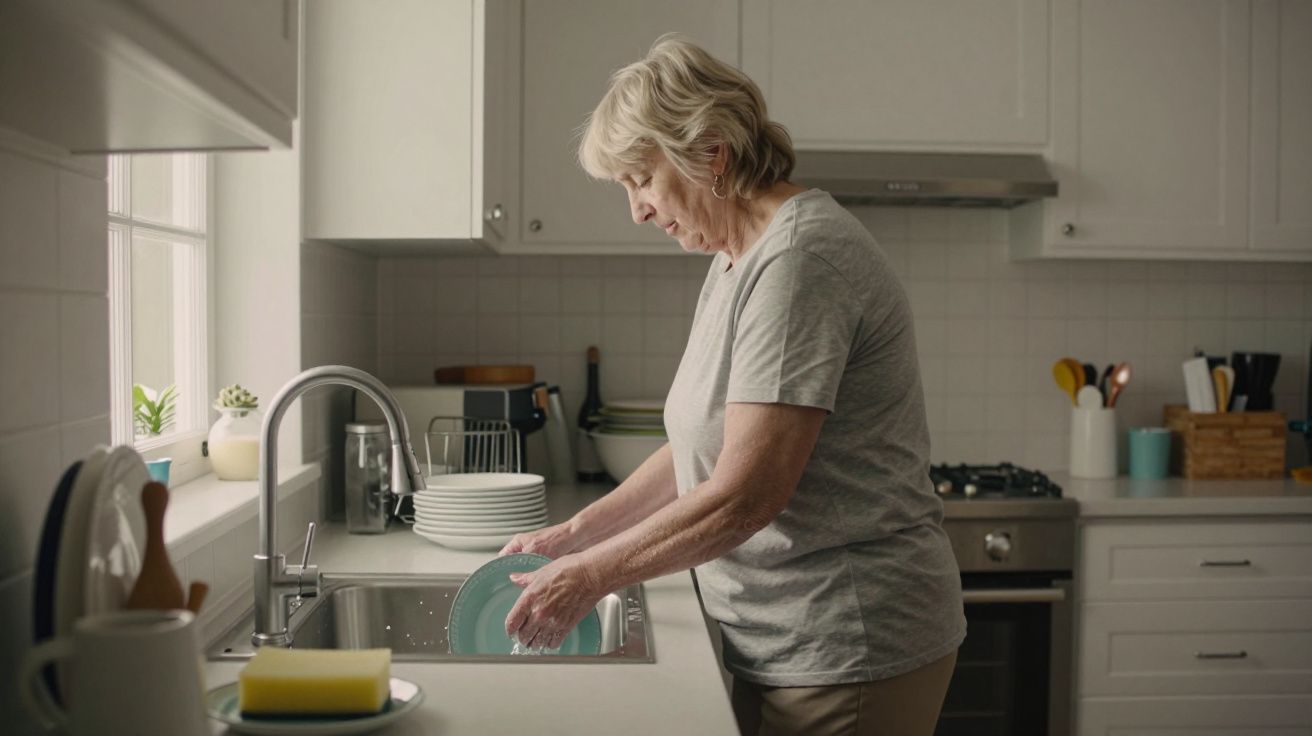
The strength secret hiding at your kitchen sink
For many people, somewhere after 65 the word “exercise” quietly moves from “I really should” to “I really can’t face it”. Gyms feel loud, resistance bands look fiddly, and even well‑meant physio sheets can end up tucked under a pile of post. The shoulders, meanwhile, grow stiff and sulky. Reaching the top cupboard, putting on a coat or fastening a bra starts to feel oddly difficult.
Yet one place most of us still visit several times a day is the kitchen sink. Hands in warm water, plate in one hand, sponge in the other – it feels about as far away from a workout as you can get. That is exactly why physiotherapists find it such a rich opportunity.
If you adjust your stance and your shoulder position just a little, washing up can turn into a quiet strength exercise that helps stabilise your shoulders and upper back. No dumbbells, no stretchy bands, no special kit – just using a chore you already do as a kind of standing, gentle “plank” for your upper body.
You won’t walk away from the sink feeling pumped or sore. That is the point. The gains are subtle: a steadier reach, less shoulder ache after hanging the washing, a sense that your posture is not collapsing inwards quite so fast.
The right washing‑up posture works like a mini, built‑in physio session – hidden in plain sight, in a place you already stand every day.
Why your shoulders after 65 matter more than you think
We tend to notice our legs when we age – stairs feel steeper, hills longer. Shoulders decline more quietly. The muscles that hold your shoulder blades in place and guide your arms – the rotator cuff and the postural muscles around it – can weaken without much fanfare.
Then one day, a simple task catches you out:
- Lifting the kettle feels oddly heavy.
- Reaching into the back of the wardrobe sends a sharp twinge through your arm.
- Sleeping on your side starts to wake you with an ache.
Strong, well‑positioned shoulders are not about vanity muscles. They are your everyday toolkit. They help you:
- Support yourself if you trip and grab a rail.
- Push up from a chair or bed.
- Carry shopping without overloading your neck.
- Keep your balance when you turn suddenly.
After 65, the body naturally loses muscle mass and joint cartilage. You cannot stop that entirely, but you can slow it down. Research consistently shows that even light, regular strength work improves function, reduces pain and lowers the risk of falls.
The problem is not the science. It is the delivery. Many people simply do not want to stand in front of a mirror curling weights. That is where the sink comes in.
The surprising “exercise machine” in your kitchen
Stand at your sink as you normally would and pause for a moment. Notice where your shoulders are. For most of us, they are hunched slightly forwards, with the upper back rounded and the head drifting towards the tap. It is comfortable in the moment, but it quietly trains the very posture that makes shoulders complain.
Change that position slightly, and the sink becomes a steady support that lets you work the right muscles without wobbling or fear of falling. Think of it as a standing version of the exercises physiotherapists teach on a treatment couch – just with bubbles.
Many older adults find they can hold good posture for longer when their hands are resting on a solid surface. The sink gives that contact point. It also gives you a natural time limit: a sinkful of dishes is long enough to get some work in, short enough not to feel like a gym session.
The aim is not to scrub harder, but to stand smarter – so every plate you rinse delivers a tiny dose of strength training.
Step‑by‑step: the washing‑up posture that trains your shoulders
You do not need to memorise anything complicated. The following sequence turns ordinary washing up into a low‑key, shoulder‑friendly exercise.
1. Set your feet and knees
- Stand about a foot (30 cm) back from the sink, not pressed against it.
- Place your feet hip‑width apart, one foot half a step in front of the other for balance.
- Soften your knees slightly, as if you were about to sit on a tall stool.
This “ready” stance stops you locking your knees and dumping all your weight into your lower back.
2. Find your tall spine
- Imagine a string gently drawing the crown of your head upwards.
- Let your chest lift a little, without flaring your ribs out.
- Tuck your chin very slightly, so your ears line up roughly over your shoulders.
You are not forcing yourself ramrod straight; you are just lengthening out of the usual hunch.
3. Set your shoulder blades
This is the key part.
- Let your shoulders relax away from your ears.
- Gently draw your shoulder blades down and slightly together, as if you were trying to slide them into your back pockets.
- Do not pinch them hard; think of a soft, firm “engaged” feeling.
You should feel a mild effort between your shoulder blades and perhaps around the sides of your ribs, not a pinch in the neck.
4. Lightly “lean into” the sink
- Place your hands on the edge of the sink or on a stable part of the worktop, shoulder‑width apart.
- Lean your weight very slightly forwards, so some of your body weight passes through your hands and arms.
- Keep that gentle shoulder‑blade engagement as you lean.
You have just created a tiny version of a wall press‑up: your shoulders, arms and chest are now working isometrically (holding against a load without moving much).
5. Wash up in slow motion
Now, instead of letting your shoulders roll forwards as you scrub:
- Keep your shoulder blades set and your chest gently lifted.
- Move mostly from the elbows and wrists, not by rounding your upper back.
- Every few plates, pause with your hands resting on the sink, hold the posture for 5–10 seconds, then relax briefly.
Aim for smooth, unhurried movements rather than frantic scrubbing. You are letting the time at the sink do the work.
6. Add a tiny shoulder “press” if you feel steady
If this feels comfortable and your balance is good:
- After you place a plate on the rack, keep one hand on the sink edge.
- Gently bend both elbows a few centimetres, bringing your chest slightly closer to the sink, then press back to your start position.
- Breathe out as you press away.
1–3 of these micro “sink press‑ups” sprinkled through the washing up are enough to start. They train similar muscles to wall push‑ups, but with extra support under your hands.
What you are quietly strengthening
You may not feel much at the time beyond a pleasant sense of standing taller. Under the surface, several important muscle groups are at work:
- The rotator cuff – a group of small muscles deep around the shoulder joint that stabilise the ball in its socket. These are essential for safe reaching and lifting.
- The scapular stabilisers – muscles between your shoulder blades and along the upper back (such as the lower trapezius and rhomboids). They stop your shoulders collapsing forwards.
- The chest and upper arms – gently loaded as you lean into the sink and perform small presses.
- The core – low‑level engagement in your abdominal and back muscles as you stand in that “ready” stance.
Unlike big gym moves, you are not trying to exhaust these muscles. You are reminding them what their job is and giving them enough work to stay interested.
Done regularly, this kind of subtle training supports the movements you actually care about: reaching a high shelf, closing a heavy window, or lifting a grandchild for a cuddle.
How often, how long – and when to stop
One of the advantages of using washing up as your “exercise slot” is that frequency takes care of itself. Most people are at the sink daily, sometimes several times a day.
A simple guideline:
- Duration: hold the good posture for 1–3 minutes at a time, or for as long as a modest batch of dishes lasts.
- Frequency: aim to use the posture for at least one sink session most days of the week.
- Intensity: effort should feel like a 4–5 out of 10 – you are working, but you could still chat.
Listen to your body as you go.
- A mild sense of tiredness in the upper back or arms later is acceptable.
- Sharp, catching, or radiating pain in the shoulder, arm or chest is a reason to ease off and seek professional advice.
- If you feel dizzy when leaning forwards, bring your feet a little closer to the sink or skip the lean and just practise the upright posture.
If you already have a diagnosed shoulder problem (such as a tear, severe arthritis or recent surgery), check with your GP or physiotherapist before changing your routine. They may want to adapt the angle or suggest alternatives, like doing a similar posture holding the back of a sturdy chair.
Turning more chores into shoulder‑friendly moves
Once you get used to the feeling of “tall spine, soft knees, shoulders down and back”, you can export it beyond the sink. The same principles apply when you:
- Stand at the bathroom basin brushing your teeth.
- Lean on a trolley in the supermarket.
- Fold laundry at a worktop.
- Wait for the microwave to ping.
Each of these moments can be an excuse to practise setting your shoulder blades and gently bearing a bit of weight through your arms. Over days and weeks, those micro‑repetitions add up.
You can also pair the washing‑up posture with tiny habit tweaks:
- Do one slow “sink press‑up” for every mug you wash.
- Take three slow breaths in your tall stance before you start the hot water.
- Use the time the kettle boils to stand in posture, hands resting on the counter, shoulder blades engaged.
None of this looks like exercise from the outside. That can be a relief. It simply looks like you, in your own kitchen, moving with a little more intention.
The quiet confidence of a stronger reach
Shoulder strength after 65 rarely arrives with fanfare. There is no medal when you can reach the top shelf without wincing. Instead, you notice tiny shifts:
- The cardigan that was awkward to pull on now slips over more easily.
- The garden tools feel less like a strain after ten minutes of pruning.
- You catch yourself standing at the bus stop a little taller, shoulders less rounded.
That is the real payoff of using the washing‑up posture. It respects the reality that you may not want – or be able – to overhaul your life around workouts. It works with what is already there: the sink, the dishes, the warm water you were going to run anyway.
You are not adding “exercise” to your day so much as changing the shape of what you already do.
And while it will not replace medical treatment or formal rehabilitation if you need it, it can become a quiet ally: a daily, almost invisible way to remind your shoulders that they still have a job – and that, with a little help from your kitchen, they are still up to it.
FAQ:
- Do I need to feel sore for this to be doing any good? No. With this kind of low‑level, posture‑based work, the goal is steady practice, not next‑day soreness. Think of it more like brushing your teeth than running a race.
- What if I already have arthritis in my shoulders? Many people with mild to moderate arthritis tolerate this posture well, because it keeps the joint in a safe, mid‑range position. However, if your arthritis is severe or flares easily, speak to your GP or physiotherapist before making changes.
- Can I do this instead of all other exercise? It is better than doing nothing, and it is an excellent start, but it does not replace the benefits of walking, leg strength work or balance exercises. See it as one helpful piece of your overall activity, not the whole jigsaw.
- Is it still useful if I sit to wash up? Yes. You can still sit tall, bring your shoulder blades gently down and back, and keep your head aligned over your shoulders. You will not get the same load through your arms as when standing and leaning, but your upper‑back posture will still benefit.
- How long before I notice any difference? People who practise most days often report feeling more aware of their posture within a week or two, and modest improvements in shoulder comfort or reach over 4–8 weeks. Progress is usually gradual, not dramatic.



Comments
No comments yet. Be the first to comment!
Leave a Comment