You notice it in the most ordinary moments.
Halfway up the stairs your stride shortens, not because you’re out of breath, but because one hip feels like it won’t “give”. You take the steps a bit sideways, hand on the bannister, pretending it’s just caution.
Then there’s the car. You swing a leg in and the seat catches you at exactly the wrong angle - hip pinches, lower back tenses, and you do that familiar little wriggle to find space.
Most people try to solve it with a heat pack, a long hamstring stretch, or a full yoga session they don’t really have time for. Physios often go the other way: a short drill that tells the joint and the nervous system, quickly, “this movement is safe - here’s your range back”.
The 90‑second hip drill that makes “getting in position” feel easier
This is a simple 90/90 hip switch sequence. It’s not about forcing flexibility. It’s about practising the exact rotations your hips need for stairs (hip extension and stability) and for car seats (hip flexion and rotation).
You’ll do it slowly, with control, for 90 seconds total. Many people feel a difference immediately - not because anything has “lengthened”, but because the hip stops guarding.
Think of it as lubrication for your movement pattern, not a stretch to endure.
Why hips feel tighter after 60 (even if you walk plenty)
Hips don’t just get stiff from “age”. They get stiff from repetition.
A typical day gives your hips lots of one thing - forward-and-back walking, sitting with hips bent - and not much rotation, side movement, or controlled end-range work. Over time, your body gets efficient at the ranges you use and cautious at the ones you avoid.
A few common culprits show up again and again in clinic:
- Long sitting hours: hips live in flexion, glutes “switch off”, and the front of the hip learns to feel crowded.
- Reduced rotation: getting into a car, clipping a seatbelt, putting socks on - all need rotation that many people stop practising.
- Protective bracing: if your hip has been sore, your body may tighten around it as a safety strategy, even after the flare settles.
The goal of a short drill is to restore options without picking a fight with your joints.
How to do the 90‑second 90/90 hip switch (no equipment)
Pick a firm surface: carpet, yoga mat, or a folded towel. Wear socks off if they make you slide.
If you have a history of hip replacement, significant arthritis, or sharp groin pain, keep the range smaller and consider checking with a clinician first.
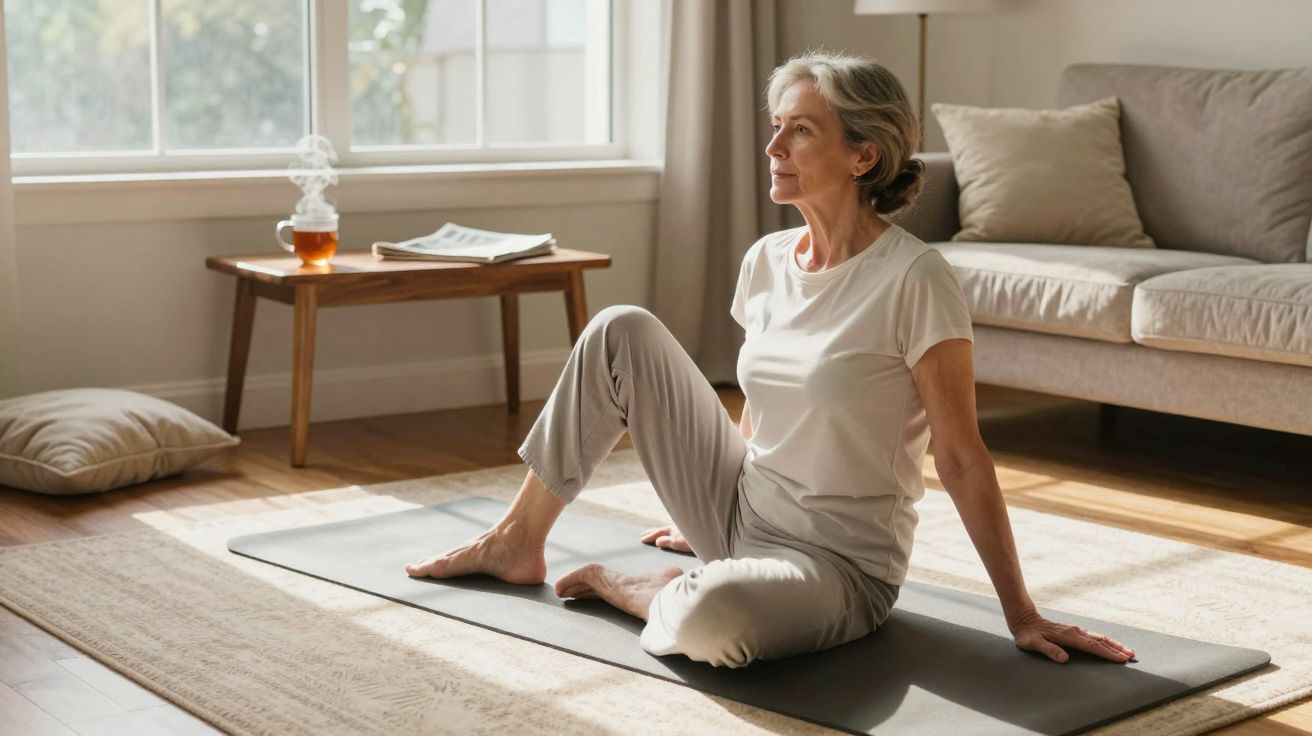
Step 1: Set up your 90/90 position (15 seconds)
Sit on the floor with both knees bent. Drop both knees to one side so your front leg and back leg are each bent to roughly 90 degrees (it doesn’t have to be perfect).
- Sit tall through your spine, hands on the floor behind you for support.
- Aim for a gentle, “workable” position, not your maximum stretch.
- You should feel a mild stretch around the hips or bum, not a sharp pinch in the groin.
Step 2: Slow switches side to side (45 seconds)
Keeping your feet on the floor, lift your knees slightly and switch them through the middle to the other side, like slow windscreen wipers.
Go at a pace where you can breathe and stay relaxed through your jaw and shoulders.
- Exhale as you switch.
- Pause for a second at each side.
- Keep the movement smooth; this is practice, not a test.
If your knees don’t come close to the floor, that’s fine. Use a smaller range and let it improve over days, not seconds.
Step 3: Add a gentle “tall sit” on each side (30 seconds)
Now make it more useful for stairs and getting out of seats.
When your knees drop to one side, grow tall through the crown of your head and lightly shift your weight towards the front hip for two slow breaths. Then switch to the other side and repeat.
You’re teaching your hip to accept rotation and load, which is often what’s missing when stairs feel awkward.
What it should feel like
You’re looking for “easier motion”, not deep stretching. Most people feel it around the outer hip, glute, or inner thigh.
Stop if you feel:
- sharp groin pinching
- numbness/tingling
- a catching sensation that makes you hold your breath
The tiny details that make it work (and the ones that ruin it)
This drill is short enough that the temptation is to rush it. Don’t. Control is the point.
Common mistakes physios end up correcting:
- Forcing the knees down with your hands. That often triggers guarding.
- Rounding your back and collapsing your chest, which turns it into a low-back stretch instead of a hip drill.
- Going too wide too soon. A smaller, smoother range beats a bigger, shaky one every time.
- Holding your breath, which tells your body “this is a threat”.
A good rule: if you can talk while doing it, your intensity is probably right.
When to use it: the “doorway moment” trick
The best time is right before the movement that usually feels sticky.
Try it:
- before a walk that includes stairs
- before a long drive
- after sitting for more than an hour
- as part of a warm-up before gardening, gym work, or housework
It’s also a useful “reset” on stiff mornings because it asks for movement without demanding impact.
A quick guide to pacing (so it stays 90 seconds)
| Segment | Time | Focus |
|---|---|---|
| Set up 90/90 | 15s | Comfortable shape, tall spine |
| Hip switches | 45s | Smooth rotation, steady breath |
| Tall sit each side | 30s | Light load + rotation |
If you want more, do another round. But keep the first round almost ridiculously easy. Consistency beats intensity here.
Turning a drill into a habit (without making it a whole routine)
The people who get the best results don’t treat this like a special mobility ceremony. They do it the way hikers check a strap before a long day: quick, calm, preventative.
Pick one anchor point for two weeks:
- right after you brush your teeth at night
- while the kettle boils
- before you put shoes on for a walk
Then watch for the small wins: a higher step feels less like a pull; getting into the car takes one movement instead of three; you stop thinking about the hip every time you turn.
That’s the real shift - not “perfect flexibility”, just a return to normal, confident motion.
FAQ:
- Can I do this if I’ve got arthritis? Often yes, if you keep the range small and stay in a comfortable zone. If you get sharp groin pain or flare-ups that last into the next day, get individual advice.
- How often should I do the 90‑second drill? Daily is fine for most people, especially if you sit a lot. You can also use it “as needed” before stairs, walks, or driving.
- What if I can’t sit on the floor? Sit on a firm bed with a folded towel under your hips, or do a smaller version seated on a chair: gently move both knees side to side while keeping feet planted.
- Should I feel a stretch in the front of the hip? A mild stretch can be normal, but a sharp pinch at the front of the hip isn’t. Reduce the range, sit taller, and avoid forcing the position.
- Is this better than stretching my hip flexors? It’s different. Long stretches can help some people, but controlled rotation drills often transfer more directly to stairs and car movements because they rehearse the joint action you actually use.




Comments
No comments yet. Be the first to comment!
Leave a Comment