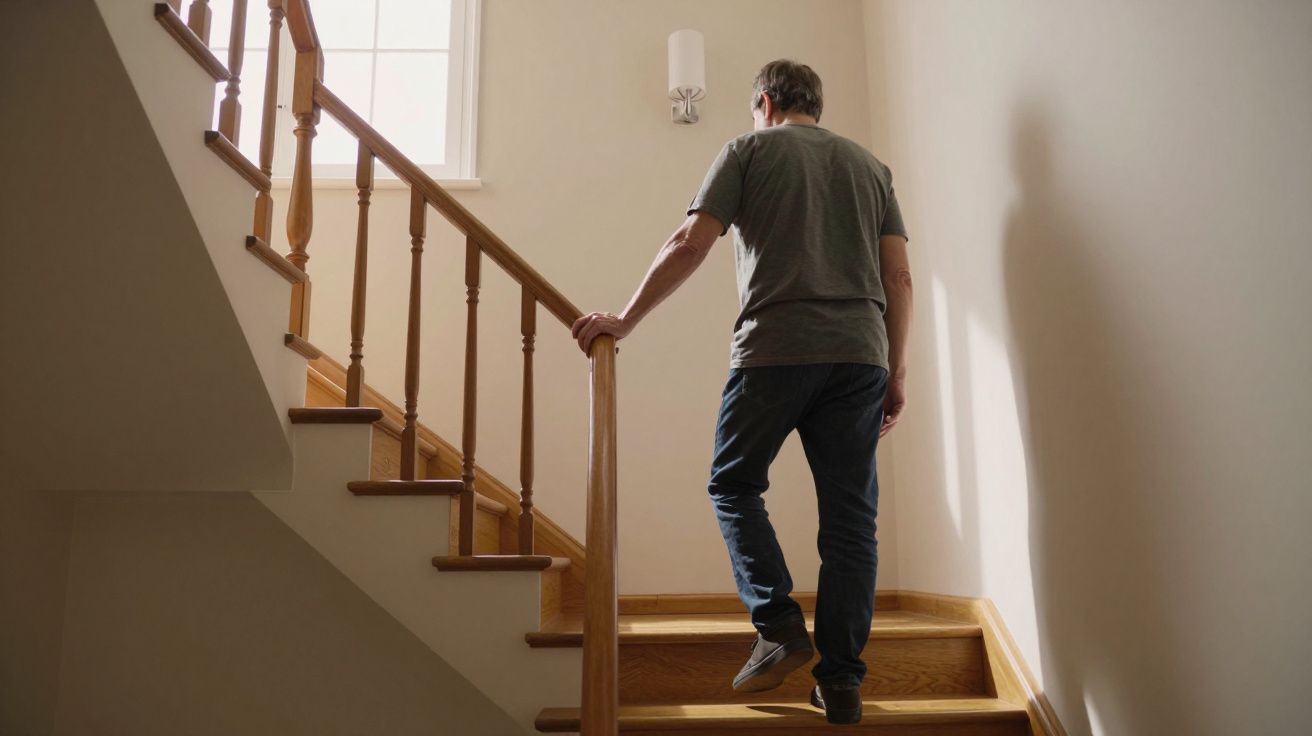
You know the script by now. Someone tells you to “protect your knees” after 55, and the suggestions arrive on repeat: start jogging, try yoga, join a gym, buy special trainers. Meanwhile, your knees already mutter on the stairs, your schedule is full, and another direct debit for a fitness membership feels like a bad joke.
Ask a physiotherapist, though, and you often get a different answer. Not a marathon. Not a headstand. A habit you already brush past several times a day: your stairs – used on purpose, in a very particular way, for a few quiet minutes that add up more than you’d think.
Stairs have a reputation as the enemy of sore knees. Physiotherapists see them as the opposite when used well: a built‑in leg press, balance rail and coordination drill in one. No apps, no mats, no changing rooms – just a tweak to what you’re doing anyway.
Why physiotherapists quietly rate stairs over jogging
Running and deep yoga poses can both be brilliant for the right body at the right time. They can also load the knee in ways that annoy cartilage, tendons and joint linings that have already done 55+ years of service.
Stair work, done deliberately, hits a sweeter spot:
- It strengthens the quadriceps and glutes that protect the knee.
- It uses a “closed chain” movement (foot planted, body moves over it) which many arthritic knees prefer.
- It trains balance and coordination, two of the biggest fall‑risk factors in later life.
- The load is easy to scale: one step, two steps, higher rail, slower tempo – you’re in control.
“Used well, stairs are one of the best free tools we have for older knees,” says London physiotherapist Dr Amrita Singh. “It’s not the stairs that cause trouble, it’s rushing, twisting and collapsing onto them.”
The key is to stop seeing stairs as a sprint to the next room and start treating them as a tiny, daily strength session.
The stair habit, in one line
Once or twice a day, you take 2–5 focused minutes to walk up and, if comfortable, down a small section of stairs with slow control, good alignment and support from the rail – as a practice, not just as travel.
Think of it as brushing your teeth for your knees and hips. Short, regular, quietly powerful.
The basic drill physiotherapists teach
Start with a safe, boring set‑up. No slippers, no rushing, something solid to hold.
Choose your stair zone
One full flight is fine, but even 3–4 steps can work. Clear clutter, switch on the light, and make sure there’s a handrail or solid wall.Set your stance
Stand at the bottom, feet hip‑width apart, toes pointing forwards. Lightly hold the rail. Look ahead, not down at your feet.Step up with purpose
- Place your whole foot on the first step.
- Push through your heel and the ball of your foot.
- Let your knee travel forwards over your toes, not collapsing inwards. Think “knee over second toe”.
- Place your whole foot on the first step.
Bring the other foot up to meet it
You can either:- Use a “step‑to” pattern (both feet on each step) for beginners, or
- Use a “step‑through” pattern (one foot on each step) if balance and strength feel good.
- Use a “step‑to” pattern (both feet on each step) for beginners, or
Control the way down
This is the bit most people rush.- Keep holding the rail.
- Lower yourself slowly, as if sitting onto a very high chair.
- Land softly, not with a thud.
- Keep holding the rail.
Tempo and breathing
Count “up‑two, down‑two” in your head. Breathe out as you push up, in as you lower. Speed is not the goal; control is.
If in doubt, slow the movement until it feels almost annoyingly careful. That’s usually where your knees start to feel safer.
How much is enough after 55?
You don’t need 10 flights. You need a level that feels like work, not war. A simple way to pitch it:
| Level | What to try | How it should feel |
|---|---|---|
| Starting out | 1–2 runs of 4 steps, up and down, once a day | Slightly warm legs, no sharp pain, can still chat |
| Building up | 3–5 minutes of up‑and‑down on 4–8 steps, most days | Muscles working, breathing deeper, knees comfortable‑tired not sore |
| Strong & steady | 8–10 minutes total per day, maybe split in two short bouts | Legs feel “used” like after a brisk walk, no next‑day flare |
You can break this into tiny chunks: 60–90 seconds after breakfast, another bit before you put the kettle on at night. Consistency matters more than heroics.
Physiotherapists often talk about the “24‑hour rule”: the real test is how your knees feel later that day and the next morning. Mild ache that fades is fine. A spike of pain, swelling or stiffness that lingers is a sign to dial it back.
If your knees already hurt
Painful, creaky or arthritic knees don’t automatically rule out stair work, but they do change the rules.
Adjust the habit like this:
- Shorten the range. Use just one or two steps. Even gentle “mini‑stairs” are useful.
- Favour the up, respect the down. Many people tolerate stepping up better than stepping down. You can walk up a few steps for strength, then walk back down slowly one at a time, or even take the lift down in public buildings.
- Use more support. Keep a firm hold of the rail, and if needed, place your other hand on the wall or a walking stick for confidence.
- Lead with the stronger leg up, the more comfortable leg down. Physiotherapists often use the phrase “Up with the good, down with the bad” when one knee is worse than the other.
There are times to pause this habit and get specific advice first:
- Sudden, unexplained knee swelling.
- Locking (knee gets stuck and won’t fully bend or straighten).
- Giving way or buckling under you.
- Sharp, catching pain on every step despite doing less and going slower.
Those are moments for a GP or physiotherapist, not just more willpower on the stairs.
Make it a habit, not a workout
You don’t need a special outfit or a blocked‑out hour. You need small anchors that tie stair time to things you already do.
Try:
- “Homecoming” laps. Each time you arrive home once or twice a day, put bags down, use the loo, then spend one slow minute going up and down 3–4 steps before you kick shoes off.
- Kettle intervals. While the kettle boils, walk up and down a couple of steps, focusing on smooth knees and easy breathing.
- Screen break reset. Every 45–60 minutes of sitting, get up, use the stairs for one quiet minute, then sit back down. Your knees, back and concentration all win.
Treat the stairs as a little appointment with your future self: fewer wobbles, steadier curbs, more confidence carrying shopping.
If you live in a bungalow or have very few steps, a single sturdy step (like the first stair, a thick exercise step, or a low kerb) can do the job. The principle is the same: slow step‑ups, good alignment, repeat.
Common mistakes that annoy knees
Most people don’t need more effort; they need fewer unhelpful habits.
Watch out for:
- Collapsing knees. If your knees drift inwards, imagine gently pushing them out over your middle toes.
- Tiny toe landings. Make sure your whole foot – especially the heel – is on the step for power and stability.
- Holding your breath. Breath‑holding stiffens everything. Quiet, steady breathing matters as much as the steps.
- Racing the stairs. Rushing turns a strength drill into a jolt. Slow steps build muscle; fast steps chase adrenaline.
- Doing loads, then nothing. Ten intense minutes on Sunday and nothing all week is far less helpful than two calm minutes most days.
Why this beats another membership card
After 55, the goal isn’t to win a race. It’s to keep joints moving, muscles strong and balance sharp enough that you can do what you actually care about: carry grandkids, climb hills, manage suitcases, take the upstairs seat on the bus without thinking twice.
The “stair habit” helps that because:
- It loads bones and muscles in a way that supports bone density.
- It rehearses the exact movement patterns you need to avoid falls in real life.
- It builds stamina without screens, subscriptions or commutes.
- It can be dialled up or down every single day, depending on how your knees feel.
You may still choose to jog, swim, do yoga or lift weights. Stairs don’t replace everything. They simply give you a low‑friction, knee‑savvy foundation that lives where you already live.
FAQ:
- Won’t going up and down stairs wear my knees out faster?
Wear and tear mainly comes from poorly controlled load, not load itself. Short, slow, well‑aligned stair sessions strengthen the muscles that support the joint and can actually make everyday stairs feel easier over time.- What if I don’t have any stairs at home?
Use a single stable step, a low outdoor kerb, or stairs in a nearby park or block of flats. Even a 10–15 cm rise is enough to train good form and strength.- How quickly should I expect to feel a difference?
Many people notice slightly easier stairs and less “wobble” within 3–4 weeks of doing 2–5 minutes most days. Bigger changes in strength and confidence usually take 8–12 weeks.- Is this safe if I’ve been told I have knee osteoarthritis?
Often yes, provided you work within comfort, progress gradually and avoid flare‑ups. Research supports appropriately loaded strengthening for arthritic knees. If your arthritis is severe or you’re unsure, a physiotherapist can tailor the routine.- Do I still need other exercises?
Stairs are excellent for legs and balance, but your body also benefits from some upper‑body strength and activities that lift your heart rate in other ways, like walking or cycling. Think of the stair habit as a cornerstone, not the whole house.
Comments
No comments yet. Be the first to comment!
Leave a Comment