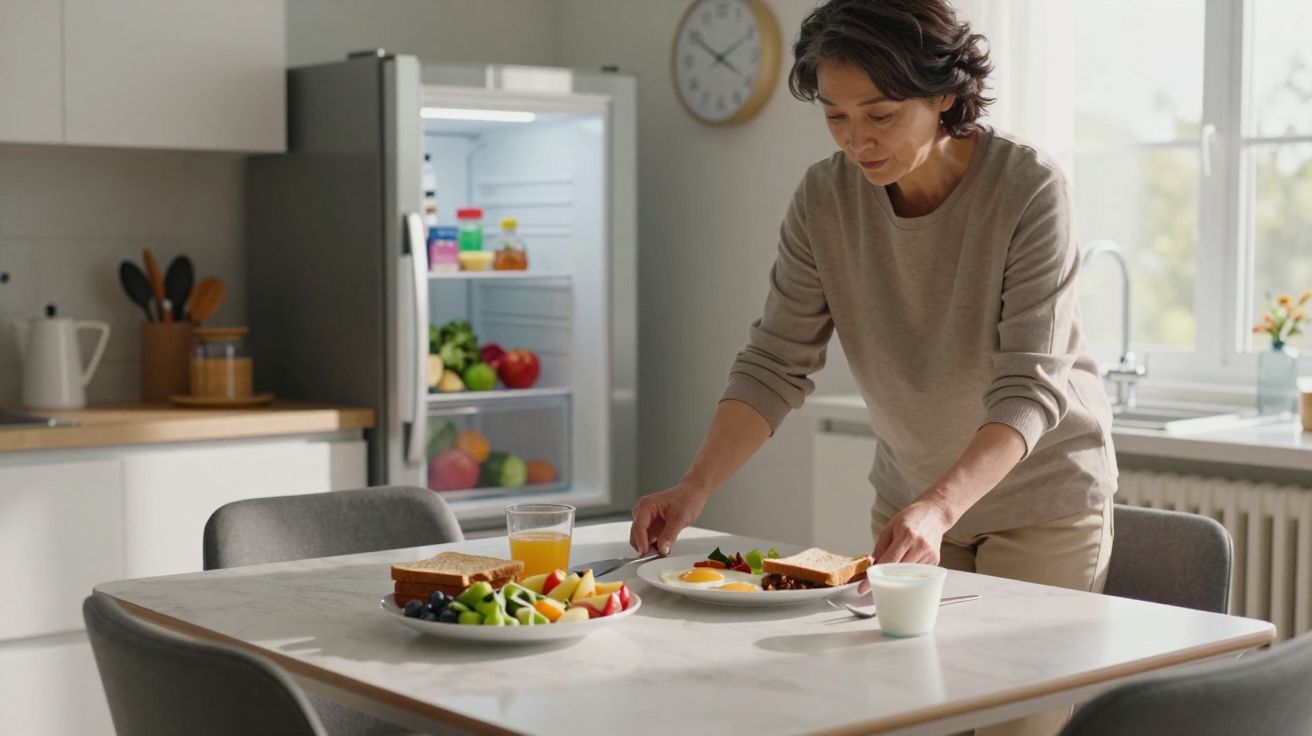
At 4pm, you swear today will be different. You’ll have a sensible dinner, maybe some yoghurt after, then close the kitchen and feel quietly smug. By 9.30pm, you’re standing in front of the fridge with a spoon in your hand, absolutely certain there must still be cheese somewhere.
For lots of people over 50, evenings start to feel like a test you keep failing. You’re not eating huge meals, you’re “being good” all day, you’ve even flirted with fasting or cutting out carbs completely. Yet the same pattern repeats: saintly mornings, shaky afternoons, wild‑west evenings. One nutrition scientist I spoke to described it in a sentence I couldn’t unhear: “Your appetite isn’t out of control – your day is upside down.”
Once you look at your meals through that lens, the whole thing starts to rearrange itself.
The day an expert told me my meals were upside down
The expert was a softly spoken dietitian in her sixties called Helen, the sort of person who can make the word “insulin” sound reassuring. I told her about my evenings: the grazing, the bread, the way 10pm me bore no resemblance to 10am me. She listened, nodded, and drew a little clock on her notepad.
“After 50,” she said, “your body is a bit like a solar‑powered battery. It handles food best when the sun is high, and worst when it’s gone to bed. You’re feeding most of your fuel to the dimmest part of the day.” I told her I skipped breakfast to “save calories for later”. She smiled the way GPs do when they’ve heard the same story all week. “You’re not saving them,” she said. “You’re moving them into the time of day you’re least able to handle them.”
What she described next was not a diet, not a strict fasting window, and definitely not the death of carbohydrates. It was a quiet flip in timing that made my evenings feel less like a battlefield and more like a wind‑down.
What “front‑loaded” eating really means
Front‑loaded eating sounds fancy. It isn’t. At its heart is one idea: you move more of your food – especially protein and slow carbs – into the first two‑thirds of the day, and you stop treating dinner as the main event.
Instead of a tiny breakfast, rushed lunch and sprawling evening meal with snacks wrapped around it, you shift the weight forwards. Bigger breakfast, solid lunch, modest but satisfying dinner, and a clear-ish runway to bed. It’s not about eating less overall; it’s about eating earlier and smarter.
Chrono‑nutrition researchers have been quietly mapping this for years. We’re more insulin‑sensitive in the morning and early afternoon, meaning our bodies handle sugars and starches more efficiently. Hunger hormones tend to rise later in the day, especially if you’ve under‑eaten earlier. Add in the hormonal changes of midlife – fluctuating oestrogen or testosterone, more broken sleep – and your evening appetite can easily start shouting.
The front‑loaded pattern doesn’t try to silence that voice with willpower. It tries to stop it ever getting that loud.
Step one: breakfast that actually counts
For decades, breakfast advice has bounced between “it’s essential” and “skip it, fasting is magic”. In real life, many over‑50s land somewhere worse: coffee, a biscuit, maybe half a banana in the car. Technically food, functionally not much.
Front‑loading starts by making breakfast do some actual work. Not a feast, not a fry‑up every day, but a meal with:
- A decent portion of protein (15–25 g for most people): eggs, Greek yoghurt, cottage cheese, tofu, smoked fish, leftovers from last night.
- Some slow‑burning carbohydrates: oats, wholegrain toast, beans, fruit.
- A bit of fat and fibre: nuts, seeds, nut butter, veg.
Helen’s rule of thumb was brutal in its simplicity: “If breakfast doesn’t keep you comfortably full for three to four hours, it wasn’t big enough or balanced enough.”
This feels wrong at first if you’ve spent years nibbling in the morning to “save” calories. But within a week or two, a good breakfast starts paying you back around 4pm, when your old self would already be negotiating with the biscuit tin.
Step two: make lunch the main event, not the side note
Ask a room of people over 50 what lunch looks like, and you’ll hear the same script: a quick sandwich, soup and a roll, maybe a salad if you’re “being good”. The real meal, unconsciously, is dinner. That logic is exactly what front‑loading flips.
“Think of lunch as the anchor,” Helen said, drawing a big dot on the middle of her clock. “If you’re going to have one truly substantial meal, it should be here, not at 8pm.” That doesn’t mean restaurant‑level drama. It means:
- A proper plate: palm‑sized protein, fist‑sized carbs, at least half a plate of veg.
- Enough volume that you’d happily stop eating afterwards, not start planning your “real” meal.
- Carbohydrates you actually enjoy, rather than hoarding them for later.
Here’s how a day can quietly change:
| Front‑loaded day | Usual pattern |
|---|---|
| Substantial breakfast, decent lunch, lighter dinner | Token breakfast, rushed lunch, big evening meal |
| Energy steady by late afternoon | Energy crash, “I could eat the cupboards” feeling |
| Smaller, calmer evening appetite | Constant grazing from 5pm to bedtime |
Many people find that when lunch becomes “the big one”, dinner naturally shrinks without much effort. You’re simply not arriving at 7pm in a state of nutritional panic.
Step three: evenings that don’t turn into snack buffets
Front‑loaded eating does not mean a joyless, carb‑free evening staring at herbal tea. It means right‑sizing dinner for the job it actually has: refuelling you a bit, not rebuilding you from scratch.
A front‑loaded evening often looks like:
- A lighter, earlier dinner where vegetables take up space on the plate.
- Carbs that are present but not dominant: a small portion of pasta, potatoes, rice, grains, or bread.
- Protein that’s there for muscle and satiety, not as a centre‑piece banquet.
The other quiet shift is timing. Bringing dinner forward by even 30–60 minutes gives your digestion more time before bed. Sleep, which often frays after 50, tends to behave better when you’re not going to bed full. Better sleep, in turn, steadies hunger hormones the next day. The loop starts to work with you instead of against you.
If you like an evening snack, the trick is to plan it instead of pretending you never snack. A small bowl of yoghurt and berries, cheese and an apple, or toast with nut butter can all fit. The difference is that it’s intentional and sized, not an open‑ended relationship with the biscuit tin.
Why this pattern suits bodies over 50
Once hormones join the party, the old “eat less, move more” advice starts to feel suspiciously incomplete. Metabolism slows a little, muscles are easier to lose, and blood sugar tends to spike higher than it used to for the same meals. Night‑time heartburn, hot flushes, joint pain – all of it can nudge you towards the kitchen when you’re tired and fragile.
Front‑loading doesn’t pretend to be a cure‑all. What it does is quietly line your day up with how your body already works:
- Better use of carbs earlier: Your muscles and liver are more ready to store or burn glucose in the first half of the day.
- More support for muscle: Regular protein earlier helps protect muscle mass, which naturally declines with age.
- Less chaos at night: A calmer digestive system and fewer sugar peaks late in the day often mean better sleep, which reduces next‑day cravings.
For anyone managing diabetes, blood pressure or medication schedules, the exact pattern needs tailoring with a clinician or dietitian. But the general direction – more earlier, less later – is increasingly echoed in research and in clinics.
The small daily rituals that make it stick
No eating pattern survives if it depends on you becoming a full‑time food project manager. Life gets in the way. Grandchildren appear. Meetings run late. You forget to defrost the chicken.
That’s why people who quietly succeed with front‑loading lean on tiny, almost boring tweaks:
- Keeping quick proteins in the fridge: boiled eggs, yoghurt, hummus, sliced meat or tofu.
- Doubling up dinner so tomorrow’s lunch is ready without thinking.
- Setting a loose “kitchen wind‑down” time – not a ban, just the moment the default switches from “What can I eat?” to “Do I actually want anything?”
One man Helen worked with added a rule that changed everything for him: no important food decisions after 9pm. If he wanted something, he could have a pre‑chosen snack he’d already decided was “worth it”. Within a month, he wasn’t eating less overall, but his night‑time raids had shrunk from full meals to a couple of deliberate bites.
“Habits beat willpower,” Helen told me. “If you have to negotiate with yourself every night, you will eventually lose the argument.”
The “truth moment” about willpower and blame
There’s a quiet shame around evening eating that many people in midlife carry. You can be competent at work, caring with family, disciplined with money – and still feel utterly undone by a packet of crisps at 10pm. It’s easy to label that as weakness.
The front‑loaded view is kinder and more honest: you’re not failing a test of character; you’re reacting to a day that never really fed you when it mattered. A tiny breakfast, a half‑hearted lunch, and a late, heavy dinner are not a moral issue. They’re just a design that doesn’t suit a body that’s changed.
Once you stop seeing yourself as the problem, curiosity has room to sneak in. What happens if breakfast is 50 per cent bigger for a week? How does your 8pm self behave if lunch includes the carbs you usually “save” for dinner? You’re not punishing yourself into control; you’re running small experiments.
And there is a moment – usually a few weeks in – when you notice that the evening voice in your head is…quieter. The urge to rummage is still there sometimes, but it no longer feels urgent or bottomless. You can say, “I’ll have something small” and actually mean it.
When “front‑loaded” finally clicks
Once you’ve lived a few days with meals shifted forwards, you start to see your old pattern in a new, slightly unforgiving light. That tiny breakfast suddenly looks like setting a time bomb for 9pm. The heroic self‑denial at lunch feels less virtuous and more like booby‑trapping your evening.
You’ll still have late dinners, celebrations, long travel days. Life is not a perfectly timed lab experiment. The point isn’t perfection; it’s a new default. A day where the best, most satisfying food happens while the sun is up, your energy is needed, and your body is primed to use it.
You don’t need to give up carbs, sign up for a 16:8 fasting plan, or eat in a five‑hour window to calm your evenings. You just need to move the centre of gravity of your eating a little earlier, and let dinner step down from the starring role.
Bit by bit, the cravings that used to feel like a character flaw start looking more like what they always were: your body, late at night, asking for the fuel it should have had hours ago.



Comments
No comments yet. Be the first to comment!
Leave a Comment